Travel dispatches from a shrinking planet

Travel dispatches from a shrinking planet

RECENT DISPATCHES
11.18.08

Six Degrees of Vietnam

Julia Ross went to Vietnam seeking relaxation and a place to recover from a breakup. She found a whole lot more.

10.16.08

Another Tet Offensive

At a cafe in Nha Trang, Vietnam, in the midst of Chinese New Year celebrations, Joel Carillet worked up the courage to ask out his waitress

TRAVEL BLOG
ASK ROLF
image

How Can I Save on Transportation During a Round-the-World Trip?

Vagabonding traveler Rolf Potts answers your questions about travel

THE LIST
image

13 Great Travel Horror Movies

The Hollywood horror archives are filled with tales of bad trips. To celebrate Halloween, Eva Holland and Eli Ellison sift through the carnage to pick their favorites—and lose a little sleep doing so.

Q&A
image

Matt Weiland: Through 50 States With 50 Writers

The coeditor of “State by State: A Panoramic Portrait of America” talks to Frank Bures about the book, the WPA and how the United States hasn’t been “bulldozed for speed”

HOW TO
image

Love Herring in Sweden

From artery-clogging casseroles to a fermented concoction that smells alarmingly like vinegary flatulence, Lola Akinmade digs in to a smörgåsbord of herring and explains how to best appreciate Scandinavia’s favorite fish. 

BOOKS
image

The Water Is Wide

Bronwen Dickey considers Tim Butcher’s “Blood River: A Journey to Africa’s Broken Heart,” which takes readers deep into the Congo

SPEAKER'S CORNER
image

Vagrant Ruminations of a Compulsive Traveler

Where does the urge to hunt for that “fleeting fix of elsewhere” come from? Peter Wortsman recalls a life of travel inspiration. 

AUDIO SLIDESHOW
image

Notes From an Unofficial Tourist Greeter

Summer is over, and so is Julia Ross‘ season as an ambassador to travelers in Washington, D.C.’s Woodley Park neighborhood. She’s happy to be off duty.


DISPATCH
9.12.06

Lost City of the Silk Road

To know the heart of Turkmenistan John W. Kropf thought he had to know the ancient city of Merv. That was just the beginning of his search. 

We came in view of an immense wilderness of ruined buildings, forming a semicircle in front of us to the north and south. —Edmund O’Donovan, The Merv Oasis, 1882

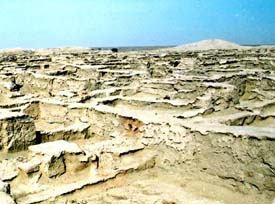
imageA man named Kurbam sat in the passenger’s seat of my Jeep, instructing me in Turkmen to drive off the dirt road bordering a cotton field and into a line of ruts in the sand. Kurbam was my guide to find an archeological dig of Margush, an ancient fortress that pre-dated the legendary Silk Road city of Merv. Driving through the soft sand, I kept repeating a four-wheel mantra to myself—keep the tires moving.

The unlikely adventure began after my first year in the secretive Central Asian country of Turkmenistan working for the American Embassy. I was fortunate enough to be invited to a rural village outside the provincial city of Mary by a young Turkmen friend, Dovelet. From Dovelet’s family home, we hoped to venture out for a look at an archeological dig outside the ruins of Merv.

To know the heart of Turkmenistan, I had to know the ancient city of Merv. Once heralded as “Queen of the Ancient World,” it rivaled Baghdad as a center of Islamic art, culture and learning. Merv’s position between the great civilizations of East and West fixed it squarely in the path of the West’s greatest empire builder, Alexander the Great, and the East’s greatest empire destroyer, Genghis Khan. Alexander and Ghengis Khan were like bookends to Merv’s noble history with the trade routes known as the Silk Road. Since the abrupt end of its golden age at the hands of the Mongols in the early 13th century, nature had buried its acres of desiccated remains under the sands of the Kara Kum Desert, leaving only the nearby Russian-founded city of Mary (pronounced Mer-REE).

After a year of a friendship with Dovelet, he invited me to visit his village outside Mary. Turkmen are very private, clannish, and wary of outsiders, so when Dovelet extended the invitation, I felt we had crossed an important threshold of trust. Unlike the more gregarious Arab world, an invitation to eat with a Turkmen in the family home was not made lightly. Dovelet also had to be cautious because the Government would take particular interest in anyone who visited with foreigners, particularly those associated with the American Embassy. The family was the most valued part of Turkmen life. 

Dovelet was unusual for a Turkmen. He lived and worked in the capitol city of Ashgabat but came from a small agricultural village. He was proud of his tribal heritage as member of the Merv branch of the Tekke tribe. At the same time, he had worldly interests, showed talent for painting and music, and spoke Arabic, English, German and French. Dovelet aspired to study in the United States and to work for the United Nations. He and his two younger brothers were raised by a single mother who had been a schoolteacher and had divorced her husband, something almost unheard of in Turkmen society. Usually it was the husband who divorced his wife. She was also one of the first women in Mary to drive her own car. 

On a May morning, Dovelet and I set out from Ashgabat to follow in the eastward route of the Silk Road to Merv. By early afternoon, we had crossed the nearly dry Murgap River south of Mary, and turned off the paved road onto a dirt road that lead to Dovelet’s village. We had covered in four hours what might have taken a camel caravan four days in the 19th century. 

“This is where I feel strongest,” Dovelet said.  “I want to move back here one day.”

Dovelet’s passion for his tribal village disproved the theory of “Soviet Man”—a mythical citizen devoid of all cultural ties, whose only loyalty was to the State, an idea propagated by the Soviet Union. Turkmen love their country—from the persecuted Christians who chose to remain in Turkmenistan and practice their religion; to the exchange student who returned after a year in the U.S.; to the cultured, western-oriented intellectual struggling to make a decent life for his family.

The village was a series of one-story, dust-yellow brick houses. There were no street signs or traffic lights or pictures of the president. House fronts were lined in the traditional way with high walls facing the street. Backyards were filled with gardens, fruit trees, sheep, and usually a lone camel. 

The next morning, we met our guide Kurban at his home in the desolate cotton fields north of Mary. Introduced in the usual Turkmen way with a double-handed clasp, and the greeting of “Salaam,” his response was impassive while simultaneously conveying a sense of superiority. I found this puzzling.  I wondered how this man, in his barren surroundings, could convey such a strong sense of pride. It only occurred to me later that, like Dovelet, he was understandably proud because he was tied to a culture thousands of years old, the remains of which were here in his backyard. 

Once off-road, Kurbam navigated through a series of gestures instructing me to drive into dry streambeds, flat desert, over sand dunes, and around mud pits. I hoped my Jeep would perform like advertised in all those commercials showing robust off-road, go-anywhere-do-anything adventure. The steering wheel felt mushy in my hands as if I was driving on under-inflated tires. All that I could remember about four-wheel driving was, keep the tires moving.
Every so often the absurdity of my situation would occur to me. I was in the company of three Turkmen, dependent on one man—Dovelet—to translate, while driving through unmarked desert wasteland. I realized that no one at the Embassy knew exactly where I was. Plus I had violated the first rule of desert travel: always travel with at least three vehicles in your caravan. If one got stuck the second could pull the first out and the third could go for help. 

Keep the tires moving.

I tugged the steering wheel right and left through heavy sand to keep the wheels from rutting into the sand.

After an hour, we were moving through a featureless horizon. The sound of the in-line six cylinders labored in and out of small sand dunes mixed with the occasional scratch of thorny shrubs against the Jeep’s skid plates. 

Keep the tires moving.

At the end of the two hours, we crested a small ridge overlooking what seemed like a giant maze of mud walls. This was the foundation of the ancient city of Margush spread out before my wheels.

Margush had only been discovered in the early 1980’s, a recent find in archeological terms. Excavation had been slow, but initial artifacts had created an extraordinary debate among archeologists and historians. Before Margush, the four oldest centers of the world’s civilizations known were Mesopotamia, Egypt, India and China. Due to the research at this site, it was suggested that there was a possible fifth center—Margush. Many of the finds here date as far back as 3rd millennium B.C.

This set of ruins is located in the same delta of the Murgap River as Merv but predates it by at least some six-hundred years, or 1,200 years before Christ. The settlement had been a combination fortress, palace and a miniature city described by Soviet archeologists as a “gala.”

We walked the revealed foundation, tracing where the walls of interconnected palace rooms would have been. Broken segments of pipes protruded from the floor showing advanced indoor plumbing, and there was even a series of slots used as an air conditioning system. Rooms for cooking were located near the outside walls the palace.

The religion of the pre-Islamic inhabitants had emphasized burial rituals. There were special rooms for washing bodies to be prepared for burial. Shards of pottery lay all over the ground. Some had been left where they had been uncovered. The saddest items were shards of small pots interspersed with small bones—I recognized femurs and tibias. These were the remains of children. Parents would put the body of a dead child out in the desert to be consumed by scavengers down to the bone. From ancient times, people of central Asia had passed on their dead through “sky burials.” Pre-Islamic Turkmen worshiped the heavens and prayed to the sky god Tengri. Afterwards, the bones would be placed in small clay pots and preserved. Other collections of pottery had been placed in orderly heaps around the outside of the excavation. 

“When Merv died so did Margush,” Kurbam explained.

His sparse comments translated through Dovelet left more questions than answers. 

“This place was destroyed by fire and abandoned,” Kurbam said as if it had happened last week. He pointed to what looked like charred sections of foundation. “Peasants and shepherds later lived here.”

I examined some of the pottery. Almost none of it was decorated. I saw one rim section with the raised emblem of a bird but kept hoping I might find a fully intact water jug with a picture of Alexander the Great driving a chariot into battle or a bearded Greek throwing a discus.

That night we were invited to Dovelet’s father-in-law’s for the feast of Kurban Bairam. Men and women sat on the floor in separate rooms. The conversation was conducted in Turkmen, so I could not make use of my meager Russian skills. More food was brought out than a hungry adult could have possibly consumed. Large bowls of soup were filled with potatoes and every part of a sheep imaginable. I carefully spooned out my soup, taking care not to mistake a potato for an eyeball. I had heard stories that the foreigner was considered the guest of honor and should be offered the sheep’s head. This did not happen. Young boys brought out heaping plates of plov dripping with sheep fat. 

“Plov is best eaten with the hands,” Dovelet advised me. “If you want to be a real Turkmen you must do this.”

According to Dovelet, there was something about the natural human oils in the fingers that enhanced the plov. Still, my hosts were familiar with Western practices, and a fork was placed before me. During the parade of courses, I began to feel like a bloated sheep myself. Perhaps the spirit of the animal was to be transferred to its human consumers. I eased back on the pillow that was provided for post-meal coma.

The evening’s entertainment came from someone Dovelet called “grandfather” even though he was more like a great uncle. He wore his white beard in the distinctive Turkmen style, without a mustache, and his face was the color and texture of a walnut shell.

Grandfather played the dutar, a two-stringed traditional folk instrument. It had a plaintive, almost unmelodic sound but was evocative and lonely in the way an American cowboy might sound strumming a weather-beaten guitar around a campfire. He played for our group that included Dovelet’s three-year-old son. The old man’s playing entranced the boy, who normally had the energy of the herd of wild Tekke horses.  At one moment, Dovelet told his young son to gently clamp down on the neck of the dutar with his teeth while the grandfather strummed. 

“It is Turkmen folklore that this will put Turkmen music in his brain forever,” said Dovelet. 

Grandfather then handed Yousef the instrument. Given his level of energy, I thought he would wildly flail at it, but instead the three-year-old strummed it in a controlled, skillful way.

At midnight, Dovelet gathered his family to return home. Grandfather insisted we stay, pointing to me in particular. This was the other side of the Turkmen Clan.  While initially suspicious of outsiders, once they got to know you, Turkmen press their hospitality almost to the point that you felt they wanted you to join the clan. In 1881, Edmund O’Donovan, a special correspondent to the London Daily News, was taken as a prisoner by the Merv Tekkes. At first, the tribe debated whether to cut his throat. His life was spared, but he continued to be held against his will. All his actions were the subject of great curiosity, especially when he wrote in his journal. After several months of this, he was offered an honorary position of leadership of the tribe. Babies were even named after him because it was the custom among the Merv Tekkes to give new-borns the name of any distinguished visitor who happened to be traveling through at the time of their birth. (Once when our Ambassador was visiting the nearby town of Bairam Aly, a man of the village informed us that he had just named his newborn, “Ambassador.") Despite the “honor,” O’Donovan found his host’s “power to inflict annoyance and their obtuseness to any sense of delicacy, [made] them a most undesirable race to live among.” He eventually gained his freedom but never wanted to return. 

That night I slept easily on the futon-like mats of Dovelet’s family home. My stomach was full of plov and mutton and my head with Turkmen music.

As I left Merv the next morning, I could sense no connection between the modern tribal descendants and Merv’s inhabitants of a thousand years ago. They were, I had come to understand, part of an ever-changing kaleidoscope of tribal groups migrating and warring over the expanse of central Asia. 

Then, while packing the Jeep, Dovelet gave me a Turkmen carpet, hand-woven by his sister-in-law with the design of the traditional Tekke gul. Woven into the intricate border of crimson hues were our two family names followed by the words “Friendship Carpet.”

For an instant, I sensed a connection to the Turkmen past through this carpet. The Turkmen had been a rug-weaving people who had taken their craft with them from the cold steppes of central Asia to the fabled city of Merv. Their skill had survived the Mongols and the Russians, and their carpets had been exported over the Silk Road from China to Europe and the Middle East. The wool came from the same hearty breed of sheep that lived in the open spaces, and the knots had been tied with the same technique to form the same patterns. Now, in those same knots, used centuries ago, our names were literally tied together with the symbol of the Tekke tribe.

* * * * * *

This story is adapted from Unknown Sands: Travels Around the World’s Most Isolated Country by John Kropf. Kropf served at the American Embassy in Turkmenistan as the Country Director for the U.S. Agency for International Development (USAID). His stories have appeared in The Washington Post, The Baltimore Sun, the South Florida Sun-Sentinel and Marco Polo Magazine, among others. He currently lives outside Washington D.C.


BLOG CATEGORIES

Adventure Travel
Afghanistan
Air Travel
'Airworld'
Africa
Alaska
Albania
Antarctica
Architecture and Travel
Argentina
Asia
Audio/Video
Australia
Bali
Bookstore Tourism
Belize
Ben's Place of the Week
Bhutan
Bolivia
Botswana
Brazil
Brand That Nation!
Budget Travel
Burma
California
Cambodia
Canada
Caribbean
Celebrity Travel Watch
Chile
China
Colombia
Costa Rica
Cruising
Cuba
Denmark
Czech Republic
Dominican Republic
Dubai
Eco-Travel
Ecuador
England
Egypt
El Salvador
Estonia
Ethiopia
Europe
Family Travel
Fiji
Finland
Florida
Food: The Moveable Feast
France
Geography for Fun and Profit
Germany
Georgia
Global Village
Ghana
Greece
Greenland
Guatemala
Guest Blogger: Thomas Swick
Guest Blogger: Michael Shapiro
Haiti
Hawaii
History Travel
Holland
Honduras
Hong Kong
Hot Americans on Television Botching Geography Questions
Hotels
Iceland
Icons: Ernest Hemingway
Icons: Che Guevara
Icons: Jack Kerouac
Icons: Mark Twain
In the News
India
Indonesia
Iowa
Iraq
Iran
Ireland
Islands
Israel
Italy
Jamaica
Japan
Jordan
Kenya
Kosovo
Las Vegas
Latvia
Life of a Travel Writer
Lebanon
Libya
Literary Travel
Los Angeles
London
Malaysia
Mali
Media Addict
Mexico
Moldova
Mongolia
Morocco
Moscow
Movies and Travel
Music
Nation Branding
Nepal
New Orleans
New Travel Books
New York
New Zealand
9.11.01
Nicaragua
North America
North Korea
Norway
Outdoors
Page Turner
Pakistan
Paris
Peru
Planet Theme Park
Poland
Portugal
Puerto Rico
R.I.P.
Road Trips
Romania
Russia
San Diego
San Francisco
Saudi Arabia
Scotland
Shameless Self-Promotion
Shanghai
Shrinking Planet Statistic of the Day
Singapore
Somalia
South Africa
South America
South Korea
Space Travel
Spain
Suriname
Sweden
Switzerland
Syria
Taiwan
Tanzania
Technology and Travel
Thailand
The Critics
Thomas Swick on Travel Writing
Three Great Books
Three Travel Books
Tibet
Tokyo
Top 30 Travel Books
Train Travel
Travel and Security
Travel Disease du Jour
Travel Fashion
Travel Headline of the Day
Travel Lexicon
Travel Photography
Travel-Terror Fatigue Index
Travel Tips
Travel Writer Book Tours
Tres Loco
Turkey
Ukraine
United States
Venezuela
Vietnam
Voluntourism
War and Travel
Washington D.C.
What We Loved This Week
What Would Edward Abbey Think?
Where in the World Are You?
Why We Travel
World Hum Travel Zeitgeist
Zambia