
Mullet in the Treetops
Travel Stories: In a land studded with theme parks promising manufactured thrills, Bill Belleville discovers a different kind of Florida Fantasyland
08.15.05 | 10:16 PM ET
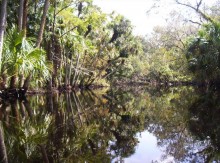 Photo by Bill Belleville.
She’s a brute of a reptile, as large as my kayak, and she’s up on all four legs, running towards me like a giant lumbering dog. I’m wedged into the cockpit of my small craft, its bow grounded on the mud bank at the edge of her bulrush hide-away. I’m holding my paddle in a white-knuckled death grip, but am otherwise paralyzed.
My only reaction is to exhale in a low distressed groan, of the sort bad movie actors use when mutant zombies have a full face grip on their heads.
As the gator reaches the edge of the low bank she actually launches herself towards me, becoming airborne for the briefest moment. Then she belly flops into the river, splashing me with water and duckweed and mud. Within seconds, she disappears beneath the surface, only the swirl of small eddies, the unsteady sway of my kayak, and the thump-thump of my heart, left to remind me she was here at all. My intellect tells me I frightened her and she was only trying to escape to deep water. But my gut tells me I was almost toast.
Around me on this spring-fed subtropical river, bald cypress are bursting with soft needles and the blooms of the river iris are glowing like neon in the green understory of ferns. I am deep inside an east central Florida landscape that seems as feral as the day it was birthed from the sea.
Ironically, there are dozens of contrived theme park “experiences” not so very far away that promise to scare the living bejesus out of you in exchange for pricey admission fees. But there is no scare like the real scare, and no aesthetic like the one the native Florida terrain can deliver.
I didn’t come here for the scare, of course. That’s the realm of extreme sports junkies who are in it just for the thrill. While I have done my share of cave diving inside the Swiss cheese limerock under foot, I did so to enjoy the discovery of a rare place. That promise of discovery is what keeps me here, what allows me to believe the natural world still has a chance to prevail inside a peninsula that is busy reshaping itself to resemble something other than its true nature.
Florida is a wonderfully odd and biologically diverse state largely driven by a bunch of screw-balls who are big on spin but dangerously out of touch with real-world constraints. To get to this Wekiva River system, I drove past a gauntlet of just-pretend places that had Jabberwocky written all over them. There were the synthetic chain restaurants that could have been anywhere—Joe’s Crab Shack (mock fish net floats that will never see water and frozen Alaskan king crabs) and Don Pablo’s Mexican Kitchen (intentionally distressed stucco without a Mexican in sight).
The most ludicrous modernism was a new development that, after the native baywood and sweetgum were clear-cut and clay was pilled atop the rich black wetland earth, would become the “Bella Foresta,” an enclave of ritzy new homes guarded by a gate. It is as if the delusion of Disney has spilled over its fence and rolled pell-mell over the countryside. It is no wonder Katherine Harris, the dented chad diva, has done so well.
But here’s the kicker: This Florida also has one-fourth of all its land protected as parks and preserves. So there’s enough of its extraordinary landscape left to still deliver an authentic wilderness punch. Experiences like this allow you to bore into the geography, to visit those relic water-logged time capsules that have changed the least since naturalist William Bartram first journeyed into the peninsula over 240 years ago.
And so, after driving past the make-believe Bella Foresta, I am now deep inside the real one, an enchanted place surrounded by over 100 square miles of scrub and forest, river and swamp. It is a wilderness with alligators and coral snakes and bears, only a few miserly miles from one of the most gridded-out and congested fantasylands in all the world. One single major asphalt road runs through it all, and it is lined with Bear Crossing signs that, sometimes, are not too far away from little kiosks selling knock-offs of designer sunglasses. If this surrealism didn’t exist, Gabriel Garcia Marquez would have to make it up.
After my gator encounter, I continue paddling downstream on the Wekiva, past the remnant Timucua Indian midden mounds still packed tight with the snail shells and manatee ribs and rattlesnake vertebrae, headed towards the mouth of the Blackwater Creek. This was once the territory of the ancient pre-Columbian Timucua Kingdom of the Sun. Nature and the wildlife that populated it were revered. The lives of the Timucua were woven into the environment, and not separate from it. The natural world of what would become Florida evoked awe, beauty, respect, fear. It cost nothing to get in, except an appreciation for its sacredness.
Five more miles and I find the mouth of the Blackwater, tucked away under a foliage canopy on the opposite shore, modest and unassuming for a waterway nearly 20 miles long. I poke my bow into it, stop for a granola break, check the time. The sun is dipping towards the tops of the highest cypress now, and the osprey are flying back home to roost in the golden light. Once, on an earlier trip here with a friend, one of the raptors soared right over us with a huge mullet in her talons. She landed on a cypress branch to get a better grip and when we looked up, all we could see was the large mullet tail flapping from the tree tops.
On I go, pushing against the outflow of the gentle current, spring-fed like the larger Wekiva, but tea-colored from the tannins leaking out of the surrounding swamp. Alone back here, I listen closely for sounds: The barking of tree frogs in the new dark, the call of the pileated woodpecker, the rustling of a large mammal—bear, coyote, boar—from back in the woods.
The golden light changes now to a darker umber, and I breathe slowly, using my paddle sparingly so I make almost no sound. A wading bird known as the limpkin screams like a panther from around the next bend. Fish are smacking the surface to feed, and small alligators are beginning their slow patience survey of the dark primal water, reclaiming this wild river as completely as the coming night.
Without the noise of my clumsy modern ego to drown everything out, the river regains its preeminence and grace, and seems to reach up and touch something in my soul. The Timucua carved totems to their gods, and planted them at the edge of their mounds on the shores here to protect them, iconic light against the vast darkness.
The wilderness like the one that now surrounds me is among the last repositories for the sacredness that once guided entire lives, that forged everlasting bonds between mortals and the gods of the natural world on this peninsula. I paddle deeper in now, paddle until it is full dark, until I am safely beyond the contradictions of modern Florida.
I am in wonder and awe with the evanescent quality of this real bella foresta, a place that truly seems on the verge of dissolving into vapor. I have finally broken through the artificial surrealism of the fantasy worlds, and found my way to one that mindfully threads its way through time.
Back here, everything seems to make sense. Mullet in the tree tops, alligators soaring through the air, wildflowers glowing as if lit from within. Awe, beauty, respect, fear.
I pretend I need to do nothing more in this world than to acknowledge the iconic light. And for all the many hours back home, right up until I reach the major asphalt road, I succeed.
 Email to friend
 Twitter
 del.icio.us
 Digg
Digg Facebook
 Furl
Furl Ma.gnolia
 Mixx
Mixx Reddit
 StumbleUpon
 Yahoo! Buzz