Travel dispatches from a shrinking planet

Travel dispatches from a shrinking planet

RECENT DISPATCHES
7.15.08

My Senegalese Cousin, the Rice-Loving Pig

When the woman selling peanuts at a Samba Dia market learned the Senegalese name adopted by Katie Krueger, negotiations took an insulting turn

6.23.08

Slumming in Rio

Slum tourism is on the rise. But are the guided tours educational or exploitive? Rob Verger joined one in Rio de Janeiro’s impoverished favelas to find out. 

TRAVEL BLOG
Q&A
image

Susan Sessions Rugh: ‘The Golden Age of American Family Vacations’

Elyse Franko asks the author of “Are We There Yet?” about the rise and fall of the family vacation, segregation in travel and how family trips are changing today

ASK ROLF
image

As a Woman, Can I Really Travel Without Much Fear for my Safety?

Vagabonding traveler Rolf Potts answers your questions about travel

AUDIO SLIDESHOW
image

Inside Slum Tourism

With mixed feelings, Rob Verger recently signed on for a tour of Rio de Janeiro’s favelas. He looks back on the experience—and the photos he was allowed to take.


HOW TO
image

Break Bread and Brie in France

Great cheese abounds in the land of Gaul, but dig in and you risk committing any number of faux pas. Terry Ward explains how to partake of the nation’s famed fromage with savoir faire.

THE LIST
image

10 Wanderlust-Inducing Summer Concerts

Call it world music or global pop or the sound of the world hum. Ben Keene reveals 10 acts on tour that are sure to transport you. Plus videos.

SPEAKER'S CORNER
image

A Journey Into ‘The Second World’

Some bureaucrats joke that they would never claim expertise about countries they had not at least flown over. In an excerpt from his new book, Parag Khanna argues that real global understanding can only come from serious travel.

BOOKS
image

‘The Worst Guidebook Writer Ever’?

Lonely Planet author Robert Reid reviews Thomas Kohnstamm’s “Do Travel Writers Go to Hell?” and weighs in on the controversy surrounding it

DISPATCH
1.23.07

Saying Goodbye in the Sierra Madre

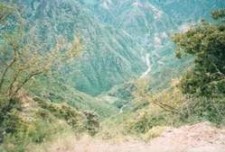
Jeff Biggers was living among the Tarahumara in Mexico’s Copper Canyon when he was invited to a funeral for a local woman. Amid the sorrow and song, he peeked at ‘the other side.’

imageAlfonzo was standing by the cemetery rock wall, weeping with a crowd of men who had been drinking and grieving for the past 48 hours. They carried their sombreros or ballcaps in their hands; their hair had been molded like clay.

“Pancho,” he said to me, motioning at the banjo strapped on my shoulder, his hand raised in a vaguely Italian gesture of pronouncement. “We need to talk.” Alfonzo’s face unhinged; he couldn’t finish his sentence. He began weeping. 

“Country, Pancho, country,” demanded Cornelio, a stocky older man who lived near our cabin. He was clearly the person most affected by country music in the Sierra Madre, also known as Copper Canyon. He once heard a song by Johnny Cash during a rare visit to Chihuahua City. The English word “country” had remained with him ever since. After a long drinking bout, he would often pound on our door at dawn and call out, “country, country, Pancho, get out here and play some country.” I would see him the following day. He would nod, I would nod, but neither of us would utter a word, as if we hardly knew each other.

A young village woman had died in Chihuahua City giving birth. She was working as a maid to a Mexican family, a common job for young Raramuri/Tarahumara women; her husband had found day jobs making adobe bricks. They lived in one of the shantytowns or colonias on the outskirts of the dusty city, which was now only a four-hour bus ride from Creel, a nearby mountain town in the Sierra Madre. 

Without a priest, the locals had prodded a visiting Mexican carpenter into service, who changed into his good pants and clean shirt, and then offered some verses of solace and led the chants of the rosary at the mission. After two days of viewing in the home of the mother-in-law, the burial took place in the graveyard, referred to in our village as the pantheon. 

Following a narrow trail along the cornfields, I cut behind the mission walls and slowly made for the log cabin on the other side of the hollow. Sweeps of pines and towering canyon walls served as borders for fields of corn. 

I had never been to a round-the-clock home viewing before. A brigade of kids and ragged dogs met my entrance at the dirt clearing around the cabin. A collection of corn cobs littered the grounds, like the corn cobs and mounds found at 12th century Anasazi sites in my childhood haunts in Arizona. Several older men, including Alfonzo, El Chapareke and Bernabe, were chatting outside. A few others sat quietly on benches made of split logs. I was greeted with the Raramuri handshake—that dusting of the palms of our fingers—and then waved inside.

Despite the blaring um-pah-pah of norteño music on a boom box in the corner, an air of regret hovered inside the sparse mourning room. Women huddled around the coffin in the emptied chamber. The variance in their dresses struck me; on one side sat those in home-stitched colorful skirts and matching tops and scarves, wearing huaraches, and on the other side sat women in polyester skirts, blouses, and plastic shoes. All the women were portly figures. 

I spent a few minutes staring at the young woman. Her death was a horrible reminder of modernity’s price for this community. Many Raramuri women made up one of the last indigenous groups in the world that still delivered their babies on their own, sometimes in the forests. One friend once saw a woman cut the umbilical cord of her child with a piece of broken glass. The girl in the coffin had actually gone to the hospital in Chihuahua City for her delivery. I made my peace and departed.

The funeral, Bernabe told me outside the cabin, would also be a festive occasion. They were celebrating with the dead, inviting them to escort the departed soul away with them. Due to the fact that it took at least a week to prepare tesguino, tequila had broken through the dike of tradition and poured forth. 

“After the funeral, the dead can leave us in peace,” Bernabe said. “Go away and not bother us.”

The Raramuri concept of immortality was so strong, Carl Lumholtz wrote, “that death means to them only a change of form.” According to William Merrill, a Smithsonian anthropologist who spent three years in a remote village for his groundbreaking study, “Raramuri Souls,” “People must overcome their feelings of sadness as soon as possible after the death of a loved one because if one’s souls are sad, they will want to leave the body to be with the deceased.”

The service at the mission lingered for hours. It appeared as if the village couldn’t bear to part with the young woman. When it started to drizzle, everyone hovered by the towering wood doors, as if they had received a slight reprieve.

About halfway through the service, I entered the mission, took off my hat, and chose a spot on the men’s side of the sanctuary. I spotted my companion Carla sitting in a quilt of women on the right. The Mexican carpenter was finishing the rosary. Haggard and long faces rejoined in groans. The fiddler and guitar players slumped in the one pew to the side of the altar, barely able to pull themselves together to play a pascol song at the carpenter’s urging. The young woman’s husband, a close cousin of the guitar player, wept by his side. 

Then I caught Cornelio’s eye. Or rather, he picked up on my appearance in the mission. A grin rippled across his crooked face and propelled him from his kneeling stance.

“Pancho,” he screamed. “Country, country, we need some country!”

I tried to flee, but it was too late. Cornelio snagged my arm, chiding me for leaving my banjo at the cabin.

“Get it,” he shouted. 

I felt like running away. Instead I saw the guitar player who waved me on.

By the time I returned, the distraught villagers flanked the procession led by the carpenter, the desperate young husband clutching a blaring boom box. A band of guitar players, a fiddler and soon my banjo straggled along, attempting to play a ranchera love song. Splashing through puddles, we swept the mission plaza with our shuffle and marched around the corn fields and then slowly made it across the arroyo. The procession reached the cemetery rock walls, with the carpenter and sober adults and children in front, fracturing into multiple ceremonies. 

imageWe marched up and down the graveyard, which had more tequila bottles than headstones. Some of the bereaved stumbled onto graves and even fell atop the coffin when we arrived at the young woman’s burial ground. We received our cue to crank up the tunes. Martin, the lead guitar player, nodded for me to follow. We didn’t manage to play more than a couple of cumbias, all out of tune, the dazed husband singing verses from other songs, still clutching at his boom box. 

There was more than one burial ritual taking place. An elder called out orders in Raramuri while the coffin was being prepared. The Mexican carpenter and several others continued to recite prayers and the rosary in Spanish. The fiesta for the dead spirits bantered around the edge of the crowd in laughter and song.

While the elder intoned a speech, family members opened the coffin one more time. Two women wailed and clutched the body, while a younger cousin stuffed in additional clothes, a bottle of Coke, and a package of cookies. The coffin had already been stockpiled with specific portions of corn, beans and tortillas. 

An aunt suddenly collapsed, overcome by the booze, a sleepless night on a bus from Ciudad Juarez, and the tragedy of the death. A few turned and watched her crumple onto the ground. Within a short time, a couple of teachers from the local boarding school were fanning her, holding her legs in the air. 

The elder then led family members in a circular ritual procession, sprinkling drops of esquiate, a roasted corn mixture, and Coke and bottled fruit juices on the coffin and themselves, in order to satisfy death and ward off evil spirits. As the coffin was finally lowered, children pitched four handfuls of mud onto the grave. 

After a moment of silence, people veered off to the rock walls, supporting each other’s stumbles. I wandered toward Alfonzo and Cornelio and a couple of other men. They all possessed the weary looks of sorrow and deprivation. They passed around an unmarked bottle.

“I’m happy you are with us in these moments,” Alfonzo said.

“One more song,” Cornelio bellowed.

I smiled and kept the banjo slung on my back. Alfonzo raised his hand again as if to make a pronouncement. “We, Raramuri,” he said, “have a hard life.” He couldn’t hold back the tears. His voice had long since broken, his lower lip quivering. “I have been on the other side,” he said, “but we Raramuri...” He unraveled, weeping, as another man comforted him, offering him the bottle. 

I stood quietly, watching him, trying to understand what he wanted to say. His allusion to “the other side,” I assumed, referred to the United States. Within a couple of minutes, Alfonzo tried again to speak, but he was too upset, and shook his head and walked away. 

Cornelio staggered over and leaned against my shoulder for support, grinning his riddled grin, and quietly said, “Pancho, we’re all leaving for the other side one day.”

* * * * * *

Also on World Hum:
* Straight Men Are Better Map Readers Than Straight Women, Study Says*
* Bill Gates’s Yacht Inspires Plans for Thai Island
* Eating Fajitas in France
* The Distance From Dachau to Darfur
* Ask Rolf: How Much Money Do I Need For Long-Term World Travel?

What is World Hum? Read more.

* * * * * *

This story, reprinted by permission of the University of Illinois Press, is an excerpt from Biggers’s book, In the Sierra Madre. Biggers is also the author of The United States of Appalachia: How Southern Mountaineers Brought Independence, Culture and Enlightenment to America. His last story for World Hum was Family Traveling.

Photos, including bottom image of the author playing the banjo, by Carla Paciotto.


WEBLOG CATEGORIES

Adventure Travel
Afghanistan
Air Travel
'Airworld'
Africa
Alaska
Albania
Antarctica
Architecture and Travel
Argentina
Asia
Audio/Video
Australia
Bali
Bookstore Tourism
Belize
Ben's Place of the Week
Bhutan
Bolivia
Botswana
Brazil
Brand That Nation!
Budget Travel
Burma
California
Cambodia
Canada
Caribbean
Celebrity Travel Watch
Chile
China
Colombia
Costa Rica
Cruising
Cuba
Denmark
Czech Republic
Dominican Republic
Dubai
Eco-Travel
Ecuador
England
Egypt
El Salvador
Estonia
Ethiopia
Europe
Family Travel
Fiji
Finland
Florida
Food: The Moveable Feast
France
Geography for Fun and Profit
Germany
Georgia
Global Village
Ghana
Greece
Greenland
Guatemala
Guest Blogger: Thomas Swick
Guest Blogger: Michael Shapiro
Haiti
Hawaii
History Travel
Holland
Honduras
Hong Kong
Hot Americans on Television Botching Geography Questions
Hotels
Iceland
Icons: Ernest Hemingway
Icons: Che Guevara
Icons: Jack Kerouac
Icons: Mark Twain
In the News
India
Indonesia
Iowa
Iraq
Iran
Ireland
Islands
Israel
Italy
Jamaica
Japan
Jordan
Kenya
Kosovo
Las Vegas
Latvia
Life of a Travel Writer
Lebanon
Libya
Literary Travel
Los Angeles
London
Malaysia
Mali
Media Addict
Mexico
Moldova
Mongolia
Morocco
Moscow
Movies and Travel
Music
Nation Branding
Nepal
New Orleans
New Travel Books
New York
New Zealand
9.11.01
Nicaragua
North America
North Korea
Norway
Outdoors
Page Turner
Pakistan
Paris
Peru
Planet Theme Park
Poland
Portugal
Puerto Rico
R.I.P.
Road Trips
Romania
Russia
San Diego
San Francisco
Saudi Arabia
Scotland
Shameless Self-Promotion
Shanghai
Shrinking Planet Statistic of the Day
Singapore
Somalia
South Africa
South America
South Korea
Space Travel
Spain
Suriname
Sweden
Switzerland
Syria
Taiwan
Tanzania
Technology and Travel
Thailand
The Critics
Thomas Swick on Travel Writing
Three Great Books
Three Travel Books
Tibet
Tokyo
Top 30 Travel Books
Train Travel
Travel and Security
Travel Disease du Jour
Travel Fashion
Travel Headline of the Day
Travel Lexicon
Travel Photography
Travel-Terror Fatigue Index
Travel Tips
Travel Writer Book Tours
Tres Loco
Turkey
Ukraine
United States
Venezuela
Vietnam
Voluntourism
War and Travel
Washington D.C.
What We Loved This Week
What Would Edward Abbey Think?
Where in the World Are You?
Why We Travel
World Hum Travel Zeitgeist
Zambia