
The Lost World of Nigeria
Travel Stories: The Eredo once formed a boundary between the real and spirit worlds, and could easily contain Manhattan. Frank Bures goes in search of one of the planet's forgotten architectural wonders.
07.30.07 | 11:41 AM ET
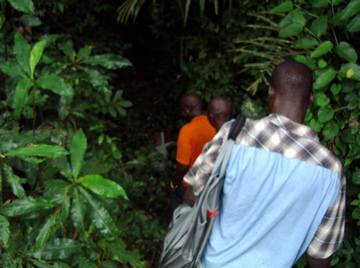 Photo by Frank Bures.
The road dipped as Akeem and I came into the sleepy town outside Lagos, Nigeria. It was a town named after the greatest archaeological monuments that most people have never heard of: the Eredo. As we drew near, the road went up a hill. To our right stood a huge tree. Then the road dipped down into town.
We pulled up to the local government office, a run-down, tin-roofed building with just one door and few windows. Almost as soon as we stopped, people started coming over to our car to see what we wanted. Akeem asked if they knew where the Eredo was. They said they did. They told us to park across the street and come over to the building.
We left the car and went back to the building where our new friends had gathered. There had been two. Then there were four. Soon it seemed everyone in the town came over to investigate. The local police officer was there, and was very friendly. He was the only policeman I’d been happy to see in Nigeria.
Our six escorts took us down behind a building and sat us on a bench against the mud wall of a house.
The leader, a man named Otumba, sat in front of me. “Yes,” he said. “We can go to see the Eredo.” But he wouldn’t say when. So we sat there for a while, chatting, until finally Otumba turned to me seriously and said, “Before you go to see Sungbo’s Eredo, what can you do for the village?”
“I don’t know,” I said, though I had a good idea.
“You see,” Otumba went on, “you have to make a sacrifice to the ancestors so they will be happy when you go to see the Eredo. That way, when you go, nothing bad will happen to you.”
I asked if he had any suggestions.
“How about ...maybe ...1,000 naira,” he replied.
It was steep. Nearly $8. But it was a small price to pay see one of the greatest man-made structures in Africa, or the world, and one few Westerners had seen. The Eredo might not be quite as breath-taking as the pyramids, but it was bigger, and in some ways more impressive. Archaeologists estimate that it took more than a million man-hours more to build the 100-mile wall-and-moat system around the kingdom of the childless matriarch named Bilikisu Sungbo, 1,300 years ago.
So I paid up, and we headed off on foot, down the road to see the village chief, a man named Mr. Sanni. He was sitting on a bench under a tree, and he, too, had us sit down and talk to him. Not many people had come through, Mr. Sanni told us. A reporter every now and then, or the odd expat. A few years ago, he said, he’d been interviewed by the BBC. I told him I’d seen that story and read about him in America. This made him happy. When I came back, he said, he’d show me his maps.
By then there were 10 of us, and together we headed off behind the house through the cassava fields, until we got to a dense patch of forest with a small break in the trees. Otumba pulled back some leafy branches to reveal an opening, and we headed down a steep muddy path into a trench. We were at the bottom before I realized this was the moat that had once run around the outside of the wall.
Much about the history of the Eredo is murky, and Nigerian archaeologists have been less than enthusiastic about field work. But what is known is that it encloses an area 30 times bigger than Manhattan. According to Patrick Darling, a British archaeologist who has studied the Eredo for 10 years, it is related to the massive Benin earthworks nearby, which he says may be “the largest single archaeological phenomenon on the planet.”
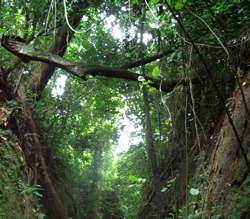 We walked along the bottom of the moat, and on both sides the ancient mud wall rose up. In some places, the Eredo had been 70-feet high. Little is known about the kingdom inside it, other than the connection to Bilikisu Sungbo, whose grave now sits along the wall to the north and is still a pilgrimage site. It may have been built by the Awujale dynasty after Bilikisu died. Much of that history has been lost, or must be untangled from stories, but according to Darling, the Eredo wasn’t strictly for defense. For those protected by it, it was the border between the real world inside, and the spirit world outside. Today that seems to have been reversed. The real world seems far away, while the wall has kept its own secrets and spirits within.
Overhead, the trees had grown across from each side making the moat into a dark tunnel through the forest. How would you know this massive rampart once contained a huge civilization? The Eredo was now so hidden that I didn’t know the hill we came over was the wall itself.
But that is the way here: The earth swallows things whole, especially history. History lives in stories, but disappears into the forest. Once, in East Africa, I found myself in a small, washed out gully with a geologist who knew the place well. Water had run down and uncovered a host of large stones. They looked like nothing at first, but then you could see there were actually ax blades and hammer stones. The geologist said the site had been rejected by the British Museum as having low quality specimens, but she thought the “stone industry” site was probably 400,000 years old.
While I was standing there, an old Maasai man came up to me. “Are you looking at rocks?” he asked.
There was no indication whether he thought this would be strange or not. I told him I was, and they were made by people who lived there long ago, maybe 400,000 years ago. He made a noise as if he thought this was impressive, then said that he still had a long way to go before he reached his home. We said good bye. He walked on.
These sites exist across the continent and fuel a brisk black market trade, something that Darling and others are frustrated by, but which shows little sign of changing. It’s hard to care about ancient history when the present demands all your attention.
Back in the moat, we came across small, conical statues: idols, Otumba said, to honor the ancestors. I stopped to photograph one, and Otumba and Akeem started yelling and jumping and running ahead. Had I offended the spirits?
Otumba pointed to my feet, but I could already feel it: a sharp stinging up my ankles and legs. Army ants were crawling all over my sandals and up my pants.
I jumped and ran ahead, then stopped to pick them off my legs.
We trudged on until we came to a rise. Near the top, Otumba bent down and picked up a handful of cowrie shells, which were brought overland from the Indian Ocean long, long ago.
“Olden days money,” Otumba said, and let them fall through his fingers like coins.
We walked on, and went back out into the sunny cassava fields, past a small idol in the trees, then headed back to the village.
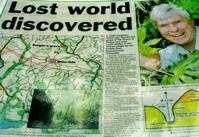 Mr. Sanni was waiting for us, sitting on his bench. He had fetched a large envelope, and he pulled out some maps and articles from a few papers and magazines around the world, all dating from around the same time, in 1999, when the world had shown a brief flare of interest in the Eredo.
Since then, the world has turned its gaze elsewhere and the Eredo has sunk back into the forest, almost as forgotten as it was for 1,000 years. No one I talked to in Nigeria, or outside of it, had ever heard of the Eredo, and they were amazed to hear that such a thing still exists.
Akeem and I said goodbye to Otumba and Mr. Sanni. I signed his guestbook, and the entire village escorted us back to our car. We climbed in, headed over the hill, and I took one look back on that world of spirits and memories, before we started down the hill and back into the real one.
 Email to friend
 Twitter
 del.icio.us
 Digg
Digg Facebook
 Furl
Furl Ma.gnolia
 Mixx
Mixx Reddit
 StumbleUpon
 Yahoo! Buzz
Citrus 07.31.07 | 3:47 PM ET
Great nature. Beautiful place. I Would like to visit it. I hope that though the hands of civilization will not reach here?
Lantern 08.01.07 | 4:36 PM ET
I have nothing to say, nice place (especially on photoes), but of couse it’s not bat to visit it sometimes
divine logix 09.26.08 | 11:17 AM ET
Do you have GPS coordinates? I would like to explore this place. Thanks. D.