
A Spook’s Planet: “The World Factbook”
Travel Books: The CIA's "The World Factbook" isn't just a treasure trove of curiosities. Frank Bures writes that it just may be the mother of all guidebooks.
05.30.06 | 3:20 PM ET
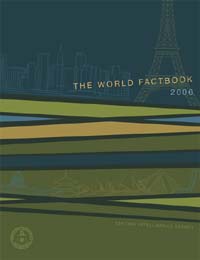 These days, the CIA may not have the best reputation for its “facts.” And, yeah, the good analysts have been known to miss a thing or two. They didn’t actually see the fall of the Soviet Union coming. And don’t even mention WMD.
Nonetheless, the agency does have a gigantic, multi-billion dollar number crunching machine whose sole purpose is to quantify the world, and to give a quick, thorough snapshot of every piece of land on it. The result is the CIA’s The World Factbook
Recently published by Potomac Books, the new edition is massive thing—nothing you can stow away on your trip. But it is a key reference for every traveler who wants to know the world a little better, even for those who just want to poke around in the planet’s odd corners.
Every country, island, territory and province are listed here—many of which you may be surprised to learn even exist. Each country is broken into categories: geography, people, government, economy, communications, transportation, military and “transnational issues.”
That may sound boring to the non-wonks among us. But it’s not: This is a treasure trove of curiosities. Did you know, for example, that in 2002-3, 11,588 tourists traveled to Antarctica? Did you know that the age of military conscription in Oman is 14? Did you know that there are at least twice as many cell phones than land lines in Nigeria? And did you know Uruguay’s full name is the Oriental Republic of Uruguay? I didn’t.
The pure geography is great, too. Each country has a map (even Vatican City) with important features marked that you might never have taken the time to notice. Have you ever seen the jagged line that runs through the heart of Cyprus? Have you ever really noticed how long Chile is? And have you ever even heard of the islands called Wallis and Futuna?
These aren’t the kinds of things you normally research before you go somewhere, but they are the kinds of things that could change how you travel, and possibly even where you travel. Whenever you go to a country, check out that country in “The World Factbook” before you leave. This will give you a deeper understanding of the place and could even give you opportunities for stimulating conversations:
“So, I understand the fertility rate is 4.59 childen per woman here.”
Or:
“I hear your country has seven paved runways.”
Or:
“How you get along with your export partners?”
As for the recently printed edition, I like it, though the font is lackluster. It’s the prefect book to page through to stumble upon interesting trivia. (Mozambique is almost twice the size of California!) But for those who don’t want to shell out $54.95, there is always the free online version, which is actually more up-to-date than the printed one. That means “The World Factbook,” not unlike the CIA, is everywhere. So you don’t even need to carry an extra suitcase for this tome—just check your local Internet café.
The world is full of facts, and this book, which may be the CIA’s finest product, is a fine place to find many of them.
Just don’t go waving it in front of the Security Council.