
A Winter’s Tale
Travel Stories: Jim Heintz goes to Iceland
01.11.05 | 12:51 AM ET
 In a wash of gray, a treeless lava field melded into the sky as the weak sun crept below the sea. The four-hour day was closing and a handful of American tourists on a tour bus with me gazed dully out the windows, clearly less than enchanted with wintertime Iceland.
Our minder, Osk Vilhjalmsdottir, was trying to engage the gang by recounting some folk legends. Among these were the malevolent Christmas Cat, who inexplicably eats people if they don’t get gifts, and the huldufolk—the “hidden people” who live invisibly on certain mountains and occasionally appear out of some parallel dimension to seduce hapless humans to come to The Other Side.
You recognize the huldufolk this way, she said: “They look exactly like us, except they’re much more beautiful.”
This incongruous statement didn’t prod the other tourists out of their listlessness—they didn’t perk up until Osk mentioned the bus could drop us off at the shopping mall.
But I couldn’t get it out of my mind and it still dogged me an hour later as the rest of the bus debarked at the mall, some of the women chuckling as if they were doing something clever and risque.
These cryptic words were exactly what I wanted from Iceland, why I’d come when the country is locked in darkness. Ever since Iceland popped up in my 4th-grade geography book, I’d been infatuated, feeling that information I needed to know was held somewhere in its remote, austere expanse. The book’s single sentence on how Reykjavik is heated by scalding water from the Earth’s core hinted at primal power more thrilling than my suburban life of tract houses and finicky flowerbeds had led me to expect.
At age 9, I didn’t know the word “epiphany,” but I knew that’s what I hoped was waiting for me in Iceland.
Thirty-odd years later I made two summertime trips there. Although I was delighted—the play of subtly changing round-the-clock light on the severe mountains; sheep grazing near thin, shining waterfalls; steam shooting from cracks in the earth—I’d left each time gnawed by the sense that I’d somehow missed its essence, the galvanizing moment.
Every couple of months I’d dream of Iceland, seeing it riding on the horizon and feeling it to be unreachable. The sense that I couldn’t get to a place I’d already been to puzzled me; what was I doing wrong?
Maybe I’d just held a childhood fancy embarrassingly long into adulthood. Or I’d misunderstood what travel, even as a tourist, is supposed to be about—should I have gone to Iceland with the aim of disinterested learning rather than hoping to be enraptured?
This maundering led nowehere and I concocted a theory as a way out: I’d erred by visiting Iceland in its most benign season; to reach a country’s emotional core maybe one needs to visit in its most difficult conditions, the weather that placed the greatest challenge on its people to be inventive and cooperative. So I headed off in the depths of December for one more try at the Iceland I yearned for.
Osk’s elliptical comment on my first day there seemed like a promising indication that my theory was sound. In subsequent days, as I explored without a clot of other tourists in tow, my confidence rose.
I began to regard Osk’s strange tales as realistic accounts rather than fancy: winter Iceland is shot through with agreeable eeriness.
For Advent, Icelanders place red-lighted crosses at cemetery graves, so the fields of the dead have a warm and welcoming aura while nearby white-lighted houses of the living seem cold and lonesome. A snow-caked dog stands in an empty field, wagging its tail at something unseen. The chill sky stays black for hours, then rips open in swirling spears of orange and purple and green—the aurora borealis.
In the few hours of daylight, the air is so clear that far-off mountains seem just a few blocks away, like the truncated distances one experiences in dreams. Even hip, high-tech Reykjavik was uncanny in December. The simple lines of its trim white buildings stood out against the obsidian night as precisely as an etching, and seeing people move on the street was like watching an architectural drawing come to life.
All of this was amid profound stillness, as if the silence of Iceland’s empty center was flowing out into the coastal settlements.
By the time I left for the northern town of Akureyri, I was enthralled with the otherworldly atmosphere and ready to believe anything. Though when I arrived, I didn’t believe I’d made a smart move.
Akureyri’s boosters brag that it is Iceland’s second-biggest city. What they avoid mentioning is that it has just 15,000 people. The only cinema was showing films so stupid that even I, who enjoyed “Dude, Where’s My Car?”, couldn’t see coughing up money for them—especially since movies, like everything else in the country, cost a bundle.
Going to a bar, my reliable default strategy when at loose ends, seemed unwise: in Iceland, “happy hour” means a glass of beer drops to about US$8. Life didn’t look promising, and the next bus out didn’t leave for two days.
The next day, lacking other ideas, I headed for the edge of town, where a fine path appeared, along the lower edge of a range of flat-topped mountains that rippled back from a fjord toward Iceland’s vast, uninhabited center.
Wind-driven slate clouds seethed over the mountains toward me, but swerved abruptly before reaching me, leaving blue sky above and the air perfectly still around me, as if a spell had been cast. I walked a couple of hours, not just killing time anymore but pulled by the sense that something was waiting for me in the interior: a chapel, a cup of tea at a peaceful hut, a loyal dog.
The feeling was amorphous but intense, like a teenager’s belief in true love. If there had been a soundtrack, it would have been a choir holding a single tonic chord.
The sky slid from turquoise to amethyst en route to black; going further would be romantic but foolish, heading back would be prudent but spiritless. A rock padded with moss made a nice place to sit and figure out a compromise.
Taking photos seemed right: I could do the safe thing and return to town, knowing that I’d have lovely pictures to look at that would someday spur me to come back and take the trail to its real end.
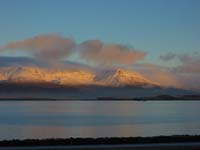
Up the fjord loomed a mountain whose shoulder wore a stole of white cloud; the mountain I would aim to reach someday. But when I checked my digital camera’s screen after clicking the shutter, the mountain wasn’t on it. A couple of adjustments didn’t help.
True, it was a second-rate camera in the hands of a third-rate shooter—but still, missing a 2,000-foot mass of rock seemed like more than incompetence. The accumulated oddities of the day spooked me—the storm that never came, the silent siren call, the elusive mountain—and I began to worry about a question I’d failed to ask Osk: How do you know if you’re on one of the mountains where the huldufolk work their wiles?
A soft scraping noise broke through the hush, and another, and in moments a woman came running out of the empty mountains in just shorts and a halter despite the freezing air and in another instant she zoomed out of sight. Although she’d be judged as homely by a guy prowling in a bar, she was extraordinary out here: strong, with an easy stride and a luminous smile as she relished her gracefulness.
They look exactly like us, except they’re much more beautiful.
Her passing was so quick, I didn’t even think to try to snap a photo. All to the better: If she’d shown up in my camera, that would prove my thrill was just a spasm of overheated imagination.
Instead, I have the luxury of not knowing.
What I do know is that the dreams about being unable to reach Iceland haven’t come back.