
All the Flowers in Amsterdam
Speaker's Corner: Friday marks the 10th anniversary of the death of Diana, Princess of Wales. Lynne Friedmann recalls a visit to a Dutch flower market when it seemed the whole world was grieving.
08.29.07 | 12:09 PM ET
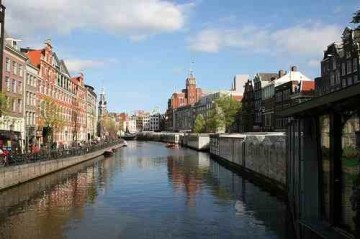 On an overcast morning in Amsterdam I decided to lift my spirits by strolling through the world’s only floating flower market. I’d stopped by on a previous visit to the city a year earlier, savoring the phantasmagoria of color and fragrance. But today, as soon as I entered, I stopped in my tracks. The stalls were bare, devoid of flowers. Not a single bloom, petal or stem to be found in the block-long area, only gnarled bulbs tossed carelessly in baskets and nondescript seed packets on metal racks. Suddenly the breeze that lifted off the canals felt colder.
The Netherlands is the world’s leading exporter of cut flowers and the Amsterdam Floating Flower Market is an iconic symbol of this trade. Starting in 1862, barges laden with fresh blossoms arrived daily from the countryside. The nurserymen sailed up the Amstel River and moored to sell cut flowers and live plants without leaving their crafts. These days, blossoms arrive by truck to fill permanently anchored barges now converted to open-air stalls, like a row of giant lily pads on the edge of a stream.
But not on this day. The few tourists on hand lowered their heads; no one spoke. A funereal air had overtaken this usually joyous place. At first, I was confused. While traveling, it’s easy, and often desirous, to divorce ourselves from the day’s headlines and news feeds. The first week in September 1997, I’d done exactly that. I had come to Amsterdam to take leisurely walks along the waterways, linger in museum galleries and marvel at the rows of svelte canal houses crowned by ornamented gable tops.
But as I walked among the empty flower stalls, as deserted and desolate as a stadium parking lot after a game, it began to dawn on me that I’d put a big news story, perhaps the year’s biggest, out of my mind. I’d heard the first bulletin Aug. 31 while at home in California watching the 11 p.m. news.
Diana, the Princess of Wales, had been killed in a car crash. In the days that followed I saw the television and newspaper images of giant crowds gathering in London, and of an estimated 15,000 tons of blooms placed by mourners outside of Buckingham and Kensington palaces.
Suddenly, there in the flower mart, I was struck by the enormity of it all. All the flowers in the UK couldn’t satisfy the demand of mourners. The grief was too great. Most of this sea of flowers had, in fact, flowed from the Netherlands. But not even the world’s largest flower producer could meet the demand. I would later learn in newspaper reports that once the Netherlands was depleted, and additional flowers were flown to London from Israel, Kenya, Morocco, South Africa, Thailand and Colombia.
As it happens, the flower mart is located in the part of city adjacent to the museum quarter, where I’d made several visits over the years to the Rijkesmuseum, the neo-gothic behemoth that holds the magnificent Dutch national art collection. In the Dutch Golden Age of the 17th century, many artists, forbidden by the Dutch Reformed Protestant Church to create images of religious subjects, applied their talents to detailed realism and hidden symbols in still life paintings.
Especially popular were paintings in which opulent arrangements of fruit and flowers, or lavish banquet tables with fine silver and crystal, were depicted not only for their beauty but also as symbols of the transience of life. Allegorical themes suggested the vanity and brevity of life and the inevitability of death. Peering at some of those paintings, I’d discovered a skull, an hourglass, a pocket watch, a burnt candle, a book with turned pages and flowers beginning to whither.
Joy and jealousy, desire and dejection, solitude and sadness, loyalty and love—we often use flowers to symbolize such emotions. They were all themes, it occurred to me, that resonated in Diana’s life.
Like many Americans, I’d had only a casual interest in Diana. I noted the occasional headlines—marriage, the birth of her children, divorce. Still, Diana’s life of privilege was alien to my working-class roots. I’d felt no connection to her.
Until that day in the flower market.
Returning home a few days later, I changed planes at Gatwick airport outside of London. Arriving late in the evening, the airline lounges were closed and I wandered the duty-free area. So it was that I found myself standing outside the Harrods outlet where a condolence book for Diana and her doomed lover Dodi al-Fayed presented itself.
It had been more than a week since her death. Still, a few people queued up to sign the book. To my surprise, I joined them. Suddenly the overly bright lights and din seemed to recede into the background as if I were standing in a hushed chapel foyer. Some travelers quickly signed the book; others entered longer passages, recalling Diana’s impact on their life. When it was my turn, I simply added my name to the long list of mourners, acknowledging the death of a fellow traveler on this planet.
Photo of Amsterdam flower market by Neil Rickards via Flickr, (Creative Commons).