
Chador Etiquette
Travel Stories: In a Kuwaiti shopping mall, Christine Michaud learns that dressing like the locals is not as easy as it looks
05.23.03 | 9:52 PM ET
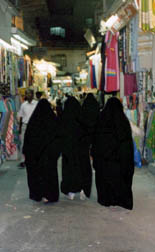 Photo by Christine Michaud.
 Darkness had fallen on the quiet bay almighty Saddam once set ablaze for months on end. All across the city, muezzins perched atop neon-lit minarets were calling believers to prayer, their blaring chants echoing off into desert and sea. The timing was perfect. Hugging a black cloak around me, I slipped out into the warm winter night.
A few blocks from the nearest mosque, four women walking closely together passed me by. In addition to the standard chador—a large black cloak and head covering—they wore a black gauze that completely covered their faces and gloves and forbade any sight of their hands. Like black ghosts, they silently floated away down the narrow alley, leaving but the scent of their expensive perfume to be remembered. Tonight, I had decided to be one of them. Having similarly concealed my alienating fairness under silky veils, I could be just another black ghost in the land of Allah.
Or I could make an all-time fool of myself.
It all happened a few days after I first set foot in Kuwait, a country a single woman cannot enter unless she is visiting blood relatives, a husband, or going on business. My boss had worked miracles to get me in, as I had been refused entry to other Gulf countries such as Qatar where officials insisted that the sole business purpose of an unmarried blond girl in the region should be prostitution.
By then I had seen the Arabian desert, crowds of sheikhs in golden-trimmed robes, and a whole lot of Mercedes. However I had yet to visit any of the expensive malls dotting the city. And so on this lonely evening, I decided to venture beyond the limits of my regular hotel-to-office route to go shopping. I was leaving the business center. Alone. Time had now come to take out Jihan’s chador. Jihan was the wife of an Arab co-worker who had kindly offered to teach me the fundamentals of proper veiling. While only Saudi authorities demand that foreign women cover up, I figured one could never be too prepared. Thus, a few days before I left my home in Montreal for the Arab Gulf, I dropped by Jihan’s place for my initiation to modesty.
A shy Filipino maid answered the door and ushered me to a posh living room where Jihan greeted me with three kisses. Jihan was a tiny Saudi woman in her early thirties. She wore a white sweater and blue jeans that matched her tight navy hijab, a headscarf worn by Muslim women to conceal hair and neck. On the wall before me hung a large framed picture portraying Jihan and her husband in a romantic embrace. He wore a three-piece suit and she a white hijab that matched her dress.
After a mandatory tea and round of questions about the most current health status of each of my family members, Jihan invited me to follow her into her lavish bedroom for “the lesson.” She pulled a number of sweetly perfumed silk scarves out of a fancy drawer and laid them out on the gigantic bed for me to make my selection.
Jihan stressed the importance of a well-centred hijab (pronounced “hee-djab”), drawing my attention to the discreet ironed-in ply that marked the center of each scarf and was meant to be aligned with my nose. She swiftly took off her own hijab and proceeded to address me with step-by-step instructions while skilfully covering back up her thick black mane. A hijab looks deceivingly easy to put on, especially when you receive instructions from a woman who has been wearing one for twenty years. Basically, the Muslim head covering is nothing but a large square of cloth folded once into a triangle. The fold goes over the forehead and the sides are pinned tightly under the chin to completely cover a woman’s hair, ears, and neck. One of the tips of the scarf is then wrapped around the neck to hide the unfashionable pin.
Now, how hard can this be? Well, for someone who’s got a perfect cube for a head, I suppose it’s a cinch. For the rest of us sporting somewhat rounded skulls, no hijab will ever fit tightly and entirely hide a full hairline unless it is slightly folded in on each side just above ear level, symmetrically of course. While I could achieve symmetrical folds, closing a safety pin under my chin single-handedly (the other hand is busy holding the whole thing tight) was simply beyond my poor Catholic girl’s capacities.
“You might need a little practice,” Jihan told me, unable to conceal a smile as I furiously struggled with my safety pin in a vain attempt to cover up one last unruly blond lock. Leaving me looking more like a desert warrior than a modest lady, Jihan disappeared into the depths of her walk-in closet and re-emerged with a chador in hand. She gently took the pin out of my clumsy fingers, expertly rearranged my rebellious headgear and secured it tightly under my chin. She then helped me put on the chador and had me turn to the full-length mirror.
“A chador calls respect,” she said, talking to my reflection. “Although you are not required to wear it, it’ll make it easier for you to go unnoticed.”
Easier for me to go unnoticed? I’m a husky five-foot-nine, blue-eyed blonde with chipmunk cheeks and a little curled up nose. That made me twice the size of Jihan with half her pigmentation. A total chameleon.
I thanked Jihan profusely as she carefully folded “my” black hijab and chador into a plastic bag. I could give both back whenever I returned, she insisted. Jihan accompanied me to the door, kissed me three times and wished me luck. And may Allah watch over me. In spite of my protests, the borrowed outfit was meticulously sprayed with holy water by my I-don’t-feel-this-trip-
is-a-good-idea-and-I-still-think-you-should-dye-
your-hair-brown mother. Candles were lit and prayers were said for me all over the province. And may God bless me. The scorching sun was setting quickly over a skyline of towers and slender minarets. I knew Kuwaitis would soon pour out of their air-conditioned hideouts to enjoy the evening’s relieving coolness. And so would I.
I pulled Jihan’s silk chador and hijab from the bottom of my suitcase, pleased to find them both surprisingly wrinkle-free. Remembering the little Saudi lady’s detailed instructions, I proceeded to wrap up my blond head the Arab way. Unfortunately, no matter what I did, the silky scarf slipped back, forth and sideways over and again. My uneven folds took turns coming loose and I completely lost sight of that center ply. After nearly slashing my jugular open with the pin, I had to face the facts: I couldn’t put on a hijab decently if my life depended on it. So much for the hijab, I decided, the chador would have to do. Throwing the silk cloak over a long black skirt and black top, I headed on out to my fancy mall.
The mall was really nothing to rave about, at least not for someone who had been expecting golden elevators, crystal chandeliers, and wall-to-wall Persian carpets. Bare grey floors of composite marble, white gypsum walls, and neon lights were all I found. Sure, it was airy, new and modern, but in a disappointingly American way. Nonetheless, the mere fact of having a chador on made me happy, so I went on with my window shopping. Yet the more I walked around, the more I got the uneasy feeling that everyone was intensely staring at me. First resorting to denial, I discarded the feeling as the product of a CNN-bred paranoia.
The stares persisted throughout the mall. After the fifteen most self-conscious minutes of my life, I finally noticed that most women wore their chador pulled over the head, much like one does when pulling their coat over them in the rain. After a week in Kuwait, it made perfect sense to me that the curve of a woman’s neck would be considered too provocative a sight and had to be concealed under yet another veil. “So that’s what it is, I’m wearing this thing like a tourist,” I thought to myself. Jihan had never been to Kuwait, maybe she didn’t know about this local trend.
I pulled the chador over my head. The stares doubled and children started pointing at me. Now there was no mistaking: there was something distinctively odd about me and it was entertaining the mall’s entire clientele. What was these people’s problem anyway? I was all covered up like everybody else, what more did they expect me to do? I just didn’t get it. Then I walked by a full-length mirror. Jihan was a full nine inches shorter than me. Pulled up over my head as it now was, her chador barely covered my butt. What the whole mall was staring at was some freaky cross between E.T., Thor, and the Flying Nun. But that was only half the story. The Koran preaches that women should “not strike their feet so that what they hide of their ornaments may be known” (The Light, 24.31). In plain English, this means a gal shouldn’t walk in a fast heavy pace because it makes her boobs jiggle.
Indeed, there is much more to wearing a chador than putting it on. I later learned—and witnessed—that a woman veiled from head to toe can actually be incredibly sensual, and sometimes outright sexy. The secret lies in the way she makes her veils flow about her when she walks. Her body will move in harmony with wind and light to let her soft silky robes flow sensually with her every step. Speed—or lack of—is therefore key. Some veiled women even wear little bells around their hidden ankles and literally stop traffic when they stroll across busy intersections in a walking melody. Women the world over have an intrinsic need to please; veiled ladies have simply found their own way of being beautiful. In light of all this, I could only be damned. Being as graceful and light-footed as my lumberjack grandfathers, there was nothing to do but accept that no number of veils could ever make me pass for a “believing woman.”
The short but intense episode of horror that followed the sight of my own grotesque reflection only served to entertain the mall crowd some more. Without further ado, I tore the ludicrous black cloak off my head and back and I shoved it in my purse. As I stormed out of the mall through a forest of giggling black ghosts, Jihan’s words echoed through my mind: “A chador calls respect ... it’ll make it easier for you to go unnoticed ... easier for you to go unnoticed.”
Don’t be fooled: all black ghosts were not created equal. Some are definitely spookier than others.