
Cycling India’s Wildest Highway: Paradise is Stinky
Travel Stories: In which Jeffrey Tayler pedals more than 1,000 miles along the Grand Trunk Road. Part three of five: To the Taj Mahal.
02.25.09 | 10:20 AM ET
 REUTERS/Jayanta Shaw
From Delhi I headed south down the Sher Shah branch of the Grand Trunk Road, into Uttar Pradesh state. Just past Hodal, as the sun crested a jungle horizon over fields of corn and onions, I rolled out of my hotel’s grassy grounds onto the GTR, now a divided, four-lane tarmac in decent repair, with much less traffic. Gone were the chilly dawns of the Punjabi highlands. Here the Gangetic Plain spread before me, warm and humid, bathed in mists from the Yamuna and Ganges, unseen, but growing closer, my map told me. From spired Hindu temples echoed hymns in Sanskrit, setting the countryside alive with sacred verse. I was finally adjusting to my expedition; my fatigue was lessening, my soreness fading.
But the pain of Indians along my way showed no sign of abating; Uttar Pradesh is one of the poorest and most backward states in the country. Crews of turbaned Biharis, emaciated and sun-blackened, labored by the side of the GTR, digging ditches and breaking rocks, overseen by paunchy masters laughing into their cell phones while reclining in wicker chairs under umbrellas. Dalit women with despairing eyes treaded the highway, scavenging for metal in putrid rubbish. In the world’s largest democracy, despite reform movements and protective legislation, one-sixth of the population remains (especially in rural areas), as in bygone ages, largely “untouchable.” Along the GTR, the Bhagavad Gita’s admonition, “Mixture (of caste) leads to naught but hell,” still obtains.
MORE ON INDIA’S WILDEST HIGHWAY: Part one | Part two | Part three | Part four | Part five | Video: Jeffrey Tayler on Cycling Across India | Video: Jeffrey Tayler: ‘I Was Getting in Over My Head’ | Video: Jeffrey Tayler on Why He Started Traveling | Video: Jeffrey Tayler on His New Book, ‘Murderers in Mausoleums’ | Slideshow: Bicyclists in India
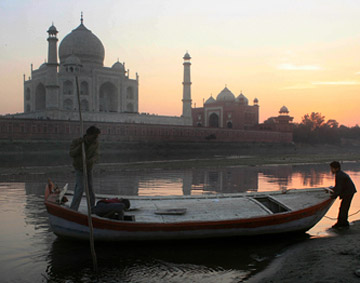
Four days later, while bumping down Agra’s riverside embankment road with my bike’s chain chinking ominously and its gears gnashing, I marveled at a quasi-celestial vision dominating a curve in the silty green Yamuna: smog, crayoned pink and orange by the waning sun, was garlanding the dewdrop domes and gem-embellished minarets of the Taj Mahal, the world’s most gorgeous mausoleum. Close up, however, by the monument’s gates, the Taj’s aura vanished amid cow farts and sales spiels. Under the kindly gaze of Brahman cattle, a crew of buck-toothed touts, banshee-eyed postcard peddlers and pretzel-legged mendicants scrimmaged to accost every tourist arriving, Indian or foreign. I pushed my way through the ruckus, paid a pestering huckster to help me jump a seething, quarter-mile-long queue held in check by baton-brandishing guards, and found myself on the paradisiacal grounds of the Taj. (If I hadn’t arrived so late, I wouldn’t have considered cheating.)
Paradise turned out to be rather stinky. Shoes had to be left at the steps, so hundreds of bare-toed visitors thronged over the Taj’s esplanade, imbuing the breeze with a pungent footy aroma. Nevertheless, I stood in awe of Moghul India’s emblematic architectural masterpiece, which was commissioned by Shah Jahan in the 17th century to house the tomb of Mumtaz, his beloved wife. It took 20,000 workers 20 years to complete the structure, the on-site viewing of which exceeds even expectations heightened by all the guidebook photos and postcard images that most tourists absorb long before arriving. Now at dusk rosy light illumined the Taj’s feminine marble curves, inlaid with precious stones and graced with Quranic inscriptions. Devastated as he may have been by Mumtaz’s death, Shah Jahan expired not from grief but from the raucous rounds of opium-abuse and sex in which he indulged after losing his throne to his usurping son.
Hankering after fresh air, I walked over to the esplanade’s edge. There I squinted and focused on the Taj, and succeeded, for an instant, in shutting out the crowds and seeing it as did the Bengali writer Rabindranath Tagore—as a “tear on the face of eternity.”
On the miry banks of the sacred Yamuna River, in the tumbledown town of Mathura, Hindus hold that Lord Krishna was born, chubby and comely, blue as beryl, apt at antics and heroically inclined. Once settled into a hotel, I hired a wiry and affable quinquagenarian sporting a Mister Softee turban to transport me in his cycle rickshaw over hilly lanes to the temple complex built atop the Shri Krishna Janmasthan (Birthplace of Lord Krishna). Astride the entrance gates towered two 30-foot statues of spear-wielding warriors decked out in armor from the time of the Bhagavad Gita, setting an intimidating martial ambience; between them, Krishna in effigy lashed his chariot’s horses to battle; and, at ground level, a gang of snarling, pink-assed monkeys hustled pedestrians for handouts.
I passed beneath the warriors and through a metal detector, and underwent two pat-downs verging on the obscene from uniformed guards. On the grounds ahead, among clutches of tilak-daubed worshippers, patrolled soldiers shod in khaki slippers, with their automatic rifles at the ready. Only the silvery gray Brahman cows, lazing about with their humps flopping on their ridged backs, looked relaxed.
Krishna, who proclaimed salvation to be achievable in this life, without mortification of the flesh, enjoys wide popularity in India. So why all the uptight guards?
My graybearded guide, Brij, explained. “De birtplace of Shri Krishna is here, almost under de Id Gah Mosque,” he told me, droopy-eyed, pointing a crooked forefinger at minarets and domes separated from the temple by a barbed-wire fence. Relations between Hindus and Muslims in India sometimes erupt into violence, especially since, here as elsewhere on the subcontinent, shrines of competing faiths have at various times occupied the same patches of earth. Muslims had first destroyed this temple in 1017.
Brij presented the mien of a professor emeritus and dressed accordingly (patched sports jacket, frayed cardigan, wrinkled chinos). He spoke grammatically sound English, which didn’t mean I could understand a word he said, at least without asking him to repeat himself. His tongue flapped between sparse stalagmite teeth, turning familiar words into blub-blub approximations or puzzling doggerel. It soon hardly mattered, though. He led me through a hall where an idol of Krishna, wreathed in flowers, more chartreuse-skinned than blue, his curly locks thick and black, sat on a silver-brocaded carpet, beaming beatifically beneath a painting of a parrot-filled tree. I found all the colors beautiful, but I declined a priest’s offer to tilak me, though I ceded to his request for a donation of a few rupees.
We then descended into a subterranean corridor and emerged into a grotto shrine. Sanskrit and Hindi inscriptions decorated the walls around a slab of reddish rock—the god’s birthstone—overlooked by paintings depicting him in childhood as blue-skinned and rosebud-lipped, plump and playful. Votaries surged in, crowding past us, murmuring Hari Krishna! Hari Krishna!, touching their fingers to the rock and then to their foreheads; some kneeled and chanted; the eyes of a few went blissfully lachrymose. Brij and I ended our tour out by a sylvan mock-up of Govardhan Hill, where, beneath pipal trees and palms, water buffaloes, deer, monkeys and peacocks, cast in shiny plastic, had gathered, statically enchanted, to hear a mannequin of Krishna playing the flute.
Brij went on to tell me of Krishna’s slaying of the evil king Kamsa and other exploits. I would have dismissed it as pure fancy, save for the look of mellow piety in Brij’s aged and watering eyes.