
Do Not Demolish
Travel Stories: Kevin Fay recently joined voluntourists still helping to rebuild New Orleans-area homes destroyed by Hurricane Katrina. Judy's house was waiting for him.
08.26.09 | 10:26 AM ET
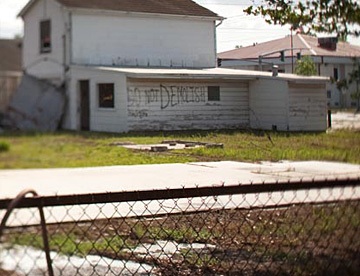 Photo by Allison Chipak
Next door to Judy’s house was an empty lot. Nothing remained but a concrete slab, the footprint of a house—someone’s home—that was no more. The weeds were slowly dismantling the slab, with every intention of reclaiming this land and returning it to swamp. Just beyond the empty lot stood a run-down house with a desperate plea spray-painted on the wall: DO NOT DEMOLISH.
Judy’s house had been scheduled for demolition on Feb. 7, 2009. But when I got there in early May, her house was still standing. In fact, it was nearly rebuilt. Midway through the week, we finished with the tubes of caulk and the sandpaper, and we swept the floors and broke out the paint. I used to remodel houses for a living, and painting the trim was always one of my favorite parts. It means the work is almost done; the house is almost ready to become a home again. Pretty soon people will move back in. They’ll put rugs on the floors, hang clothes in the closets, put pictures up on the walls.
For my wife, Allison, and me, and the other volunteers, it was just one week. Give up a few days of your holiday, do something worthwhile, feel good about yourself. But for Judy, the journey to the finish line had been long and painful. Judy was born and raised in this house in Chalmette, Louisiana. It was the only home she’d ever known. That is, until Aug. 29, 2005.
Slideshow: The Haunting Houses of New Orleans
Like all of the homes in St. Bernard Parish (just outside New Orleans’ infamous Lower Ninth Ward), Judy’s house was rendered uninhabitable by Hurricane Katrina. In the nearly four years since the storm, she’d spent time living in both a FEMA trailer and her mother’s garage; in the last few months, she’d been living in the hospital. Judy had been diagnosed with inoperable cancer, and her health was deteriorating. She’d tried to move back in at one point, tried to start the work of rebuilding, but she didn’t have the strength to reclaim the house, to rid it of the mold, to fight back the weeds.
But then Judy’s friends and family contacted the St. Bernard Project, a local non-profit that rebuilds houses. That’s how Allison and I found ourselves working alongside Joan and Doug, a couple from California who were back for their fourth week volunteering in the New Orleans area. Our little crew of workers was led by Bob, a retired mason and firefighter from Arizona, who had been volunteering for the better part of a year.
In early May, you’ve still got several weeks before the real heat sets in, but it was hot enough. The electric wasn’t turned on yet, which meant no A.C., no fans. Rose and I sat on the front steps, taking one of our frequent water breaks.
“It’s just such a blessing what y’all are doing,” she told me. “Coming here from all across the country, helping someone out that you never met. God’s got a special blessing for you and your wife.”
Rose was Judy’s best friend. They’d both lived in the Parish their entire lives. At this point, Judy was too sick to come and meet us. Talking to Rose turned out to be the most important part of the trip for me. I certainly didn’t feel like I deserved any special blessings, but I did feel, very strongly, the connection that two people share when one person helps another when they need it most.
We knew Judy wasn’t doing too well, and we relied on Rose for updates.
“The poor thing has been through almost 20 rounds of chemo, and her doctor doesn’t know if she can handle any more,” she said. “But I went and saw her yesterday, after I came over here, and I told her how close y’all were to finishing, and she just lit up. I really do think this house is one of the things that’s keeping her going.”
People talk a lot about “voluntourism,” often while rolling their eyes. Maybe it’s the inherent cutesiness of the word. Maybe it’s a backlash against do-gooder liberals. I don’t know, but the bottom line is it’s easy to find fault, to criticize; but it’s actually fairly easy to help out, to lend a hand. Most of us don’t have a lot of free time, or extra money. But a little effort, a small sacrifice, can change someone’s life. A woman was sick, dying, and a group of strangers had taken it upon themselves to make sure she didn’t finish her days in a trailer.
The St. Bernard Project was started by a family friend of mine, an amazing woman named Liz McCartney, and her partner, Zack Rosenburg. The thing I love so much about the work they do, is that they don’t knock down houses and build new ones. They go into your house—the house where you made your life, raised your family, the house that Katrina left for ruin—and they rebuild it. They strip it down to the studs, remove the mold, hang the sheetrock, paint the trim, and they put your house back together again. Since the Project started in 2006, they’ve rebuilt 230 homes in St. Bernard Parish and New Orleans with the help of over 15,000 volunteers. In 8 to 12 weeks, for a mere $15,000, they can bring a family back home.
It’s been four years since Katrina, and New Orleans and St. Bernard Parish still have a long way to go. Houses, families, neighborhoods and lives still need to be rebuilt. But progress is being made. Judy’s house had been scheduled for demolition, but because a group of people, locals and tourists alike, were willing to give a little of their time, her wish had come true. A few weeks after Allison and I returned home, we got a message from the Project: Her house was done; Judy was home. 