
Exiled to America
Travel Stories: Adam Karlin tries to reconcile his love for the road and his love for home
02.11.09 | 9:49 AM ET
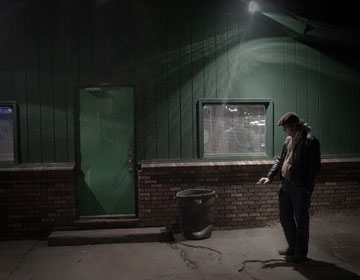 Photo illustration by Adam Karlin
The train cut into the heart of the paddy country west of Hanoi like a slender knife into mud. It made a clak-clak over the velvet silence of the Vietnamese countryside at night, clack-clack clack-clack, like pin drops reflected from the still, silent cross-hatches of waterlogged rice fields that shimmered under the ghost moon.
I was laying on my belly, staring at the villages and huts, huddled and dark indigo but for the sharp, staccato lick of the occasional paraffin cooking flame. The smell of the girl next to me in the narrow bunk, sweat but sweet, fogged my brain.
“I never want to stop,” I said, unable to take my eyes off the window.
“What?” she asked.
The moon flashed like flip-book animation behind copses of palm trees, floating above another village.
“Moving.”
Clack-clack clack-clack, and she turned towards me so I could see the sweat beaded into her dark curls, and her face moved towards mine, and we kept moving.
My mother smiled sadly at me as I stumbled into the kitchen.
“Oh, my wandering son,” she said, and offered me dinner.
She said “wandering” in a way unique to her role, with the gentle but worried inflection that motherhood reserves for itself. When that tone attaches to a word, it casts the term under the light of tender suspicion; to me it said, “I know you feel like you have to travel, my boy, but why not enjoy a bit of home time?”
I didn’t have much of a choice. I was home, for the conceivable time being, having left a girlfriend and a chunk of my heart elsewhere, consigned to the relationship rubbish bin by my mistakes and the thumbscrew tensions of distance. Past the personal, there was a professional reason for me to come home: I had a guidebook to work on, describing the contours of my American backyard.
I wasn’t looking forward to the research. My insistence on moving home to the Washington, D.C., area and my need for a grounded base between assignments to places like Cameroon, Malaysia and the Andaman Islands, had driven an unbridgeable wedge between my ex and me. Now I was at the store counter, gift-wrapping what I had asked for: exile to America
That weekend I drove from Washington, D.C., to Wilmington, wondering how in the hell I could make Delaware exciting, how I could love a place that had caused me to love a person imperfectly, how travel writing and all the associated lure, romance and exoticism I had felt on a night train in Vietnam had landed me in heavy traffic northbound on Rt. 13, bumper to bumper under Dover Downs Racetrack.
An exit onto Rt. 71 loomed ahead of me. I swung my station wagon onto the road. Fifteen minutes later I was walking through the campus of St. Andrew’s School, which you may know as the boarding school from “Dead Poet’s Society.”
It was deep summer, and visiting students and alumni were strolling through the manicured lawns. An old man with an English accent laughed with friends fresh out of the J. Crew catalog. Nearby, some college-age men played Frisbee. Their wealth was evident in their effort to hide it; the cut-off T-shirts, plumeria board shorts, puka-shell necklaces, shaggy white-fros and Frisbee screamed their class more than an accent could, but these were the only distinctive signs of status quo in an institution whose cinematic identity enshrines the concept.
Otherwise, the halls were pinned with syllabi that emphasized critical thinking. Students splashed each other in the cold heart of Noxtontown pond under the brilliant sunlight. I realized this was a co-educational boarding school and not Hogwarts, open to all the raging susceptibility of adolescent hormones. The cliché of the totalitarian academy portrayed in “Dead Poets” was neatly turned on its head.
For some reason, learning that bit of something about somewhere reignited my appreciation of place. The rest of the drive through Delaware—yes, Delaware—took on a new sheen. I listened to Snoop Dogg’s “Gin and Juice” pump over a wedding in the heart of a restored colonial village. I drove up Rt. 9, through fields of marsh grass eructed over a long, low horizon of blue tides and skinny ponds. It’s a land-and-waterscape that gets me stone-heavy with homesick when I’m cut off from it for too long. The tinkle of slow water and the stab of salt wind on acres of sedge grass has captivated me ever since I sank bare feet into the mud of a rural Maryland childhood. The Chesapeake Bay was reminding me: this was what you missed. And past those whispers I realized home was full of the same edges I seek out whenever I travel. Home, in other words, could move.
Driving down Druid Hill Avenue in Baltimore, the kids were jumping in their oversize white tees to hip-hop that thudded between the alleyways. I slowed down at a corner where some dealers glanced at me; when they knew I wasn’t buying, they crossed the street. An old man staggered, leaned and sighed on a stoop under the effect of a brown-bagged 40-ounce. The kids were dancing in good sync, even with the mica-sprinkle from a knocked-out fire hydrant pushing them towards the curb.
I swung around the old Paramount Theater, past the spot where the Sunday farmers’ market takes place, past the Lexington Market where watermen and hunters from the Eastern Shore used to sell dressed muskrat and hand-carved duck decoys, now a place for locavores and slow-food types who consummate an odd marriage of agriculture and bougie yuppie that is occurring at the best margins of American cities.
Driving up Greenmount, past corner shops bedecked with Obama T-shirts and bumper stickers, I stopped into Waverly’s and smelled the good, Maryland smell of Old Bay mingling with beer and watched the good, Baltimore sight of an ethnic ensemble picking and cleaning crabs, joking with each other in a patois of Spanish, Tagalog, Bawlmerese and urban black.
I bought a handle of vodka from the liquor store clerk on Memorial Day weekend, and he smiled at me.
“Heading to the beach?”
“Yeah.”
“Enjoy that,” he said with a friendly wink. I smiled back. Small-town Americana may be romanticized, but when it reveals the real core of its friendliness, you can’t help smiling back.
I was reviewing Delaware’s beaches that weekend. I’ve walked on some of the world’s best sand: in the Thai islands, on the Kenyan coast, South Africa’s Cape Peninsula and under the southern Australian sky. All of the above are, no doubt, prettier than Rehoboth Beach. But between the bachelorette party with the inflatable penis, and the drunk guy from Pennsylvania with a tattoo of an angel-winged alien fetus who pattered on about his unfinished novel, and a tacky apartment decked out in flip-flop themed everything, from Christmas lights to sink handles, and an alt-country band that ripped through a set in the Dogfish Head Brewery, I remembered the distinctive charm the mid-Atlantic possesses in summer, and how much I miss it, even in ostensible tropical paradise.
The muskrat swam slowly up the little neck of an Eastern Shore watercourse, pausing occasionally, the jerky rhythms of its doggie paddle leaving a trail of concave ripples in its wake.
A few minutes down the road, I visited one of the best crab houses in Maryland. It was all-you-can-eat taken to a postmodern level, tables groaning under crabs, fried chicken doused in Tabasco, clam strips, hush puppies and ears of sweet white corn.
A waitress came by with a few more crabs. I looked her in the eye with the pain of a man defeated.
“I’ll pass, hon.”
Her silent stare was the perfect reply; a mix of admonishment, pity and the faintest twinge of disgust at my inability to continue participating in that great celebration of American prosperity: sheer culinary excess.
A little part of me died inside, but a little part of me elated in rediscovering the joys of eating with utter and careless abandon, a carelessness towards food that, as troubling as it may be, is a part of my character, a part of me I sublimate in more reserved, graceful parts of the globe.
As night fell I drove out to the Baltimore docks. That evening, I drank Barbancourt rum in a pizza parlor on North Avenue, ate crab dip in a Latvian bar that radiated Baltimore’s casual menace and affability and knocked on the door of a speakeasy-turned-French-rustic restaurant, where I would later return and joke with a bartender who had gone to my hometown reform school.
I sat on the hood of my car and watched the Domino Sugar sign flash over the inky Patapsco, the ships docked in their ponderous berths with the glow of condensation and 3 a.m. dew just illuminating the outlines of their hulls. The smooth, shared kiss of the river and the night sky, dark as a dream. The booze, salt and shit scent after-breeze of the city ruffled the mirror skin of the harbor and I thought, I am in love.
Home is a difficult concept for any professional who moves for a living. I am that, and more so, I am obsessed with place.
Lately my mind has retreated into its darkest corners, partly because it has tried to reconcile my love of the world and the road—the Adam who never wanted to stop moving—and my love of this place, my home, which gave me the eyes and curiosity that first got me out the door.
I took a swim the other day in the St. Mary’s River, where I have gone since I was a child whenever I needed renewal. I stripped down to my underwear and slipped into the water, the last jellyfish of the summer waving their poisonous goodbyes to the season, the green cool of the place washing my skin and soul. I thanked the world for being so beautiful, for constantly renewing my appreciation of it, even as that appreciation has sent me down roads that are sometimes lonely and difficult.
One day, I’ll strike a balance between the road and home. Until then, I skip stones on the river and thank it again for being so beautiful. Beautiful enough for me to spend a life seeking something to complement it. Beautiful enough to always need its steadying embrace.
When I do stop moving, I won’t, because the river always flows under my skin.