
Feasting in Lyon
Travel Stories: Jeffrey Tayler feared he would never feel as intoxicated with the sense of discovery as he once did. But something clicked when he set foot in France's third-largest city.
09.30.08 | 9:08 AM ET
 The more I travel, or maybe it’s just the longer I live, the more I find elusive the pleasure of novelty, the exhilaration of discovery. I most memorably experienced these feelings on a sunny but cool May morning in 1983, when I stepped off the train from Madrid, where I had been studying during my senior year of college, and walked out into Paris to spend a week. I carried with me little more than postcard notions of the city, but it did not disappoint, bringing to mind, of course, every sort of grandiloquent truism: historic grandeur, aesthetic splendor, romance and haute cuisine. Since then, more than two decades and some 60 countries later, I’ve often thought back on those days and recalled Rimbaud’s words about life, once, “long ago,” being a “feast” at which “all hearts were open,” “all the wines were flowing,” and despaired of ever again feeling so intoxicated with a new place, of tasting anew such bittersweet, yet revivifying, wine.
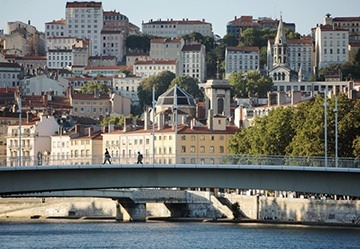
But recently in Lyon, riding on the open upper deck of a Grand Tour bus, I felt tipsy with discovery once more. Evening’s blue pallor was washing over shiny Citroens and Renaults that scooted around beneath us like giant bejeweled beetles. My bus, amid them, skirted place Bellecour, an expanse of raked beige pebbles dominated by an equestrian statue of Louis XIV, the Sun King, and glided down the smoothly paved streets of the Presqu’île (or “Peninsula,” as the commercial center is known) past the glittering gilt shop windows of Praho and Kenzo, Milano and JB Martin. We soon mounted the bridge to Vieux (Old) Lyon, crossing over the river Saône, near where the embankment curved west beneath the labyrinthine hilltop neighborhood of Croix Rousse, the longtime abode of silk weavers.
Above, by the twin belfries of a soaring white basilica atop Fourvière promontory, stood a floodlit golden statue of the Virgin Mary. My audio-tape guide told me that Roman invaders had initiated Lyon’s history up there, founding the military colony of Lugdunum after capturing, in 43 B.C., this part of France in the Gallic wars. But Vieux Lyon, with its mélange of burnt sienna and peach façades, recalls Florence—apt, since Lyon flourished during the Renaissance, following an influx of Italian bankers. It came as no surprise when the tape informed me that, in 1998, UNESCO had designated the arrondissements on both banks of the Saône a World Heritage site—the largest urban environs on Earth so designated, in fact.
An hour and a half later, after having wound up Fourvière’s switchbacks, passed by the basilica (the Notre Dame de Fourvière) and France’s oldest Roman theater, and rolled down to cross a bridge over Lyon’s second river, the Rhône, we pulled back into place Bellecour. I jumped off into the dreamy light, and joined the promenade of elegantly dressed Lyonnais heading toward the outdoor cafés near the Hôtel de Ville.
Though Lyon, with more than 400,000 people, is France’s third-largest city, it has never counted among its most popular tourist destinations. Partly this stems from its reputation as home to a plethora of polluting riverside factories. But also a certain Lyonnais reclusiveness—or bourgeois aloofness, many French would say—has been to blame. Wealthy from its banking, viticulture, printing and silk industries, Lyon, until the 1990s, preferred to repose in relative solitude, doing little to attract tourists.
“Lyon always relied on word-of-mouth advertising,” Blandine Thenet, the press attaché for the municipal Office of Tourism and Congresses, told me the day after my arrival. But, she explained, that changed in the 1990s, with the launching of a campaign to attract visitors, especially business tourists, and the enactment of Plan Rhône and Plan Bleu, development projects that aimed to revive the city’s rives gauches and rives droites, which had suffered damage from now-defunct factories. They succeeded. Tourism, mostly French, has been growing, and (for example) from 2004 to 2005, increased by 7 to 8 percent, bringing in revenues of a billion euros. Among the French, at least, for the first time, Lyon has become branché (cool) or, more colloquially, “in,” to use the English slang they often employ.
What surprised me most, however, was the relative absence of tourists at a time when Paris is full of them. Whatever the stats may be, I found the Lyonnais as unjaded, even solicitous, as the inhabitants of any small town. The driver of my tour bus, a pencil-thin woman in her 50s who looked like a Gallic Pippi Longstocking, in bright red lipstick and candy-stripe stockings, urged me not to buy my day-long tour ticket at such a late hour, and so lose money; my taxi driver spontaneously offered me a free map; and, when I stepped out of the metro holding that map, an old man stopped and asked if he could help me find anything. I have always considered the French reputation for coldness undeserved, but this was all more than I expected.
Wandering through the alleys of the Presqu’île one day, I pored over, with some consternation, the window menus of the bouchons: “fowl poached inside a bladder,” “silk-weaver’s brains,” “death’s fingers” and “tripe gratin.” I hardly knew where to start, what I should start with, or, frankly, whether I wanted to start. But I persevered. Blandine had told me that the bouchons were not just restaurants, but “a Lyonnais way of life.”
I settled on the family-owned Le Garet, a bouchon dating from 1918 that is hidden on a side street of the same name near the opera house. I opened the door on a scene from another time, presided over, of all things, by a reproduction of “The Ricotta Eaters” hanging crookedly between an array of old photos and ancient clocks. In the wainscoted smoky dining hall, patrons sat stuffing themselves, their napkins tucked into their collars, their jaws chomping away. They spoke throaty French through full mouths as they decanted pots (crude greenish demi-bottles) of Beaujolais and Côtes du Rhône into stout glasses, while I sensed an aroma of fricasseeing pork mixed with the bouquet of fresh-cut roses decorating the bar. The spiky-haired hostess, whose orange halter rode up to reveal love handles, seated me at the table d’hôte and urged me, in a squeaky falsetto, to try the quenelle. (“Comment?”) She handed me a menu, and my eyes lit on the first line: “A woman who farts is not dead.” Another Lyonnais dictum followed: “At work we do what we must/In bed we do what we can/But at the table we really try.”
Thus began the first of my many meals at Le Garet, under the direction of its flamboyant, if rumpled, owners and hosts, Agniès and Emmaneul Ferra (a renowned chef, it turned out), who ceaselessly circulated among the checker-clothed tables, taking orders and chatting with their clientèle. This time, I started with a simple salade de marché lyonnais (lettuce, egg whites, bacon, and hot croutons) and quenelle de brochet à la lyonnaise, which turned out to be a fluffy pike dumpling not really to my liking. On following days, rather than deal with the bizarre dish names, I just ordered the menu Gnafron—Gnafron being the worldly-wise wino character from Lyon’s Guignol (puppet theater). Every meal opened with a basket of warm pain campagnard (country bread), crusty and rich, and a pot of red Côtes du Rhône.
To the menu Gnafron. I first dug into a pile of cold peas laced with baby onions and doused in vinegar. A bounty of steamed potatoes arrived next. I ate and ate, unable to stop.
“Doucement!” cautioned Emmanuel.
He finally brought me the pièce de résistance—andouillette vin blanc, moutarde—a pair of truncated pig intestines stuffed with charcuterie and drenched in tart wine sauce. I set to work on it, truly unable to resist, not knowing whether I would down the meal and live to return, or expire then and there, fork in hand.
Unable to finish, I sat back in my seat. Emmanuel slipped a fromage blanc crème in front of me. I spooned it in and raised my head. Emmanuel was still standing over me, his hands clasped behind his back.
“Dessert, monsieur?”
“I thought that was dessert.”
“You thought wrong, monsieur. This is not work or the bed. At the table we must make an effort.” He named three or four sweet dishes, but I asked to be excused with a few slivers of vanilla ice cream. Somewhat disappointed in me, he relented.
On one of my last days in Lyon, after lunch in Le Garet, I stopped by Kiosque Bellecour, a café on place Bellecour. For the first time during my stay, it felt like spring. The sun was shining, bright but not hot, and the snow-covered Alps glistened against the azure on the eastern horizon.
I ordered a glass of Beaujolais from the waitress, a young student with creamy skin and plucked eyebrows, and opened the slim volume of Rimbaud’s poetry I had brought along.“Le Soleil, le foyer de tendresse et de vie/Verse l’amour brûlant à la terre ravie.” (The sun, source of tenderness and life/Pours burning love over the delighted earth.) Rimbaud may have never visited Lyon, but in a city of mostly gray skies and cool and rain, his words fit the moment.
My waitress brought me the Beaujolais and smiled as she set it before me. After a week in Lyon, my life again felt like a feast, and the wine, once more, was flowing.