
Subterranean Gulag Baroque
Travel Stories: In an excerpt from his new book, "Straphanger," Taras Grescoe explores Moscow's extraordinary Metro system
07.20.12 | 10:23 AM ET
 Moscow Metro
 I‘d come to Moscow not only to see the hell emerging on its streets but also to see the paradise beneath them—and because no straphanger’s round-the-world journey would be complete without a trip to the legendary Moscow underground. New York’s subway has grit, London’s Tube has history, and Paris’s Métropolitain has glamour. But Moscow’s Metro, I’d been told, had something I’d never seen in an urban transit system: full-on, unabashed splendor.
I knew I would need a guide to this sprawling museum. Anastasia, in her late twenties, fluent in English and French, had volunteered to play the docent, and we’d arranged to meet at the terrace of a café surrounded by musical conservatories, a ten-minute walk from the Kremlin gates.
I apologized for arriving late. “You took taxi?” she said. “From now on, take Metro. Is fastest. With Metro, you can be anywhere in Moscow in thirty minutes. When you take car, you can never be sure.”
The tour began at Komsomolskaya station. After pausing to applaud a sloppily dressed string quintet’s precisely rendered version of Mozart’s Eine Kleine Nachtmusik, we followed the crowds to a line in front of a ticket booth in a high-ceilinged vestibule. As my turn approached, Anastasia whispered a magic incantation into my ear; I repeated it, and the woman behind the glass handed me a cardboard ticket.
“Diesyet bileti,” ten tickets, is the “Open, Sesame” that unlocks the gates to Moscow.
Every Metro station, explained Anastasia as she strode ahead of me, shares a few common features. First, you will encounter banks of turnstiles, inevitably overseen by grim-faced women in late middle age. When things are quiet, these uniformed babushkas sit in plexiglass booths doing the Cyrillic version of word-search puzzles. When rush hours approach, they run about like fierce little dogs, blowing their whistles at fare skippers and rule breakers. (We watched as one such attendant yelled, in vain, at a long- haired woman in flower-print bell-bottoms and a matching linen jacket who strode willfully through the gates, preceded by a giant black poodle.)
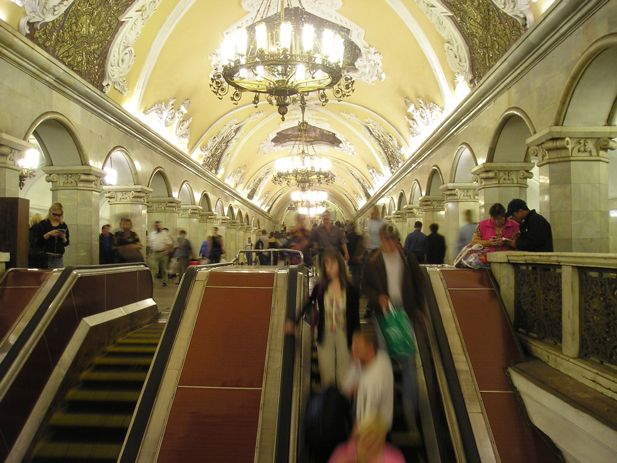
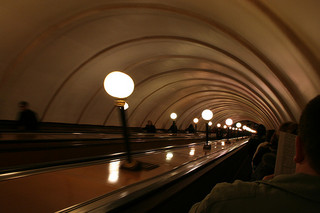
Second, you will see escalators, many of whose risers are still topped with wooden slats, which move fast and go deep. (Really fast and really deep. To give you an idea: though the escalators at Park Pobody, the world’s deepest subway station, are one and a half times faster than those in the London Underground, they still take three full minutes to reach the platforms, which are located 32 stories beneath street level.) As we scrolled diagonally past businessmen in ties, school kids in uniforms, and workers in paint- splattered overalls, the thrumming under our feet felt like an extended drumroll, preparing us for the third and main act: the Zal or central hall that precedes the platforms of most stations, like the victory hall in a baron’s mansion.
“Every Zal has different decoration,” said Anastasia, as we entered a secular temple of late-Stalinist kitsch. Two rows of marble-faced columns topped with Corinthian capitals supported a canary yellow barrel-vaulted ceiling, from which dangled immense circular electroliers, leading to a bust of a supercilious Lenin beneath the gilded coat of arms of the Soviet Union. It was subterranean Gulag Baroque—Liberace’s basement ballroom if it had been decorated by master propagandists. The theme of Komsomolskaya, Anastasia explained, was the Russian fight for freedom through the ages, from Alexander Nevsky’s Battle on the Ice to the Soviet troops’ raising of a red flag over the Reichstag, all rendered in elaborately framed ceiling mosaics. When the station opened in 1952, the last of the eight mosaics showed a half-dozen Soviet luminaries casting the banners of the defeated Nazis in front of Lenin’s tomb. As each politician suffered reverses, his likeness was excised, tile by tile: first Stalin’s chief of secret police disappeared, then Deputy Premier Molotov, and finally Lazar Kaganovich, the man responsible for building the Metro’s first lines. Nikita Khrushchev’s de-Stalinization campaign brought the ultimate retouch: all human figures were replaced by a scowling Mother Russia, who can be seen raising a hammer and sickle in her left hand while crushing a swastika and eagle beneath her bare feet.
“Come, come,” beckoned Anastasia, as a train arrived on one of the side platforms. “We have many stations to see.” We slipped into a Circle Line train, half empty in midafternoon. There is nothing remarkable about the Metro’s aging rolling stock—the heavy-duty trains are painted gun- metal gray and run on wide-gauge tracks on a third-rail system, piloted by grim-faced, underpaid drivers—except for the unforgiving doors, which slam shut with guillotine-like ferocity. What amazes is their frequency. At the mouth of every tunnel, a wall-mounted display counts the seconds since the last train left the station; I rarely saw the counter get past two minutes, and during the rush hours, headways were as brief as 90 seconds—the kind of efficiency normally achieved only by automatic, driverless systems. Most trains are eight cars long, and the Moscow Metro maintains an average throughput of 6.5 million passengers a day—nine million on busy days—giving it the highest ridership in Europe. Globally it is surpassed only by the two separately owned companies that run Tokyo’s Metro.
Anastasia said that rush hour crowding could be awful. “When there are many people, I dislike taking Metro,” she said. Her worst experience happened not on a train, but in the station, as she attempted to leave. “It was Friday evening, on the way to railroad station. Everybody was in a hurry to get a train, but only one escalator was working. I got stuck in the crowd, and spent one hour just trying to exit. I missed my train, of course!”
Our next stop was Novoslobodskaya. “In my opinion,” said Anastasia, “this is the most beautiful station.” I could see its appeal. The Zal was decorated by Latvian artists, who had assembled stained-glass tributes to the life of the mind—a pianist in a tuxedo and tails seated at a piano, an intellectual at a desk bent over a newspaper, a palette-wielding painter at his easel—and the brass frames, pinkish marble, and warm lighting contributed to a sensation of being in an airy, skylit atrium.
The impression of lightness, I found, was strongest in Mayakovskaya station, named after Vladimir Mayakovsky, the globe-trotting Futurist poet who, disillusioned by the realities of Stalinism, committed suicide by shooting himself in the chest after being denied a visa to travel abroad. The station’s theme was “A Day in the Land of the Soviets,” and the ceiling of the central hall featured three-dozen cupolas, each dimpled at its center with an oval mosaic medallion. Anastasia showed me how you had to position yourself below a medallion to view it properly, just as you would to see the all-seeing eyes of the Pantocrator on the dome of an Orthodox cathedral. Each showed an inspiring image of the Russian sky: a zeppelin soaring above a red star-topped skyscraper, a bomber overlying electric power lines, ski jumpers in crimson suits airborne over pine trees. Impressively, the palate changed as you moved down the platform, progressing from the blues and grays of pre-dawn gloom to yellows and whites corresponding to midday in the center, and back to crepuscular tones at the far end.
The Moscow Metro, in the words of its master builder, Lazar Kaganovich, was meant to be a rebuke to the “gloomy, monotonous, and dismal” subways of the capitalist world. He deliberately built its ceilings twice as high as those in Berlin’s U-Bahn or New York’s subway, and decorated it in a manner that “provides comfort, better spirits, and artistic delight” to its passengers, making them feel “as if in a palace.” As we continued to explore, marveling at arches clad in stainless steel, and marble shipped from the Caucuses and Urals or stripped from the original Cathedral of Christ the Savior, I had to concede that the planners of the Communist subway had succeeded where others had failed. For all its lapses into bad taste, the Moscow Metro is the one subway system explicitly designed to ennoble and uplift the long-suffering straphangers of the world.
And Muscovites remain fond of their Metro; people linger on the platforms, and arrange to meet friends in the cavernous Zals. Our last stop was Revolution Square, where seventy-six life-size statues of heroes of the Soviet Union—engineers with rolled blueprints, a schoolgirl with a book in one hand and a rifle in the other—crouch or squat on square plinths beneath arches of red and brown marble. Noticing that the nose of a sculpted German shepherd with erect ears, nestled beneath the arm of a border guard, had been burnished shiny, we asked a young woman in tight jeans why she was giving his snout a good rub. “For good luck, of course!” she told Anastasia.
Our tour ended in the octagonal vestibule of the Kurskaya station, on the Circle Line. Above the heads of striding commuters, pallid caryatids extended their arms toward black Cyrillic characters that circled the room above the capitals of columns.
I asked Anastasia what they meant. “That’s the words of anthem of Soviet Union.” Swiveling her head, she read aloud: “‘Stalin raised us on loyalty to people. He inspired us to labor and be heroes.’ Those are old words. I think they are changed now.”
She hummed a few bars of her nation’s de-Communized anthem, which now speaks of “a holy nation” and “a free Fatherland.”
“Yes,” she said, with a wry smile. “The music stays the same, but the words have changed.”
Back at street level, among the 24-hour Dunkin’ Donuts, Mercedes billboards, and girls in miniskirts handing out free cans of Coke, we exchanged cheek kisses and said our good-byes. Two all-day tickets to this museum of forgotten ideology—this Louvre of the Revolution—had cost us 44 rubles, or less than 78 cents each.
Excerpted from Straphanger: Saving Our Cities and Ourselves from the Automobile.