
Guns, Mom and Guinea
Travel Stories: April Thompson wanted to show off her new West African home to her mother. Nothing could go wrong, right?
03.11.09 | 9:27 AM ET
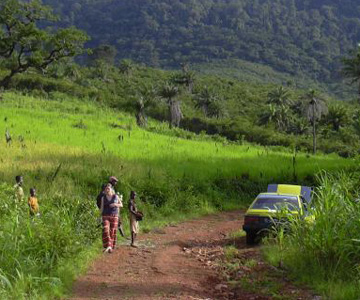 Photo by Aaron Sharghi
The car coughed and wheezed as it ground to a halt at the checkpoint.
“Did you see the guns those guys packed back there?” Mom asked.
“No, but I saw the guns those guys were packing on their biceps,” I quipped, trying to lighten the mood. But mom’s anxiety stirred up my own.
Perhaps we should have checked IDs before we gave these mountain men a ride, but I knew how hard transportation was to come by in these parts. Oh, did I know—that’s partly why my perfectly laid plans to show off my new home to my mother had gotten off course.
I was only three months into my contract as reporting officer for a UN agency in Guinea, a Francophone country on West Africa’s coast.
My stepfather, a Pentagon employee with the inside scoop on State Department travel advisories, urged my mother not to come. Her friends, whose travels were limited to weekend getaways in the Bahamas, couldn’t imagine a mother’s love being strong enough to chance the diseases, the heat, the unrest, the bugs. But my loving mother just had to visit me.
Of course, her journey had an ulterior motive: to see what I was really up to. Was I heeding the traveler’s rule she had read about? (“If it ain’t peeled, boiled or packaged, it doesn’t belong in your mouth.”) Was I altering my routines to throw off would-be kidnappers? Was I was wearing a bike helmet? And, God forbid I should need it, carrying a condom?
I didn’t have a good reputation in my family when it came to traveling. I once spent the night stranded on a Bulgarian mountaintop after climbing the wrong peak. I accidentally brought a terrorist home from Cairo. And I nearly overdosed on a block of hash in Kathmandu. But my mother was known to get in a bit of trouble herself. I recall having to carry her out of a Napa Valley winery after she’d tasted a Chardonnay too many, and one of my favorite family photos shows her play-handcuffed by a flirtatious cop outside a San Francisco salsa club.
Since Mom’s international travel experiences were limited, she was sure only her prayers to an overworked guardian angel had kept me out of a third-world prison. But for all her hand-wringing, I knew from the way she bragged about her daring daughter to strangers in elevators that she admired my globetrotting and didn’t mind occasionally being dragged along for the ride, as long as there was air-conditioning and bottled water.
As a compromise between our travel styles, I had planned a “soft adventure” in N’Zérékoré, the heart of forested Guinea. We checked into the four-star Nimba Hotel, named for Guinea’s tallest mountain. That’s when things started going downhill. The hotel’s electricity, we discovered, only worked from dusk to breakfast. And though I had tried to shield Mom’s intestinal tract with French mineral water, she spent the first night acquainting herself with the hotel toilet. Nevertheless, the next morning we had to get up early to tackle 5,700-foot Mount Nimba. I had arranged for a car and driver to pick us up at 9 a.m. so we could summit Nimba before the sun did. It would be the perfect way to kick off Mom’s visit, I thought.
By 10 a.m. the chauffeur hadn’t shown up. Another two hours passed before my colleague Hablos showed up with a kid named Boiro, our newly appointed driver. The car wasn’t exactly the cushy four-wheel drive with the fancy communication systems I was used to being chauffeured in: there were no seat belts, shocks or a speedometer. Its windshield was a splintered web that looked like it would shatter if you blew on it.
We soon learned we had something in common with the driver—Boiro had never been to Nimba, either. But eventually we arrived at the village at Nimba’s foot, where Jean, an out-of-work iron miner with a serious case of plumber’s butt, offered us his guiding services.
Setting off on the trail, we soon left Jean behind in the heat and dust.
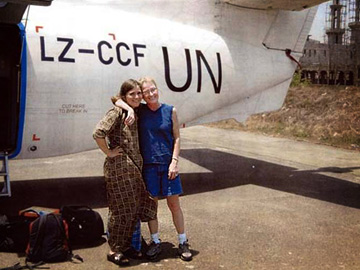 The writer and her mother.
Mom was quietly suffering from a bladder infection that had her squatting in the steamy grass every few minutes. Under the circumstances, a few miles into the hike, we decided to forego the summit and started to descend. It wasn’t until we were two-thirds of the way down that we “caught up” with the guide.
While we were ready to part ways with him and get back on the road, Jean decided to take us to one last tourist attraction: an abandoned shack filled with cylinders of marbleized iron ore, extracted with machines that went home with their investors’ euros once it became clear that Guinea wasn’t going to finish its railroad.
“Normally it is customary now to give something to the guide,” said Jean as he held out our parting gift, a hunk of ore. We grudgingly handed him a folded wad of small bills.
As we boarded our taxi, so did Jean, three of his friends, a couple dozen packs of expired bottled water, and, yes, as Mom would swear later, a few objects that looked suspiciously like guns. Our guide had decided to profit from our presence by riding to N’Zérékoré to sell last year’s swill. The other guys were just going “up a ways.” We were saving Nimba’s delicate environment by carpooling, I told myself. Having a bit of extra time and emboldened by Mom’s easy-going attitude, I asked our driver to take the roller-coaster road to Boussou. Endangered chimps known to use stone tools lurk in Boussou’s bush, and I wasn’t going to leave the area without seeing something wilder than a butterfly.
After we were stopped at a security checkpoint and Mom worriedly asked me about the guns our fellow passengers had packed into the back, I felt ashamed and regretful: What kind of a daughter was I, putting my mother through this ride and torturing her bladder in such an extreme fashion? Only a photo of the chimps juggling stone axes behind their backs could redeem this decision. It had to.
At last we reached Bossou’s chimpanzee research center. Finally, I told myself, Mom would have the Great African Experience: a glimpse of our primate cousins in the wild. The director took us back to his office, put out his official nameplate and ran through the customary greetings that are a prelude to any serious discussion in Africa, asking about my well being and the health of my family.
“Très bien passé, merci,” I replied. The customary answer is always “well,” even if your mother is clearly not. “But do you think we can see the chimps?”
“Désolé, mais c’est le jour du marché,” he said. “Les gens qui s’occupent de chimpanzees ne sont pas là.”
Translation: yes, we have no chimps, we have no chimps today.
I was crestfallen. I had wanted things to go according to plan so badly and had refused to acknowledge that the universe might not telepathically receive and carry out my wishes.
We did the road in reverse. Thankfully the rain waited until we hit the paved roads. Trying to compensate for the broken windshield wipers, Boiro eased off the gas and put on his hazards as rain smeared across the splintered windshield. We sat in nervous silence until we finally made it to the city limits of N’Zérékoré. Never have I been so happy to see the squalor of a third-world city.
Back in the bar of our cushy-chaired hotel, Mom and I raised glasses to another day of survival.
“Tomorrow, we’ll just go shopping, OK?” I said.
This was not the first of our dubious adventures, and we both knew it wouldn’t be the last—not with me as a daughter. I’d come to realize she would never cease to worry, and I would never cease to wander. But I also knew she was secretly proud of my adventures, and I was just as proud to have a mom I could drag along with me on occasion.
When she gets old and I get gray, these are the kinds of tales we’ll be telling the next generation. Already I’ve caught her regaling friends with this story at holiday parties—and the guns get bigger every time she tells it.