
Italy’s Dark Heart
Travel Stories: In the Umbrian hilltown of Narni, Jeff Biggers stands face to face with 2,000 years of grim history
11.19.03 | 9:48 PM ET
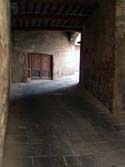 Photo by Jeff Biggers
We were rattling in a local train across Umbria, following the outskirts of la Via Flaminia, the epic Roman road that had wound straight through the Italian peninsula like a cobble-stoned snake for a over thousand years. The older Italian man sitting in front of me, twisting a cigarette in his hands that, due to new laws, he was now prohibited from smoking in our cabin—a twist of fate in this Marlboro-bound country that would have seemed impossible a couple of years ago—couldn’t resist breaking his own boredom with a barzelletta, an Italian riddle that I had heard numerous times in central Italy.
“If you are in search of the heart of Italy,” the older man told me, in a deadpan, confessional voice, “you must go to the town of Foligno.” Two other passengers looked on with knowing smiles; a woman to the old man’s side toyed with reading the leftist newspaper, Il Manifesto. The man continued, animated by his story. “There on the main piazza you will find a billiard hall, and there in the middle of the billiard hall sits a billiard table. At this point you must carefully place an eight ball on the middle of the table.” He paused for the punchline, casting out his eyes for the attention of the others. “There you will find it, the heart of Italy, right behind the eight ball.”
We flattered the old man with a couple of grins. The rather sober-looking woman returned to her newspaper and its headlines about a new law recently passed by the center-right parliament that provides immunity to government officials under criminal investigations. I found the old man’s twist of this old joke—I had heard a different version, which ended with the line that “Foligno was the center of the world”—underscored a dark sense of humor about the country’s self-inflicted misfortune.
I was indeed heading to the heart of Italy, not too far from Foligno actually, that geographical point hailed by the geographic society of Italy as the vortex where all other points converged on the map. Hence the prompt for the Italian’s riddle. I pulled out a map of Italy and showed the older man. The remains of an ancient Roman bridge, once a critical crossing on the la Flaminia, was technically the center of Italy; the bridge led to nowhere now, abandoned to the elements in the forest. Across the Black River Valley, though, the town of Narni perched on a hill like a classic medieval Umbrian hilltown assembled from a quarry, capped by la rocca fort, ringed by stone walls, bracing for a sacking that had plagued its surroundings for the past two thousand years.
Placing the map back into my bag, I withdrew a recently published book that I had been reading on the train, “The Dark Heart of Italy.” Authored by a young British journalist, Tobias Jones, based in Italy, the book is a fascinating journey beyond the bel paese seen by tourists, investigating the largely dark and intriguing post-war history of blatant corruption or political violence now embodied by the mercurial Silvio Berlusconi, Italy’s prime minister and also its richest man. His wealth has been estimated at $14 billion. Jones categorized the Italian leader as the “most unconventional and controversial political leader on the world stage.”
Jones’ book haunted my side journey to Narni with its implications. Recognizing his own inability to sort fact from fiction in a country that thrived on intrigue, Jones quoted one Italian historian who claimed Italy’s post-war history was “partly submerged, dark, not revealed because perhaps not revealable, not mentionable, as if it were the history of a grim divinity.”
I was traveling to Narni because of my interest in its dark secret, one dating back to the medieval period. Unlike contemporary times, one could argue, the story about Narni’s tragic past had emerged and been made public, grim as its divinity might have been. Arriving at the basis of the valley, I departed the train and saluted my trainmates, who had engaged in a lively discussion about Berlusconi. The recent passing of immunity laws, a thinly veiled effort by the center-right controlled parliament to protect the prime minister, who was currently on trial for bribery of a government official in the purchase of a food company, had split the country into volatile factions.
Like many Umbrian hilltowns, Narni looked down on the train station with the challenge of a 240-meter hike. After gauging the distance, I opted for the bus, which put me off in one of the side piazzas, not far from the town center. Heading in the opposite direction, I climbed the cascading staircases on the opposite hillside of the town, reaching la rocca fort and its breathtaking view of the Black River Valley. A deep gorge sliced to the side of the town, whose origins dated back to 600 B.C.
On first impression, Narni appeared dour, its stone façades unkempt, the town in an economic slump. Having arrived at lunchtime, it took me several minutes before I could find an open restaurant. The streets were virtually empty; tables in front of a café outside the main piazza, which stretched long instead of wide, were occupied by a cadre of elderly men, the proverbial quattro gatti, or four cats. The more I walked around the back streets, though, I recognized the serenity of the town. Unlike the Perugia-Assissi-Spello-Spoleto axis, or the boutique tidiness of Gubbio—all gems on the Umbrian tourist circuit-Narni had remained a truly Italian town, unfettered by tourism and its polished transformation, unafraid to show off its backside. I was less than an hour north of Rome but I felt like I had stepped away from the bella figura obsession that covered any blemish in Italy like a fancy gown.
My main interest in Narni, though, was not on its surface; I wanted to explore its infamous underground: Narni subterranea. I met my guide, Roberto Nini, after lunch. He was a wiry, energetic man in his early 40s who carried out some cryptic day job in order to maintain his passion and dedication to the city. One of the founders of the Narni Subterranea Foundation, Nini, along with a brigade of rambunctious friends, had made one of the most important discoveries in the region over 20 years ago. Active spelunkers and adventurers, they had cajoled a local farmer near the San Domenico monastery into letting them descend into a hole on the hillside of the town. The farmer, in fact, had hinted at some mysterious chapel below. Earlier in the century, Narni had suffered an earthquake, which had inadvertently exposed some of the hillside caves.
Nini and his friends, though, descended into another reality, far beyond any water system. They tumbled first into a secret chapel, directly under the monastery. Dating back to the 12th century, the chapel still maintained nearly perfect acoustics; standing before the back wall, you merely had to hum a few bars of music to realize how wonderfully balanced the sound resonated in the chambers. The remains of nearly 900-year-old frescoes of San Michael the Archangel and the “deposed Christ” were intact. Heading deeper into the cave, taking days to remove the rubble that had collapsed from the earthquake, the young adventurers discovered an ancient Roman cistern and the remains of a Roman house. Then they arrived at a wall that had clearly been sealed.
After a long discussion, Nini’s group decided to smash the blocked wall. Crawling through the space, they entered one of the last torture chambers from the Inquisition. Along with finding a plethora of torture instruments, including the ghastly stretching rack, they pushed into another room, discovering the cell of the prisoners. The entire walls and ceilings were covered in graffiti, much of which had been written in code. Nini’s group eventually found a trap door that led directly to the sanctuary of the San Domenico church.
No bigger than six feet by six feet, the cell was an oppressive chamber. The graffiti riddled the walls with the scrawl of desperation, ostensibly etched by fingernails. Contrary to the common perceptions about the Inquisition—that it lasted only a brief period during the Dark Ages—Nini’s group decoded part of the graffiti that dated back to 1759. Symbols of doves (Jesuits), attempting to survive the interrogations of hawks (largely those in the Dominican order who had been given the task if carrying out the Inquisition) had been mixed with Bible verses, dates, designs.
According to Nini, it would have been easy to cover up the discovery and dismiss the whole event as a great adventure. Instead, he and his group of supporters had worked with the monastery and town officials over the past 20 years, largely on a shoe-string budget, to develop the underground chambers into a living reminder of their country’s dark history and the town’s local complicity. Nini was currently in the process of culling through the dark chambers of archives for documents related to the Inquisition. To literally uncover the dark heart of Italy’s past.
I left Narni that evening on the train impressed and buoyed by the town and Nini’s relentlessness. The unveiled secrets of the underground. On the train seat I picked up a discarded copy of La Stampa newspaper and read the headlines about the controversial immunity law and ensuing bribery trial. I threw the paper back onto the seat within minutes. Just old news in this country.