
J. Maarten Troost: Enduring Pollution and Reptile-Laden Lunches in China For Our Benefit
Travel Interviews: David Farley chats with the author of "Lost on Planet China" about the Olympic Games, Tibet and eating not-so-well in the Middle Kingdom
08.08.08 | 10:39 AM ET
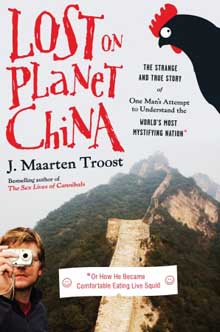 When a curiously titled book called “The Sex Lives of Cannibals” quietly appeared on bookshop shelves in 2004, little did we know that the author, one J. Maarten Troost, would pen some of the most memorable and laugh-out-loud travel prose since Bill Bryson began jotting down his travel experiences. In his book, Troost managed to turn his account of being stuck on a tiny, relatively cultureless, and inactive island into a rollicking read.
Two years later, Troost gave a repeat performance with “Getting Stoned with Savages,” where he, once again, followed his wife to a tiny island nation (in this case Vanuatu and Fiji) and soon found himself knee-deep in hijinks and misadventure. In Troost’s third and most recent tome, he changes gears, taking on China. Though he rarely strays off the beaten path in Lost on Planet China, Troost’s keen eye for the absurd has become even sharper. The result is one of the year’s best travel books. David Farley caught up with Troost via email to discuss China on the eve of the Olympic Games.
World Hum: After writing about island nations in your previous two books, what inspired you to take on a beast like China for your next book?
J. Maarten Troost: In retrospect, I had no idea what I was in for when I set out to do a book about China. I was simply curious. I’d been living in the far periphery of the world for so long that these tidbits of news you now and then hear about China—Lenovo buying IBM, for instance, or the fact that there are more than a hundred billionaires in China—seemed all the more startling. And as I began to read more, it seemed clear that if you’re going to understand this world, you need to understand China. Plus, I like a little dissonance in my life, and nothing is more dissonant than moving from the world’s smallest nations to its largest.
The writing in the book flows smoothly between personal narrative and historical backstory, and you do a particularly fine job of exploring aspects of China’s history while still maintaining your entertaining voice. What kind of research did you do to prepare for the trip and for writing the book?
I read. I Googled. I spoke with everyone I knew who had been to China. But nothing really prepares you for modern China, and so I traveled in a state of saucer-eyed wonder. It was only later, once I settled on the basic structure of the book, that I was able to think through all the issues one confronts with China.
A British friend of mine told me she recently watched a TV show on America’s foreign policy over the last 50 years. The show’s conclusion had a rather surprising twist: if you don’t agree with what the United States has done in the world, just wait until China rules the planet; you’ll be yearning for the good old days of the American empire again. What are your thoughts about the idea that the Chinese will own the 21st century? Are you frightened?
The Chinese regard the past two hundred years, when Europe humbled it with its drug trade and Japan bloodied it with its war, as a historical aberration, a traumatic anomaly. They see the 21st century as their moment to return China to its rightful place among nations—the top. But they are not looking to dominate the world with any kind of ideology. Their model, as far as I could tell, begins and ends with economic growth, and they are as willing to trade with a democracy like Norway as they are with a cruel, authoritarian regime like Sudan’s. The challenge for the rest of the world is how to accommodate China, and in particular, how to respond to the ferocious demand for resources that China’s growth demands. The American way of life, for instance, is predicated on cheap oil. The rise of China ensures the end of cheap oil. So now what?
And correspondingly, how does a world on the cusp of climate change deal with the catastrophic levels of pollution emitted by a surging China? Already today, roughly one-third of all the air pollution found in California originates in China. Those are the kind of issues, I think, that will define China’s relationship with the world during the 21st century.
Throughout your travels in China, people kept telling you—almost warning you—that it’s necessary to look at the country and its customs in the “Chinese context.” Was there a moment when this context came into focus and you could understand things that seem absurd to those of us who haven’t had the privilege of seeing China in the “Chinese context”?
When I first arrived, I wasn’t exactly feeling the love for China. The pollution was apocalyptic. The presence of hideously disfigured children begging on the streets suggested a cruel society. And for all the vaunted economic reforms, this new China seemed to encourage a kind of Darwinism—the strong prosper, the weak are crushed. And yet, after months of traveling, I came to appreciate China, to admire it even, for all that it had accomplished. This is because once you are there, once you are able to live and breathe the history of China, you can contextualize your observations. I felt this most profoundly at the end of my trip near the North Korean border. There across the Yalu River lay North Korea, a brutal totalitarian dictatorship that could not even offer electricity to its citizens. That was China thirty years ago. And today, on the Chinese side of the border, there is light and energy and opportunities. It’s an extraordinary transformation.
What was the most surprising thing you discovered about China?
I was overwhelmed by the pollution, which was surprising, really. I had, of course, known that China was polluted. At no time did I expect my wanderings to be accompanied by crisp, blue skies. And yet, I was utterly unprepared for the environmental catastrophe that is China. From Beijing to Lanzhou and on to Guangzhou and Chongqing, most of China resides in a swirling haze of coal and particulate matter that every year kills more than 700,000 people. One-third of all the freshwater in China is considered unsafe for industrial use, never mind drinking. For all the whiz-bang flash of contemporary China, I think the environment is where the country hits a brick wall.
Given the gross amounts of pollution that you just mentioned, as well as the Chinese philosophy that they’ll “eat anything with four legs except for a table,” would you rather be a long-distance runner at the Beijing Olympics or a contestant in an eating competition in China?
Bring on the Reptile Sampler Platter.
You mentioned in the book that when you were going through customs, you feared they weren’t going to let you in because you’d been critical of China in “The Sex Lives of Cannibals.” In “Lost on Planet China,” you seem to have been shocked and awed into respecting the country, while at the same time you’re also quite critical. Do you think you’ll ever be able to go back?
I don’t know. On the one hand, China has a way of making you feel small and insignificant. The observations of some writer are nothing compared to the larger story of China. On the other hand, China can be a trifle sensitive to how it’s portrayed to the outside world. I suspect I’d be allowed back in. I hope so.
Some people boycott traveling in China because of the Chinese government’s less-than-savory policies—such as their proclivity for killing citizens for what seems to us like minor infractions. What do you think about that ethical debate? Do you think traveling there is a better approach?
I’ve never believed in abstaining from traveling to a country for political or moral reasons. We’re human beings before we are citizens, and while you may find a government unappealing, I don’t think there’s anything wrong with seeing what your fellow human beings are up to in some other corner of Earth. But, of course, these days it’s easy to turn the question around. I live in an area that sees quite a few tourists. Over the past year I’ve noticed a lot of Chinese visitors. Perhaps they object to the Iraq War? Or the U.S. government’s detainment of foreigners in Guantanamo Bay? Or you could go on and on, but I for one, am happy they’ve decided to visit despite their concerns about the U.S. government.
Your chapters on Tibet were some of my favorite parts of the book. After being there, do you have any hope that Tibet won’t be completely decimated a generation from now?
I have little hope for Tibet. I think the railroad to Lhasa is the beginning of the end. Suddenly, Tibet is accessible, and by the tens of thousands the Han Chinese are moving in. Tibet will be crushed by the demographics of China. And the Han Chinese, by and large, do not have soft and fuzzy feelings for the Tibetans. Many regard Tibetans as a primitive tribe with a backward religion. Indeed, they largely resent Tibetans for their ingratitude towards China. From the Han perspective, China has brought money, development, economic progress and so forth to this poorest corner of the country, and the Tibetans have yet to say thank you. So combine the sheer number of Han Chinese with an undercurrent of resentment that flows both ways, and things don’t look so good for Tibet.
What parts of China would you go back to? And where would you not want to go back to?
I would like to return one day to Yunnan and Sichuan Provinces in the Southwest, as well as to Xinjiang Province in the far West. If I never have to spend another day in a Chinese megacity, I’ll be happy.
Do you have any plans for your next book yet?
India, baby.