
Kim Sunée: Travel, Food and the Search for Home
Travel Interviews: Joanna Kakissis asks the author of "Trail of Crumbs" about her journey back to South Korea, the benefits of "not fitting in" and her view of wanderlust
06.02.08 | 2:31 PM ET
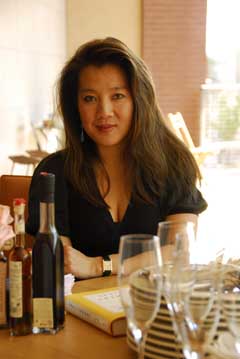 Kim Sunée was 3 years old when her mother left her in a busy South Korean marketplace in 1973 and promised to return. Police found Sunée there three days later, clutching a fistful of crumbs, still waiting. This mysterious separation continued to unsettle Sunée (pronounced Soo-NAY) well after she was adopted by an American family in New Orleans and grew up to be a worldly, well-traveled poet.
Her longing for grounding manifested itself in hunger, both physical and spiritual. Food gave her a way to express herself and connect with others. As a child in Louisiana, she made gumbo and spicy crayfish bisque with her beloved grandfather, who would sometimes wear a great aunt’s wig and talk in a Julia Child falsetto while cooking. In her 20s, she lived in Nice, Stockholm, Provence, Paris and French Guiana and fell in love with the much-older Olivier Baussan, the founder of L’Occitane, the line of natural cosmetics and soaps. They lived together in France, hunting for buried truffles and eating local delights like wild peaches and lemon verbena poached in Lillet Blanc.
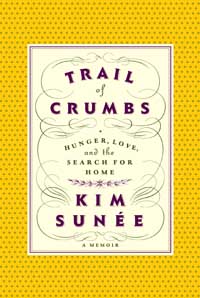
After five years, Sunée left Baussan and eventually returned to the United States. She now lives in Birmingham, Alabama, and works as the food editor of Cottage Living. Her travel memoir, Trail of Crumbs: Hunger, Love and the Search for Home, was released earlier this year to widespread attention. A Korean edition of the book just came out, and a Korean documentary filmmaker has chronicled her search for her birth family. She recently returned from an emotional trip to South Korea. I talked to Sunée about her book and how travel powered her search for home.
World Hum: Your story pivots on the search for home, and it takes you through many passages—South Korea, New Orleans, Sweden, France, China and French Guiana, for instance. It sounds like France was the most comfortable place for you. Why?
Kim Sunée: Perhaps because I’ve spent the most time there and forged relationships that have contributed to my sense of home. I also had a kitchen in France and not really in any of the other countries. But at different moments, I felt comfortable in the other places, as well, but these moments mostly seem related to food—eating a bowl of fragrant noodles at the open market in Cacao, French Guiana, or sucking the head of spicy crawfish in Louisiana.
Is home still an elusive concept? Or do you feel most at home when you’re traveling?
I do feel very much at home when I’m traveling. It’s an odd concept for some, but I truly am most alive when I’m off to another destination. There’s the glass-half-full versus glass-half-empty view of the world—mine is the suitcase always half-packed. I’m also coming to understand that sometimes we need travel in order to better come home. And home is really within ourselves—our sense of self. If we can understand that, then we can really take “home” with us wherever we go in the world.
How did the exploration of local cuisine—like that sensuous wild peach dessert—help ground you in the countries where you were living or visiting?
I think the title “Trail of Crumbs” illustrates this in some part. I think we can find our way home (as elusive or concrete as the idea may be) through food—those taste memories of our lives. And the sharing of these foods and the gifts of the table. I love the recipe for that dish you mention. It’s the first one in the book—wild peaches poached in Lillet blanc with fresh lemon verbena. The name of the recipe alone evokes an entire season for me and everything that happened that time of year at that particular place. But it wouldn’t mean as much had I made the peaches for myself and never shared them with anyone.
You told The New York Times, “Some people travel to see monuments. I travel to eat.” I loved that. Do you believe exploring a country’s cuisine helps you understand its culture?
I want to clarify that monuments, of course, are not to be dismissed, but a country’s cuisine is truly an entry point into the people and the culture and the history of the place. How and where we forage and then cook and share the food—something that occupies much of our day—is so indicative of who we are. There are culinary historians who can express this much better than I can—it’s just my passion and curiosity and guide when I travel.
It’s not that I want to eat only the “bizarre-est” foods when exploring a new country, but I do want to shop with a local, and go into someone’s kitchen, or share a meal with them at their neighborhood joint. That satisfies my hunger for the world more than snapping a few pictures of a monument.
You clearly felt like an outsider in the countries you visited. Did that perspective help you examine parts of the culture that insiders bypass?
I think so. Being a stranger in a strange land really does heighten the senses, makes us much more aware of our surroundings. In my 20s (and in my book), I explored the pain of not fitting in, but now I also understand that as a traveler, the “not fitting in” may be the most valuable travel companion.
You visited South Korea with Olivier in your 20s and recounted the trip in your book. But those scenes were full of tension and dissonance, as if you felt most like a foreigner there.
I really did. And I was. I think it was because I was so ill-prepared for the journey back to my birth country. I had no contacts, no one to show us around or decipher and explain my adoption papers, etc. It’s the first and only time I’ve traveled with a sense of fear.
 Your book made me wonder if there’s a relationship between wanderlust and an unresolved identity—or at least an unresolved sense of home. Do you see such a connection?
This is a very interesting question and, for me, an obsession, so much so that it is a central theme in my memoir. The idea of identity is as elusive as the idea of home, so they are related. Wanderlust is sometimes a more lyrical way of expressing that we don’t know where we really belong in the world, what is our place, and our contribution. For me, home and wanderlust and, even to an extent, this idea of identity are also linked to love, and the hunger and search for it.
Where have you traveled in recent years? What have you savored there? And what countries would you still like to visit?
When I returned from living in Europe, I came back to the South of the United States and have traveled all over the region and the country. I had to go around the world to come back where I started and, in a sense, to rediscover the bounty of this part of the world.
As for other travels, I always go back to France several times a year—because I have family there—my goddaughter and her parents and other friends. I was in Tuscany recently and although I’ve been to Italy many, many times, this past trip was so inspiring, mainly because of the people I met and the food—agretti, the freshest, sweetest ricotta ever, and Sicilian almond granita. I love Mexico but do not know it well enough. I haven’t been to Greece in years, but I’d love to go back. I want to go to so many places. Tanzania, Turkey, Morocco, Québec. I want to go to Croatia, and I’m just dying to get to Thailand and Singapore and back to Hong Kong.
In mid-May you returned from a trip to South Korea where you searched for your birth family. Did you find out anything about them? How did this trip back “home” feel compared to the uncomfortable one in your 20s? Could this journey inspire another book?
I am still overwhelmed by the generosity and hospitality of the Koreans. Seoul is a vibrant, bustling city, yet there remains a deep respect for tradition. The journey was rich. First, my Korean publisher, Minumsa, published the Korean-language edition of “Trail of Crumbs.” So there were press conferences and interviews and TV appearances.
Also, Hongseok Ro, a documentary filmmaker, filmed my return journey—we even went back to the market where I may have been abandoned and to the Star of the Sea Orphanage. The documentary aired in Korea, and it’s also on my website. I’ve also posted some of the delicious—and not so delicious, such as boiled silkworm—food I tasted on the blog portion of my site. I was lucky to be in Korea during fresh crab season. The crab is preserved in a soy bean paste sauce and you just squeeze it into your mouth and suck out the raw crab jelly—it’s absolutely addictive. I also loved the preserved quince tea, fresh spring radish kimchi, “bachelor kimchi,” flying pasta soup and “swimming cow” soup.
The birth-family search—which I didn’t realize I was going to be doing until I got there—was emotionally exhausting. I don’t want to divulge too much about the search, but there’s more than enough for a second book. At one point, another Korean American adoptee poet (who was also searching at the time) and I joked that it was “CSI: Seoul”—between DNA testing and several “brotherly candidates.” The crime: missing or lost children—a whole generation of divided families. And just when you think you’ve found a clue to your past, it’s erased by another theory.
But I do feel like I accomplished what I had hoped in returning to my birth country—to return fearless and with a stronger sense of self.