
Love and Marriage on the Shatabdi Express
Travel Stories: Eva Holland hoped for a romantic boy-meets-girl story from the woman on the Indian train. She didn't get one.
07.27.09 | 11:19 AM ET
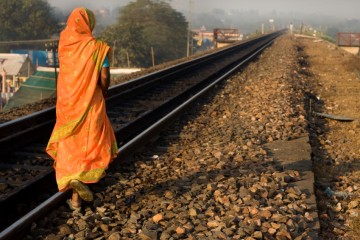 iStockPhoto
It was still dark when I boarded the train to Kalka. I chose my seat and heaved my backpack onto the rack, still in the same sleepy haze that had followed me from a seedy Paharganj hotel to the New Delhi station. Then I passed out with my face against the window; exhaustion had been a running theme of my three weeks in India.
I opened my eyes when the train started moving and watched as Delhi slid by, the train picking up speed as the first light of the new day touched the city. The sidewalk sleepers were stirring. The dust of the city mingled with the dust of the train’s passage, and gradually, the grimy, tangled streets widened into the flat plains of Haryana.
Hours passed, and I woke again. There was a 30-something woman next to me, Indian, wearing a bright blue, school-teacher pant suit. In all my train rides so far, she was the first Indian woman I’d seen traveling solo; the first who wasn’t dressed in traditional clothing, and herding children around the train.
She was also the first to speak to me.
“Where are you from?” she asked, and then, after my reply: “Oh, I’m Canadian, too.”
She lived in Calgary with her husband and two children. She had a master’s in physics engineering, a career and a big house in the suburbs. She’d left India 16 years earlier, with her Canadian husband, and was on her way back to visit family for the first time since.
Outside the window, the flat, dusty fields rushed by, baking under the unrelenting July sun. I asked, “How did you and your husband meet?”
My seatmate smiled cynically, knowingly. If I’d been hoping for a sweeping tale of foreigner-woos-local-girl romance, I was about to be disappointed.
Her husband, the Canadian-born child of Indian immigrants, had returned to the Punjab to find a wife.
“It was an arranged marriage,” she said. Then waited, eyebrow raised.
I blinked and shifted in my seat. I knew about arranged marriages, of course—at some point, I’d read a wrenching young adult novel on the subject, assigned, I’m sure, by a well-meaning teacher. Look how some women live, that book had whispered. You don’t know how lucky you are.
This woman matched none of the characters in that narrative. Arranged marriage, as I imagined it, meant dusty bare feet, youth taken too soon, bearded menfolk around the fire trading women like cattle or cattle like women. It had nothing to do with pant suits, or prairie suburbs, or the overflowing self-possession of my seatmate.
Maybe it was that self-possession, or the sense that she was expecting—even hoping for—a shocked reaction, that let me say: “What was that like?”
“I’m very grateful to my parents,” she said. “It’s the easiest way.”
Did I look skeptical, condescending? Or just confused?
She carried on, holding eye contact with me as she spoke. “The divorce rate now is what, fifty, sixty percent?”
I nodded.
“So, when you consider the unlikelihood of finding ‘happiness’ anyway—why not leave it up to chance? Right? Or make it someone else’s responsibility? An arranged marriage is just as likely to be a happy one as the other sort, you know. Maybe even more so, since it doesn’t have all the baggage of hope. Of expectations that are virtually guaranteed to expire unfulfilled.”
The speech was practiced, provocative—and shockingly seductive. I looked away and out the window to gather my thoughts. The monsoon was past due this year, and the sun-bleached fields were the same color as the Rajasthani desert I’d rolled through on a similar train a few days before. On that ride, though, the Indian women on the train had ignored me even more assiduously than the men, and all of my assumptions about patriarchy and female passivity had remained unchallenged.
I thought about the shelves upon shelves of relationship advice and self-help books in bookstores back home. “Men Are From Mars, Women Are From Venus”; “He’s Just Not That Into You”; “The Rules.” Could there be another, simpler philosophy to live by? “There Is No Such Thing As True Love: Managing Your Expectations,” or “You’ll Never Be Happy Anyway, So Why Bother Trying?”
The sheer pessimism of the idea was darkly compelling, like that quiet urge, when you stare down at Niagara Falls, to fling yourself over the edge and ride the water, adrenaline and fate to some sort of conclusion.
I glanced back at my seatmate, who shrugged at all my unasked questions. She paused, then tried again to explain.
“I love my home,” she said, “and I love my children. My husband and I? We’ve learned to work around each other.”
Heady stuff for a 22-year-old fresh off a break-up with the Long-Term College Boyfriend. And even more so for someone without a stable marriage to admire among an entire collection of grandparents, aunts and uncles, someone rapidly approaching the age at which her father got his first—first!—divorce.
I found myself nodding and saying: “That ... makes a lot of sense.”
We rode in silence until I gave in to sleep again. When I woke up we were in Kalka, my stomach was growling for a meal, and my seatmate was gone.
I headed out into the station, found the platform for the little toy train that would haul me the remaining miles through the Himalayan foothills to Shimla, and gnawed on a granola bar while I waited. I tried to shake off the gloomy fatalism that had gripped me since the conversation with my seatmate. I tried to understand why I found that fatalism so comforting.
I was still grappling with the implications of the conversation when I boarded the train to Shimla. I felt guilty about my unexpected moment of agreement with the woman, and not only out of a vague sense of feminist betrayal. If there’s anything more cliché in the travel hot spots of the developing world than the smugly indignant tourist, high up on her culturally superior horse, I thought, it’s the fawning tourist with the grotesque admiration for the “simplicity” of the lives she sees around her. I didn’t want to pity my seatmate for her arranged marriage—but I didn’t want to envy her, either.
Soon I felt the tug of the train pulling out of the station, and we started our steep, winding journey into the hills. 