
Moments of Normal
Travel Stories: Jenni Kolsky struggles to make sense of the photographs she took at a peaceful beach in war-torn Israel
03.28.04 | 9:42 PM ET
 This past summer in Israel, I found myself bouncing between two disjointed realities. On one side there was the affirmation of life: a sun-drenched Mediterranean beach crowded with families. On the other side there was the prospect of death: the escalating threat of Palestinian suicide bombings at any turn.
As a photojournalist, I have been documenting life in Israel for more than a decade. Fear had never influenced my work before. I choose to take photographs that focus on hope and not on terror, on peace and not on war. But this time my visit was suffused with unease.
My photographs are visual diaries of my experiences, as well as a way of personally understanding contemporary issues in Israel. Over the years, I have photographed the Dead Sea, a peaceful setting physically and economically uniting Israel and Jordan. I have photographed the kibbutz to celebrate Israel’s 50 years of existence and to question the utopian myth I had been raised on. I have photographed the Golan Heights to understand its strategic significance and the way the land lingers between war and peace. Each body of work offers a contrast to the media’s persistent focus on the violent struggle between Jews and Arabs.
 This brings me to my most recent journey to Israel, in the summer of 2003. I was invited by “The Artist Residence” in Herzliya, just North of Tel Aviv. I also received funding and support from the Center for Jewish Culture and Creativity. My proposed assignment was to photograph the streets of Tel Aviv, its architecture, its people and its energy. Yet, as I walked beside rebuilt cafes, recurrently terrorist-targeted bus routes, and too many memorials to the dead, I couldn’t see beyond my fear. With suicide bombings still occurring intermittently and indiscriminately, I was afraid that I might die.
 I believe that my repeated visits to Israel are inspired by the passion of its people: a zest for life, a strong bond with family and friends, fervor for its religions, politics, history, and biblical lands. I am enticed by the heat, the chaos, the spices, the utmost faith and arrogance in each belief. Yet in the past, these extremes were tempered by hope for peaceful co-existence between Jews and Arabs, between Israelis and Palestinians. I loved being a part of that energy, that important history. Now, it appears that neither government nor security presence can offer either optimism or protection. And those passions have born hatred.
 My anxiety felt palpable, yet I felt oddly alone in my perception of danger. The mantra of the Israelis goes something like this: One must live for the moment and not dwell on fate. And the possibility of crossing the path of a Palestinian on a suicide mission was appreciatively hidden for most by the routines of daily life. It would only surface in the moments when kissing a loved one goodbye became an essential ritual. For me, it was all I could think about.
On Sharon Beach at sunrise, surrounded by a people who live for the moment, I was just a few miles north of Tel Aviv in Herzliya. It was too early in the morning for security to be checking bags or for the lifeguards to be on duty. Yet there were throngs of locals walking up and down the beach, exercising, surfing, playing makot (smash ball), and kibitzing. Here it felt safe, in the moments when life is about the pursuit of pleasure, in the moments when you can forget that you are in the midst of war.
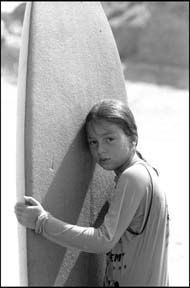
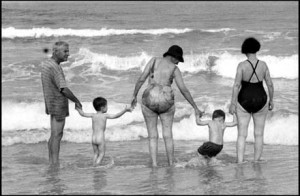
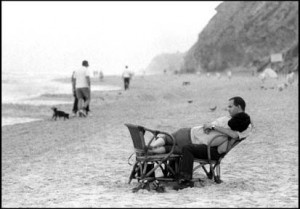
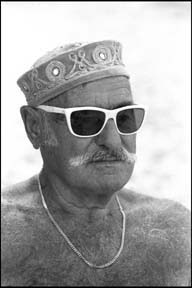
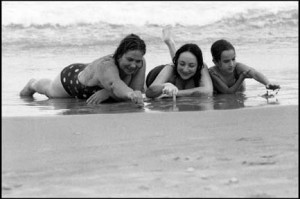 I photographed all that was expected from any beach: young families playing in the sand, teenagers worshipping the sun, pensioners spending time with friends, an abundance of recreation and relaxation. It was easy to lose myself in the visuals: lovers entwined and asleep on a restaurant’s chairs as the sun rises. Three generations of women playing in the sand as the tide goes out. Local boys taking a break from surfing during their last summer before entering the army. Teenage girls smoking rose tobacco from a hookah on the sly from their parents.
 By 9 a.m. each day, the light changed from soft and magical to harsh and unforgiving. One day, so similar to so many others, I sat in a café on the boardwalk and had a typical Israeli breakfast of eggs and salad and cheese. I then bought a newspaper. Two suicide bombs. One at a neighborhood supermarket, the other at a crowded intersection. Ten miles separating Sharon Beach from moments of normal and moments of horror.
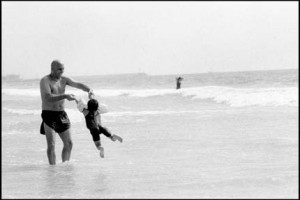 Now home again in America, I struggle to make sense of my experience. How could I justify the portraits I recorded with my camera? I remind myself that I am not a war photographer. Human suffering causes my hands to tremble, a liability when trying to focus a camera. So I offer this explanation: My experience in Israel made me aware of the untimely potential for death, especially my own. So I chose instead to focus on the realization of life, at a sun-drenched beach, with portraits of hope and of humanity, of moments we all live for and take for granted: moments of normal.