
Nicolas Bouvier: the Great Swiss Travel Writer
Tom Swick: On one writer's immense generosity of spirit and openness to experience
12.21.09 | 12:45 PM ET
 I began this year one of the best ways imaginable: in the resplendent clutches of a newly-discovered writer.
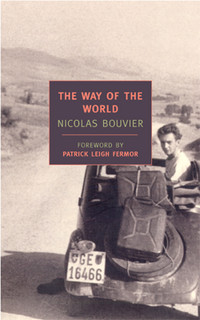
Last Christmas I received a copy of Nicolas Bouvier’s The Way of the World. I had heard of this “classic” by the Swiss travel writer about his journey in the ‘50s through the Balkans, Turkey, Iran, and Afghanistan, and the fact that it came with an introduction by Patrick Leigh Fermor heightened my expectations.
They were quickly met on page 18, when I came across this apercu: “Loafing around in a new world is the most absorbing occupation.” (The crystallization of an idea I knew very well—I was on intimate terms with—but had never formulated.) My hopes were surpassed on page 36 by this stellar sentence: “Sitting in a row behind a table covered in half-empty litre bottles, five gypsies in their forties, five dirty, tattered, wily, distinguished gypsies, strummed their patched instruments and sang.” A writer who can waylay me with the perfect outsider adjective (“distinguished”) and nail a socio-economic milieu with another (“patched”) is someone I would go anywhere with.
As I read, I realized that these two sentences encapsulate Bouvier’s genius: his sorcerer’s talent for conjuring a universal feeling in a line, and his painterly ability to capture a scene with a few omnipotent words. His uncanny and unfailing grasp of the “essence” (of people, landscapes, moments, emotions) was the product of an immense generosity of spirit and openness to experience. He lacked the intense intellectual energy of Leigh Fermor—his writing was less flowery, less encrusted with historical and architectural asides—but he shared the Englishman’s passion and worldliness.
The author bio, on my first American edition of “The Way of the World” (published in 1992), was brief: “Nicolas Bouvier was born in Geneva in 1929. Over the past twenty years he has published five books on Asia, Japan and the Aran Islands. He now works as a freelance photographer.” The thought that such a gifted writer was now making his living through images I found disheartening.
But not as disheartening as the fact, reported by Wikipedia, that he had died in 1998. Farther down in the article I read that, toward the end of the 1950s, “the World Health Organization asked him to find images on the eye and its diseases.” Further Internet investigation turned up a biography, written by François Laut, which had as its subtitle: “L’œil qui écrit” (“The eye that writes”).
I spent quite a long time with “The Way of the World.” Reading Bouvier, you are constantly torn between lingering over an unforgettable line (or paragraph) and turning the page to see what prizes await.
Then in June I learned that I would be going to Japan, and the first thing I did was order The Japanese Chronicles. The cover carried a black-and-white photograph of the author sitting in front of a trio of actors and looking very pleased with himself. It was the first picture I had seen of Bouvier and, to my delight, he resembled an out-of-character Harpo Marx.
The bio in the back filled two pages, and began with a quote from the author: “The traveller is always an enigma. He is home everywhere and nowhere. His is a life of stolen moments, reflections, minute sensations, chance discoveries and odds and ends.” It went on to note that Bouvier delighted in slow travel, and that it was in Japan that he had taken up photography, “to save himself from starvation.”
The book differs from “The Way of the World.” Because Bouvier lived in Japan, he had an intimate familiarity with the place, and the first part is a kind of historical summary, though written in his always felicitous and occasionally aphoristic style. “Here,” he declares, “anyone who doesn’t serve an apprenticeship to frugality is definitely wasting his time.”
The second half is more personal, as he describes living in a temple in Kyoto, spending a long night at a festival in the mountains, asking potential subjects at Cape Erimo: “Is it impossible to take your picture?” He explains: “It is more polite to word the question negatively, and the simpler the life, the more this politeness, which embellishes it a little, is justified.” He moves effortlessly from the concrete to the fanciful and back again. Sent off with strips of freshly-cut seaweed, he writes: “I go my way, chewing on this leathery thing that contains all the tastes of the sea: salt, iodine, hints of a school of anchovies or the oily wake of a cargo ship. Turning it over on my tongue, I even think I can feel the pulse of the tides and the pull of the moon. This takes the place of lunch.”
As with “The Way of the World,” I found myself reading “The Japanese Chronicles” not just for insights into another culture but for lessons in dealing with a gallimaufry of characters and conditions. Bouvier is one of a select group of travel writers who, in addition to conveying an unparalleled sense of place, thrills you with his use of language, rekindles your enthusiasm for travel, and shows you how to make your way, with grace and gratitude, through life.