
One Night in Palestine
Travel Stories: Cory Eldridge only smokes when he's drunk or in the West Bank. During one tense night in Jenin, he goes through a whole pack.
12.08.09 | 10:33 AM ET
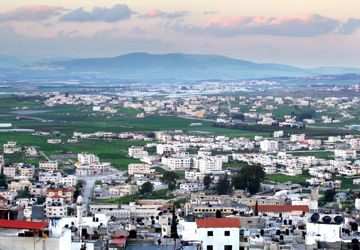 Photo by Cory Eldridge
The first staccato booms rumble as I unpack. They echo off the darkened, encircling hills and rattle down the town’s twisted streets and seem at once a block and a mile away. The sounds fade, and in the quiet I return Jordan’s incredulous look. No, it couldn’t be. Then, with a second succession of explosions, yes. Machine guns. We scurry to our third-story room’s window, lean out, and look toward the sound of the shooting—a refugee camp just a couple hundred yards away.
“What gun is that?” Jordan asks.
“AK-47, maybe. It’s Palestinians shooting; they would have that gun,” I say with untraceable authority.
The shots come sporadically, sometimes close, sometimes distant, and sometimes several at once. I’m looking for muzzle flashes, tracers, explosions even, but the moonlight only reveals a warren of narrow roads and winding alleyways that hide the innards of the camp. Then suddenly, as if in reply, another sound joins, higher-pitched and faster, going kak-kak-kak instead of chung-chung-chung, and the shooting accelerates.
“It must be a fight. A militia must be fighting the Israelis,” Jordan says.
My mind creates a shootout on the street below, with gunmen taking cover in the alleys only to die there. Part of me wants it to happen, for the imaginary battle to come true and in sight. Then the real shooting moves nearer. My heart races and I dig through my bag.
“Just breathe deep, you don’t need the cigarettes,” my lungs say. “You’re not in danger.”
“Screw you guys,” my heart says. “Calm me down, now.”
I scorch my thumb twice with the lighter and snort when I smell the smoke, but my hands stop quivering.
I only smoke when I’m drunk or in the West Bank. The cigarettes calm my ceaseless cringing as I wait for violence and wade through the daily regimen of Israeli checkpoints clogged with disgruntled Palestinians and skittish soldiers, mosque loudspeakers blaring Hamas sermons, and hope-killing poverty. Dangerous events are rare but the everyday uncertainty makes me chew my cheek like gum. I prefer smoke to blood in my mouth.
Though Jordan is an Ohio boy whose trim beard, dress shirts and neat jeans make him America’s tidiest hipster, his mother is Palestinian with plenty of family in the West Bank and Israel. We came to Jenin earlier this night to visit his two uncles, both physicians, and their families.
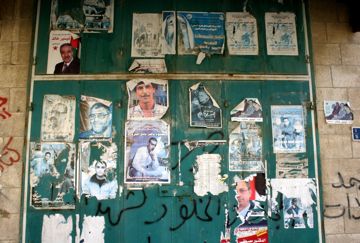 Photo by Cory Eldridge
The city lies in the northern West Bank, five miles from Israel. It grows fantastic olives and, for a long time, suicide bombers and neighborhood-destroying attacks by the Israeli military. A five-minute tour of downtown takes you from the rubble of the Palestinian Authority’s headquarters, which Israel destroyed in an air-strike, to the square named for Al-Muhandis, Hamas’ best suicide bomb belt-maker until a booby-trapped cell phone exploded in his ear. Along the way, posters of the bomb-man’s progeny shroud every house and mosque and shop. The posters show photographs of boys and girls, some smiling, some grim, superimposed on images of Al-Aqsa and the Dome of the Rock. Most were suicide bombers and fighters, others were just kids caught in crossfire. The posters are standard stuff in the West Bank but in Jenin they seem to be a building material. Maybe they’re the easiest way to cover the bullet holes that pockmark most walls.
Unlike most families in town, Jordan’s relatives live in two grand, white-stone houses surrounded by a high, stone wall. The compound includes their ophthalmology clinic, whose door, instead of holding “no smoking” signs, has “no machine guns” stickers complete with silhouetted rifles. Jordan and I came unannounced just before midnight, and only the hospital’s nurse, along with Jordan’s aunt, Manar, and her three daughters, were home. Though roused from bed and in her bathrobe, Manar, a tall, striking woman, insisted we observe the Arabic niceties: tea, pastries and news of our families. Then the nurse showed us to our room, a guest quarters for patients’ families plopped atop the flat-roofed, two-story hospital. No hotel could have matched its hominess or its view of the town.
Leaning against the bedroom wall, I drag out the last bits of nicotine from my third cigarette in 15 minutes and peer out the window. The view faces north toward Israel, where the lights of villages and kibbutzim dapple the valley. At the border the lights stop and the West Bank’s downs rise blackly to us, and even Jenin holds only a few streetlamps. The city spreads east from our window, while a refugee camp, first built after the 1948 war and named after Jenin, lies west. The camp, like most Palestinian refugee camps, is made of permanent, concrete buildings, not tents. During the past 60 years the city and camp melded, demarked by a wandering line invisible to strangers. Every building bears a large, black water barrel for when the city’s water system fails and every power pole sags with an impossible jumble of spliced and jury-rigged wires. About 45,000 people live in the conjoined community. It looks so small and sleepy. And it seems its latest gun battle has stopped.
The only sound now comes from Jordan as he fumbles with a lighter to kindle his second-ever smoke. The snap-snap-snap of failed ignitions distracts me from listening for new noises outside. I chuckle, turn to exhale out the window, and scan the darkness. Nothing, still. Jordan snap-snap-snaps for a sixth time and I nab the cigarette, breathe out to steady my hands, and touch his unlit cigarette to the other’s smoldering end. Just seeing that red ring burn into the paper relaxes me.
As I hand it to Jordan another Kalashnikov, so close, sounds—chung-chung-chung—and we drop the cigarette. Another rush of adrenaline fills my body and sends my head to the place it goes during orgasm. Then the rush, unused by fight or flight, plunges into my stomach and bursts. Bile singes my throat as I swallow it back down.
The shooting comes steadily for thirty minutes. AK-47s rumble—chung-chung-chung—and M-16s shriek their answer—kak-kak-kak. We imagine the noise will be tomorrow’s news: “Three Palestinians and one Israeli soldier were killed when Palestinian militants from Jenin attacked an Israeli checkpoint.”
We sit on the window ledge and watch the night for an hour. After a few pulls, the nicotine steadies Jordan’s hands enough he can light another cigarette himself. Most of the gunshots have moved to the hills beyond the camp. As Jordan exhales the last breath of smoke a red tracer arcs across the sky, flies from the refugee camp, crosses the blackness, and disappears into a cluster of lights inside Israel. The shooting slows but doesn’t die till dawn.
For breakfast Manar fries eggs and squeezes orange juice. The table holds dried figs and apricots, fresh flatbread covered with herby za’atar, green olives and tea with a sprig of mint growing in sugary soil. As we eat, Jordan’s three young cousins tell us about their week at school, who the cute boys like, and their field trip to Jericho. I feel haggard and ancient before their sleep-blessed brightness. I drink another cup of tea. With breakfast done, Manar takes the three girls to buy groceries for dinner.
I go to the roof and light another cigarette and toss the empty pack over the ledge, down to the street. Across it, among the chalky rubble of an exploded building overgrown with tall grass, a white mare nibbles green leaves off a sapling, brushing flies with her tail. An old battered Mercedes trundles toward the camp, bouncing in the potholes and craters, a Kalashnikov riding on the dashboard.