
Paddling Among Giants
Travel Stories: The planet is heating up. The news can be overwhelming. But on a kayaking trip off Maui, Jim Benning found some big antidotes to pessimism.
05.27.08 | 3:28 PM ET
 A quarter of a mile off the west coast of Maui, seated in the front of a two-person kayak, I glided across a glassy sea, enjoying a Hawaiian daybreak. The sun had just peaked over the mountains above Lahaina, bathing the Pacific in soft pink light. The islands of Lanai and Molokai floated on the horizon, their rutted green hills luminous and clear.
A hushed voice behind me said, “Right about here is where the whales like to hang out.”
I’d signed on for a tandem kayak trip with Richard Roshon. He’s been taking visitors out for years to explore the waters off Lahaina. From late November through May, when North Pacific humpbacks gather off Maui, his outings offer the possibility of spotting the behemoth whales close up, from water level, in perfect silence. That’s why I was here.
I’d seen whales from big boats before. I’d always assumed a boat’s hard hull offered some protection in the event that a wayward fluke brushed against it, which I imagined was something like King Kong accidentally brushing his knee against a house.
The idea of paddling among whales in something as small as a kayak was frightening—and alluring. Even by whale standards, humpbacks are big. They’re the fifth-largest whale species and can grow to 45 feet and weigh up to 80,000 pounds. Richard’s Feathercraft kayak, by comparison, is 20 feet long and weighs 100 pounds. Watching humpbacks from such a tiny craft sounded like the stuff of childhood dreams, ancient folk tales, archetypal myths.
I met Richard in his Lahaina apartment a few blocks from the water. “I always like to introduce myself and talk about the kayak at least a day before we head out,” he explained, “and I want everyone to make sure this is the right trip for them.”
Richard spoke about big-wave surfing, and about his solo, weeks-long kayaking expeditions around the Hawaiian islands. He talked about the importance of protecting the whales, a subject he had explored in lectures and a self-published book. He never approaches whales in his kayak, he explained. He paddles out and waits. He said, “My philosophy is to walk lightly and leave no footprints.”
Lean and muscular, with a thick graying beard and big round glasses, he struck me as a modern-day Henry David Thoreau. Only Richard’s pond was teeming with whales.
As I left, he told me he’d call me to settle on the exact day and time for our outing. Weather forecasters had predicted wind and rain. We needed calm seas. Three days later, around 5 a.m., my phone rattled me awake.
“Meet me at the beach in an hour,” Richard said.
Down on the sand, I pulled on a waterproof spray skirt, stepped into the warm water and tucked myself into the kayak’s front seat. Richard gave the boat a push, dipped his paddle into the water and we were off. As the sun’s first stray rays illuminated our way, we passed several boat wrecks. Richard gestured toward a hazy mountain rising off the bow—Mauna Kea, the Big Island’s biggest volcano. Then he pointed the kayak toward deeper waters—humpback territory.
Every fall, thousands of humpbacks migrate more than 3,000 miles from the waters between central California and Alaska to the Hawaiian islands. Many collect in the channel between Maui and Lanai. There, the whales mate, and females give birth and spend the winter and spring nursing their calves, preparing for the long journey back across the Pacific.
Humpbacks are on the federal endangered species list. They face threats from discarded fishing line and drift nets, pollution, engine noise and boat traffic. But for a species that was nearly decimated by whaling several decades ago—there were as few as 1,000 humpbacks in the North Pacific when hunting them was banned by the International Whaling Commission in 1966—humpbacks, amazingly, appear to be on the rebound.
As we paddled farther out, Richard said, “You usually hear the whales before you see them.”
Moments later a deep exhalation echoed across the water.
Pfoooooooohf.
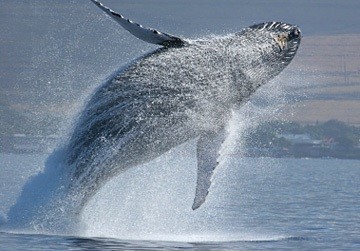
I spotted a small cloud of spray rising 50 yards away. My eyes followed the glistening molecules down to their source: a humpback the size of a school bus, the slick black skin on its hump shining in the light above the ocean’s surface.
The whale’s dorsal fin disappeared and its fluke rose, facing us like the palm of a giant hand.
“Look at that!” Richard said. “She’s saying good morning!”
Then as quickly as she had surfaced, the whale disappeared.
My heart pounded. A wave of emotions washed over me: fear, humility, wonder.
The world is getting smaller every day. More people in more countries are using more energy. The planet is heating up. The threats to all species only seem to grow. On some days, the bad news can be overwhelming, and cynicism comes easily.
But in this little patch of the Pacific, time slowed and I felt a flicker of hope. We humans had made up our minds about something. We’d come together and banned whaling. And as a result, the humpbacks were making a comeback. In fact, we soon saw half a dozen more of them surface and dive, each sighting a welcome blow to any pessimism I’d felt that day.
“I’ve been paddling these waters for thirty-something years now,” Richard told me near the end of our trip. “I never get tired of it.”
I could understand why.