
Interview With Paul Theroux: Invisible Man on a Ghost Train
Travel Interviews: Jim Benning asks the author of "Ghost Train to the Eastern Star" about his new book, aging and the challenge of disappearing in the age of the BlackBerry.
08.18.08 | 5:00 PM ET
 Few travel writers evoke such strong reactions as Paul Theroux. Readers often find him cruel and cold or disarmingly honest and wickedly funny. Regardless, few would deny that his first travel book, The Great Railway Bazaar, published in 1975, gave travel writing a much-needed shot in the arm—and many insist that with it, Theroux single-handedly reinvented the genre. In chronicling that train ride across Asia, Theroux writes that he wanted to “put in everything that I found lacking in the other books—dialogue, characters, discomfort—and leave out museums, churches and sightseeing generally.” It turned out to be a formula for success and the many books that followed—The Old Patagonian Express and Riding the Iron Rooster, to name a couple—made Theroux America’s most revered travel writer.
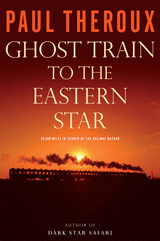
His new book, Ghost Train to the Eastern Star, released today, retraces that first trip. It’s Theroux at his best, and it gave him a chance to reflect on how he and the world have changed in the intervening three decades. I dialed him up at his home in Cape Cod to ask him about it. I’d heard Theroux could be prickly and a difficult interview; I found him to be anything but.
World Hum: Near the start of “Ghost Train,” you write that “The lesson in my Tao of Travel was that if one is loved and feels free and has gotten to know the world somewhat, travel is simpler and happier.” And you also write, “After a certain age the traveler stops looking for another life and takes nothing for granted.” Can you talk about that? Is that to suggest that you enjoy travel now more than you did when you were younger?
Paul Theroux: I feel less pressure to produce something. At my age, I don’t have to write another book. I can kick back and read a book. Or if I go to a place, I don’t necessarily have to make something of it. It might be a trip that’s a dead end; nothing may come of it. When you’re young and you are working as a writer and traveler, everything has to count. I began writing with a kind of anxiety that I had to make a living at it. That was 40 years ago. The pressure to make something your subject is intense when you’re young, because you think, I don’t have a lot of time. I’ve got to turn this into saleable prose.
Strangely enough, when you get older you realize you’ve got a lot of time and a lot of freedom. I think I’m happier now, less tense, less anxious to make something of it. And so when you’re patient, travel is a different experience—when you’re not thinking, I have to go home or this trip has an end. You might think, well, I’ll stay another month; I could get to know people. The older traveler is less optimistic about things, maybe a little more skeptical when people tell him things. All of those are components in the new book, which was written, I think, in a different spirit from the first travel book, “The Great Railway Bazaar.”
In fact, there’s a revelation of sorts in the new book that when you did embark on that first trip for “The Great Railway Bazaar” you were feeling guilty about leaving your wife and children behind. And you returned to find your wife was having an affair. That relationship ended. This time you write that your wife was much more supportive. I imagine that had an impact on your outlook and perspective on this trip.
Yes it did, because you need people to support you. You need people to be very positive about the trip and assume they’re going to be waiting for you, or they’re on your side. When you feel that you’re just slogging along alone feeling homesick, that’s terrible for travel. It’s hard for writing, too. But I think it makes a good story. “The Great Railway Bazaar” is an interesting book for the amount of trouble that it took to take the trip and then to endure this strange homecoming.
Also, I was thinking how older writers write different sorts of books. Take Evelyn Waugh, for example. When he was in his 50s he felt that he was an old man, and he wrote this book, A Tourist in Africa, where he more or less said I’m through with it, travel isn’t what it used to be, the going isn’t good anymore, I’m out of it. And then, still in his 50s, he wrote his autobiography. And then he died when he was around 60, 61. He wasn’t very old. Conrad was 68 when he died. D.H. Lawrence was 44 when he died. These are guys in their late 50s or 60s who took great trips in their earlier lives and then were very old men and out of it in their 60s. I don’t feel that way. Hemingway wrote brilliantly in his 20s and 30s and then still wrote brilliantly, but he was dead at 62 or 63. I’m 67. To me a guy who’s 62 is a young man. He’s not Papa Hemingway with a white beard. Hemingway didn’t really go back to Africa after he was in his 50s. He was done. It was over. It’s amazing when you compare the age. I’m glad that I’m healthy enough to take this sort of trip and I envision taking more. I feel as if I still have the mojo to keep doing it.
Does that mean we may see “The Old Patagonian Express” Redux at some point?
I don’t think so. This was an interesting one because it was the first trip, the longest one. No, I’d like to go to a new place, to places I’ve never been before, of which there are many.
Any places you have in mind?
Well, the Northern Hemisphere. I’ve never been to Scandinavia, I’ve never been to Greenland, I haven’t traveled in Canada, I’ve never been to Alaska. And plenty of other places. I’ve visited Brazil but I’ve never written about it.
You note in the new book that many of the great travel writers never embarked on a return trip, to retrace their steps. You were very aware that you were doing something many writers haven’t done. Did that present any new challenges for you in the way you wrote about the trip?
I had never written a travel book before when I wrote my first book, so I didn’t know what it would be. I know what a book is now, or I know what a book ought to be. And so I’ve learned a lot in that time. If you compare the two books, you’ll see that in the earlier book I wasn’t interested in politics. I might have mentioned the king of Afghanistan or the Shah of Iran, or something like that, but I never took much notice of political life. But I did in this book quite a lot. There’s a difference.
In the new book you write that “being invisible is the usual condition of the older traveler.” Do you find that you’re regarded differently in your travels now than you were, say, 35 years ago?
Oh sure, yeah. Older people are kind of invisible. It is a fact. The older you get, the less you’re taken any notice of. But it’s a great advantage to be invisible. It always has been for me as a writer. I didn’t know that older people were invisible when I was younger. Say an older man is talking to a woman. She actually doesn’t see him. When you’re young, you’re thinking, maybe she’s the one for me. And the woman’s thinking, maybe he’s the one for me. Maybe we can get it together. There’s a thought that runs through the mind of a younger person, it’s the DNA of it, it’s the mating instinct. With an older person, that doesn’t factor into it. An older person buys something, and the woman looks past him and doesn’t see anything. But you don’t know that until you’re older.
I found that interesting. I’m in my 30s and haven’t, I don’t think, experienced that yet.
It happens to everyone, it will happen to you in the fullness of time.
I’m sure it will. On the other hand, I’m not sure this will happen to me. While you may be more invisible because of your age, you’re better known than you were on your first journey. Were you recognized on this recent trip? Did that factor into things?
Uh, no—for various reasons. Not many people read. If I was Stephen King I’d probably be recognized. But I don’t think people stop him on the street and say, “I loved your latest book.” Writers don’t have faces. But I think that’s a good thing. I’m all for it. I would hate to be Harrison Ford, Laurence Fishburne, an identifiable person. I would find it very tiring, very wearying. They can’t come and go as they wish. That’s a tough thing.
 Indeed, you met up with Haruki Murakami in Tokyo in the new book, and I enjoyed the pleasure you took in his invisibility in Tokyo. Even when the two of you were entering the Tokyo subway, which he wrote about so famously, nobody recognized him.
I thought that was really interesting. That’s a perfect example of it. He’s Japan’s most famous writer and no one knows what he looks like. That’s great, actually.
Our reviewer thought she detected more compassion and even admiration from you in the way you wrote about the people you encountered on this journey, more so than in previous books. And I thought I detected that, too. Do you think there’s anything to that? Do you see people differently than you did decades ago?
I think it’s possible. I don’t know whether I’d use the word compassion. More understanding, or attempting to understand things that I would have generalized or written off before. But I think that’s a factor of age. Maybe I’m less of a wise guy. I really don’t know. That’s something only the reader can judge. It’s hard for me to judge. But if you’re saying, do I take people more seriously? Maybe I do. When you’re young and you travel, you don’t compare your life with others’ lives. But when you’ve lived a little, you say, this person is my age but look how different his life has been. When you’re young, you say, my whole life is ahead of me.
This is another reason why it’s amazing and enjoyable to be an older writer. I’m sorry that the older writers of the past didn’t repeat their journeys. At my age, most writers were writing their autobiographies. Graham Greene started his autobiography when he was about my age. Evelyn Waugh wrote A Little Learning when he was about my age. So did Ford Maddox Ford. Conrad wrote a personal record when he was my age. The older writers of the past tended to say, I’m going to tidy up my affairs, sum up my life and then I don’t know, have a cup of tea and go to bed. But I really don’t feel that way. If someone said what do you want to do, I wouldn’t say I want to write my memoir. I’d say I’d like to go to Angola, I’d like to go back to the Congo. I don’t want to sit around saying I was born and this happened and talk about my childhood.
You wrote, “If a place, after decades, is the same, or worse, than before, it is almost shaming to behold.” And you found Romania to be a somewhat sad place. But what place were you most heartened by on this return trip?
Vietnam. The difference between Vietnam at war and in peacetime couldn’t be greater. The Soviet Union morphing into Russia is not that dramatic. Although there are huge changes, it was a place of great fear before. But I think that Vietnam—because we were there, we were fighting, we were dropping seven million tons of bombs on them, and millions of gallons of Agent Orange. We defoliated them, we killed them, we flattened them, and they crawled out from the wreckage and built, I think, a very viable country that we gave them no help with. In fact, up until ‘94 there was an embargo. We only tried to prevent them from developing. And yet they did. They managed without us, so there’s a hopeful thing. People can survive without American aid. If a people are true to their traditions and see themselves as a nation, they can survive and prosper. Certainly that happened in Vietnam.
In the past, you’ve talked about the importance of isolating oneself in one’s travels, making oneself difficult to reach. And the idea that followed from that was that the more one isolates oneself, the more rewarding or powerful the travel experience is. And yet this time you traveled with a BlackBerry, you stayed in contact with home. I’m curious how that changed your experience.
It did change it, to tell you the truth. When you have a BlackBerry you’re in touch. I could run my life, answer emails, log on and so forth. It’s a detriment, obviously. I don’t really want to be in touch. I tried to see the BlackBerry as a device for playing BrickBreaker, that video game like Pong where you break bricks and try to get a big score. I got up to 8,500 points and thought, OK, that’s the use of it. It came in very useful at certain times, I can’t deny that.
On the whole, though it was useful, I’d rather travel without it. But my wife was happier getting messages from me and the reassurance that I was all right. But I think disappearing is part of the job. It’s not to be recommended for everyone. But travel writing is not recommended for everyone. When I lived in Africa, I didn’t have a telephone and there was no internet. I wrote a letter home and they wrote a letter back, and it took six weeks to go back and forth. And that was a good thing. I learned the language as a result, I was immersed in a culture. There’s no refuge. You can’t hide. You’ve got to make friends and deal with people. Now, I suppose Peace Corps volunteers, when they’re having a tough time, call home, they get on the computer, and they sort of disappear and withdraw from the country, and I don’t think that’s great.
Do you think that since you wrote “The Great Railway Bazaar” the challenge for the travel writer has changed?
No, I think the challenge is what it’s always been, which is to make the reader see a place, experience a place, smell the place, hear the voices. It’s like the great challenge in fiction, which is to persuade the reader that he or she is there in the place and seeing it. It’s quite a big challenge, but that’s what it is. It’s to make the place palpable. You know when you’re reading something like that.
There’s a book that I loved, written in the ‘70s, called The Fearful Void by Geoffrey Moorhouse. He traveled across the Sahara on a camel with two Tuaregs, and it’s a thrilling story because he had such a terrible time. He didn’t succeed in crossing the Sahara. He only got halfway. But it’s a thrilling book. There’s always room for those books—someone attempting a difficult trip and then writing about it honestly and well.
The books I don’t have a lot of time for are the frivolous ones: lovable people in Tuscany, or a little treasure of a man in Spain, or wonderful meals. The books about having a great time. I’m not too interested in them. But there are plenty of them because people have the fantasy of ditching their job and going somewhere, saying, why don’t we go live in Italy, or Venezuela, or going to a Greek island, that used to be a big fantasy. These books with lots of sunshine and beaches, they have no interest for me. I did write a book about the Pacific that had a lot of sunshine and beaches, but they in were some dark places.
In that case—you’re referring to The Happy Isles of Oceania, of course—I recall that you wrote about your divorce, too, and that cast a shadow over your experience.
Yeah, I got divorced, and I found some of the people very hostile and territorial. No, I’ve never written about, “Wish you were here, having a great time.”
And you don’t seem to have a great interest in writing a travel book about Hawaii, where you spend part of every year.
It’s very hard to write about a place that you live in. I wrote a novel, Hotel Honolulu, and that’s about as far as I would go. I could write about Hawaii, but it’s a place I want to live in, and I’m still sort of learning about it.
That’s another thing about travel. You can go to a place and write about it, but the longer you live in a place the harder it is to write about. That’s why home is so difficult to write about.
You once wrote that “The challenge for the serious traveler in the age of globalization is to prove that the word ‘globalization’ is fairly meaningless.”
Oh yes. Where did I write that?
It was in the introduction to “The Best American Travel Writing” back in 2001. I liked that, because globalization is a phenomenon that every traveler confronts these days. We see KFCs and Starbucks everywhere. Can you talk about that, about proving that the word “globalization” is somewhat meaningless?
Well you know there’s a book by Thomas Friedman called The World is Flat, which says everything is accessible and people from Bangalore can come to New York and all that. I disagree, I think the world is round. It’s not only round, but it also has dark places. At the beginning of “Heart of Darkness,” Marlow says this has been one of the dark places of the earth, talking about England. England was once dark and neolithic. And then he talks about the Congo and how the Congo was a dark place. Well, the Congo is still a dark place.
A guy called Tim Butcher tried to retrace the footsteps of Stanley going through the Congo, and he couldn’t do it. He wrote a book, it’s called Blood River, I think it just came out, and he proved that the Congo is more difficult to travel in than at the time of Stanley, or he’s not the match of Stanley. Stanley took almost three years to go across the Congo. Butcher took six weeks or something.
You could say, how globalized is that? Well, not very globalized in my opinion. If you’re going to a place like the Congo, which is completely out of touch, it’s not connected, there’s no road, no government, just child soldiers or rebel soldiers ripping you off, that’s pretty tough. How flat is that world? There are places in Brazil, India. Name a country. China. Xinjiang in China. You can talk about how modern China is, and the Olympics and so forth. But eastern China: some of those people don’t consider themselves to be even Chinese. Well they’re not. They’re the Uyghur people, and they’re Muslims. They want to be in a country called East Turkestan. And they object to Chinese domination.
The world is only globalized to a small extant. People come to the United States, for example. They go to New York and say, Oh, I was in Paris yesterday and now I’m in New York, and it’s so much the same. Well, you have to say to those people, go to eastern Oklahoma, go to the Ozarks, go to North Dakota. Yes, New York may seem flat and globalized, but Fargo isn’t. Billings, Montana, isn’t. There are places that don’t have names, that are off the map. It’s presumptuous to assume that we’re all connected. There are people who have gotten nothing out of globalization. Their lives are only getting worse. They’re more neglected. But those are the places that are worth going to, I think.
And yet, as a travel writer and editor, I like to think that one needn’t go to the Congo to write about the world in an interesting way, and that there are places in New York or Los Angeles that are equally interesting and perhaps even untouched to some degree by globalization.
I don’t disagree with you. In fact, I completely agree with you. But I think that you need a method. The United States can’t be written about like other countries. It should be written about. And there are plenty of places in the States that are never written about. Somewhere in the book—I think I was in India—I talked about how accessible India is. India possesses the accessible poor. You can go up to an Indian and ask how much he makes and meet his family, and the accessibility of people way down on the totem pole allows you to write about them. You can’t do that in the States. You can’t go to a small town in the heartland and write about them as though they were tribal people in Asad. You can’t do it.
My youngest son made a documentary in Jackson, Mississippi. I really admire him for it because I don’t know anyone who’s made a documentary or written a book about Jackson, Mississippi, particularly the inner city, the dangerous part of Jackson. You hear about Jackson—it’s the capital and everything’s fine. It’s not all fine. It’s dangerous and difficult and no one writes about it. I’d like to write that book, but I don’t know how to do it. I’d love to write a book about the States; I wouldn’t know how to approach it. But I agree with you when you say, You don’t have to go to the Congo. I totally agree. You should be able to write about anywhere. In fact, people do. But that’s why the travel book is an amorphous thing. No one knows what it is or what it stands for.
There’s a famous 18th-century book called A Journey Around My Room by Xavier de Maistre. There’s actually an edition with an introduction by D.H. Lawrence. You can write that. Thoreau wrote a book about his hometown. It’s a great book. He considered Concord, Massachusetts, the equivalent of Brazil. He even said when a man wrote a book about the Arctic that every observation made in that book about the Arctic could be made about Concord. It’s not true, but that’s what he thought. I’d like that to be the case.
A book that impressed me is Nickel and Dimed by Barbara Ehrenreich. I wish I’d thought of that. I really do. Of getting low-paying jobs and just traveling around the States and finding out how people live. It’s not a travel book, but it’s a book about America that penetrates it.
It seems that every other month some writer is declaring the death of travel writing. Do you read much travel writing these days? Do you read much of what is being published?
I don’t. I read books by my friends. Now and then if a book comes along that’s a real ordeal, I read it. I’m not looking for a well-written book. I’m looking for a book about something that appeals to me, an ordeal appeals to me, a place I’ve never been that’s written about in a penetrating way. I’m not looking for someone just joyriding or a stunt, someone riding a bicycle somewhere or whatever it is. But people used to talk about the death of the novel. That’s a kind of normal reaction to too much of something. But there will always be travel books, as long as there are places to go.
That sounds like a great place to end. Thanks very much.
Photo by Yingyong Un-Anongrak.