
Searching for Neal Cassady in San Miguel de Allende
Travel Stories: Novelist Peter Ferry hunts down the ghost of the beatnik legend who inspired Kerouac, Ginsberg and so many others
05.06.10 | 10:48 AM ET
 San Miguel de Allende (
When I first get here, the only thing I know with certainty about Neal Cassady’s time in San Miguel de Allende is that he died ignominiously just outside of town in 1968. And although that tie is admittedly tenuous, it’s curious to me that people in this artists’ colony who are surely used to outcasts and iconoclasts seem reluctant to claim him. At least at first.
One local historian says that none of the many stories about Cassady, Jack Kerouac, Allen Ginsberg, William Burroughs and Gregory Corso in San Miguel may be true. Another fails to show up for a luncheon date. And the chair person of the local literary sala suggests that we get together the next week, but never calls.
Then there is Suzanne Ludekens, the editor of the local expat paper. She is a tall, toothy, semi-glamorous Australian of Sri Lankan birth and Dutch heritage who is given to dramatic gestures. When I ask her about Cassady, she says that she knows nothing about “all of that,” that she pays no attention to “those things.” When she seems to know nothing about and pay no attention to anything else as well, I put my pen and notebook down. OK. Maybe there’s a kind of let’s-keep-Oregon-secret thing going on here. Is it that San Miguel doesn’t want publicity? “Oh my God, no! We need all the help we can get! The recession is killing San Miguel.”
When I point out that I’m offering some exposure, she continues to stonewall, but when she turns to her assistant and begins to speak sotto voce in Spanish, I almost burst out laughing and get up to leave. She catches me outside. “Go see Lou Christine,” she says. “He knows all about San Miguel’s literary history. He’s in the Berlin Bar every Thursday night after 9. He always wears a pork pie hat.”
Oh boy, this is getting to be fun, and Cassady would have liked that. He was a great lover of fun in addition to being perhaps the most important American literary figure who never wrote much of anything. In the 1950s he was the prototypical beatnik, the restless, rootless, defiant young man in rebellion against the gray flannel conformity of his time. After drifting from place to place, including in and out of prison, he fell in with the Columbia University crowd (he was not a student) that included an ex-football player named Jack Kerouac. He influenced Kerouac to give up writing flowery, sentimental prose and to adopt a hard-edged, hard-nosed stream of consciousness style based on life experience that poured out of him onto a continuous roll of paper. (Truman Capote was later to say of the process, “That’s not writing; it’s typing.”)
And since Cassady was a large and growing part of Kerouac’s life experience, he became the model for most of Kerouac’s heroes, especially Dean Moriarty in “On the Road.” Remarkably, in the years to come Cassady was to serve as a model for characters in half a dozen other novels and movies, and everyone from Tom Wolfe to Hunter S. Thompson to Ken Kesey wrote about him. He and Allen Ginsberg were on-again off-again lovers and it was to Cassady that the poet dedicated his beat epic “Howl.”
But when other beats burned out or slowed down, Cassady kept going. He intrigued the rock lyricists of the ’70s, and The Grateful Dead, The Doobie Brothers and Tom Waits all mention him in songs. He was the driver of Kesey’s famous psychedelic bus “Further” in the long, meandering journey memorialized in “The Electric Kool-Aid Acid Test,” he wandered all over Mexico with other Merry Pranksters, and he died here very suddenly. Neal Cassady had officially done almost nothing, but he had managed to fascinate and inspire some of the most interesting and creative minds of two generations. He’s a person you’d give almost anything to have spent time with. I wanted to find someone who had.
The Berlin Bar is full of smoke and Americans. Lou Christine is sitting at a table with his back to the wall so he can see the door. He reminds me of Mickey Spillane. In addition to the hat, he is with a “doll,” a very, very blond woman who he introduces as his girlfriend, and he talks in a tough guy, South Philly voice a little as if he is doing color commentary in a sports broadcast. Yes, Cassady hung out and died here, and he has heard that Ginsburg, Burroughs, Kerouac, all those guys were here, too. “Wayne Greenhaw was around in those days and knew some of them,” he says. “I’ll call him. Let’s get together Thursday at 3.”
“Oh hell yes, I knew Neal Cassady,” says Wayne Greenhaw. “Used to drink with him in the old Cucaracha Bar.” He says that Cassady was intense and introspective and liked to talk philosophy. “Course they were older, those fellas, in their 30s, and I was just a kid then.” In fact he was 19 and a student at the Instituto Allende. Now he is a handsome old man with a perfectly trimmed white mustache, a salty tongue and a wry sense of humor. He once had a class on the very spot where he, Lou Christine and I are eating lunch on the Instituto’s veranda looking up on the towering pink spires of the town’s famous Parroquia church. “Fact, one time I was in there and here comes Cassady and Kerouac and another fella circling the Jardin [the town’s central plaza] in an old green Mercedes with a naked girl in the back seat, naked girl named Sunshine,” he says. Now according to Greenhaw there was only one old Chevy cab stuck together out of spare parts in San Miguel back then, only about 12 cars all together, and none of them as exotic as that green Mercedes and none of them equipped with a naked girl.
“What year was that?”
“Well, let’s see. Sixty or ’61.”
“Little early for hippies.”
Greenhaw thinks she may have been the first one or maybe a pre-hippy “Anyway, she wanted to go in the Cucaracha like that,” he says. “Now in those days a woman could still get arrested for wearing shorts in the Jardin, and here she was without a stitch on. Someone went and got her some clothes.”
“Who was the other guy?”
“Said he was Allen Ginsberg, but he didn’t look like his picture,” he says. “Might have been Corso.” (Beat poet Gregory Corso used to pass himself off as Allen Ginsberg from time to time.)
“What brought them here?”
“Peyote and pulque, I suppose. Kerouac favored his picture, all right. I’m quite sure it was him.” Greenhaw has it on good authority: his own. A journalist who covered the civil-rights movement and knew Martin Luther King Jr. in the 1960s, he wrote for the Alabama Journal, the New York Times, the Atlantic Monthly and the Miami Herald. He was a Nieman Fellow at Harvard and is a respected historian who has written 22 books, including a biography of George Wallace.
“Are you sure it was Cassady?”
“Oh my yes. Cassady was in and out of San Miguel all through the ’60s. A dozen times or more. And, of course, he was living here at the end.” Greenhaw and Lou Christine agree that Cassady rented a house at Beneficenia #17 that was later occupied by an artist named Don Reuffert. “Cassady lived there with a hippie chick from California named J.B.”
The house in which Neal Cassady lived is on a steep, narrow cobblestone street. Like many Mexican houses, it is a door in a wall. Reminiscent of the man himself, it keeps its secrets inside. I decide not to knock; it’s too early. I turn and look down the hill over the rooftops of the town to the countryside beyond. “Well,” I say to myself, “You’ve seen where he lived. Now go see where he died.”
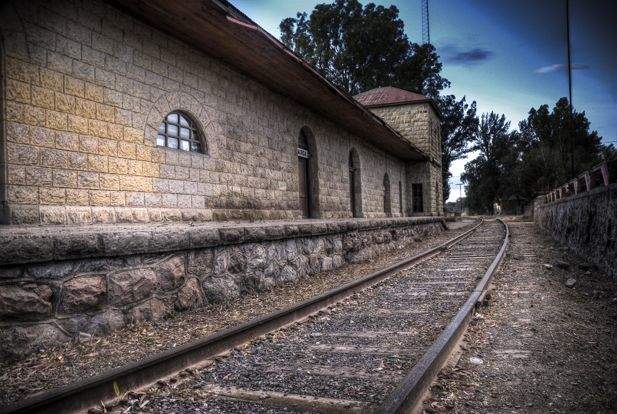
The train station in San Miguel is on the very edge of town. It’s marked with graffiti and many of its windows are broken. The passenger trains that used to stop here don’t anymore, but on its sign you can still read the faded legend “Kilometers 941.3 a Loredo. Kilometers 549.3 a Mexico City.”
I start walking south along the tracks past a loading dock, a water-treatment plant, a squatter’s farm with a house made of scrap, a neat garden, a chicken coop, clothes on a line, a horse in a makeshift stable. In no time I am in the country. Burros graze in the pretty orchards to the west. A jagged hillside covered in mesquite trees and prickly pear cacti rises to the southeast. I zip my jacket against the cool early morning mountain air. Cassady walked these tracks that February night in 1968. He’d stumbled into a wedding party in a nearby village. The local story is that he was very drunk, but was shown hospitality, invited to join in, given food. Later he went off into the darkness.
He was found in the morning beside the tracks right around here, perhaps by farmers like the two who just passed me on bicycles. He was unconscious and was taken to the hospital where he died. An autopsy was inconclusive, but drug and alcohol poisoning were suspected and hard living was certain; the doctor wrote “general congestion of all systems.” Neal Cassady was 41 years old.