
Sleepless in Rangoon
Travel Stories: On his second visit in four years to the same Burmese pagoda, Tom Downey embraces his jet lag and revels in travel's power to reveal change
11.21.05 | 11:41 PM ET
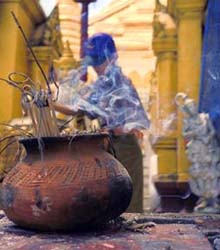 Photo by Tom Downey
A friend counsels me with his remedy for jet lag: Pretend to have insomnia and get an Ambien prescription from the doctor. But I resist. Sometimes jet lag can work wonders. On a February morning I awoke in steamy Rangoon, Burma to a perfect pre-dawn. As soon as I stepped out of range of my over-cranked air conditioner, a blast of heat and humidity hit me. At 4:30 a.m. the heat was tolerable, even pleasant, after a frigid night.
From the balcony of my hotel I could see the shining rings of the Schwedagon pagoda and hear the faint sounds of monks chanting from the hilltop temple, perched on a glorious peak that towers above this port city. I pulled on a pair of pants, threw on a T-shirt and stepped out into the still dark morning with the pagoda as my beacon.
It was still too early for the workaday bustle of the streets to have begun, and the few people I encountered eyed me knowingly, assuming that I was walking off a boozy night. When I reached the grand stairway ascending to the temple, I realized that I had been there before in almost the same circumstances. But this wasn’t déjà vu.
I had been there before, four years before. I had forgotten the exact time of my first visit to the pagoda, but now I remembered wandering these same streets on an early morning even hotter than this one. Then too I had felt the tug of the too early morning, the chance to wander a city virtually alone, and I had been drawn to the nighttime heart of this city: the Schwedagon Pagoda.
For some people there is a distinct pleasure in return: the possibility of gaining greater intimacy with a place you know. For me there is something else. I go back not just to see how a place has changed, but also to see how I’ve changed. Travel offers a rare opportunity to view myself outside of the web of work, family and friends that both defines me and confines me. That morning in Rangoon was like that uncommon diary entry that records not just the movement of life from day to day, but also its larger arc.
I climbed the steps of the pagoda alongside a few lonely pilgrims. Come daytime the steps up to the temple are lined with hundreds of tiny stores selling everything from gaudy trinkets to holy relics. Now the shops were shuttered closed and instead of the polite invitations of shopkeepers to examine their wares, I heard only the muffled footfalls of pilgrims going up the stairs.
The circumstances of this return visit to Rangoon were much different than the circumstances of my first trip. Back then I slept in a fleabag hotel and I awoke early as much from discomfort as from jet lag. I was filled with a restless energy that had propelled me all over the world. That year alone I would visit not just Burma but also Madagascar, Papua New Guinea, and nearly every country in Southeast Asia. I was traveling alone, working a job that was hard to love, and wondering what the future might hold. The four years in between visits had changed me. I was closer now to the pole of adulthood than to post-collegiate life, which was like a second childhood. Now I was traveling with my girlfriend, had just completed my first book, and I had the patience to see the present without the future continually intruding.
When I made it to the top of the pagoda I circled around the base with pilgrims who were stopping to pray at each station. As they stopped along the way to pray of I know not what, I thought about my journey back to Burma. Travel has always been my most reliable record of myself. I can recall my thoughts and dreams 12 years ago on the back of a pickup truck in Sudan more distinctly than my thoughts and dreams last week on the uptown number 2 train.
Going back to a place doesn’t make me feel the same way again. At first I sense the gulf between my old self and my present one. Then I feel the unity: how circumstances can’t really change the stuff that holds me together. And then, after doing that mental work, I look around a little more perceptively.
I sat down on the cool marble and watched small sandalwood flames flicker out into nothingness. Behind them was the pagoda, meticulously cared for and coated in gold leaf. As the flames sputtered out, the pagoda started to shine with the hint of the morning sun. Sunrise is a blink of the eye so close to the equator. Soon the whole golden pagoda was reflecting the dawn. I climbed back down into the city.
Now the place had awakened. The heat was less comfortable. The car engines were poisoning the air and the busy street commerce of the third world had begun anew. I made it back to the hotel and stood on my balcony for a few minutes. It was a different city now. Had I popped that Ambien, I would never have seen that other city, the cool and dark city of dawn, that had seemed a city made for me alone.