
Slumming It: Can Slum Tourism Be Done Right?
Eric Weiner: Global Positioning: On the intersection of place, politics and culture
03.16.09 | 11:57 AM ET
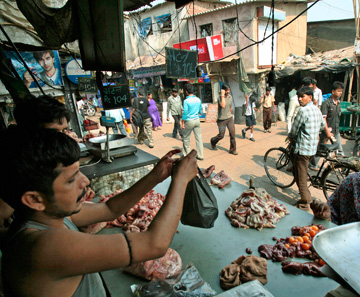 Dharavi, Mumbai. REUTERS/Punit Paranjpe
The global, meteoric success of “Slumdog Millionaire” has, among other things, shined a bright, Hollywood spotlight on slum tourism—or “poorism”—one of the more controversial corners of the travel universe. The tours, which I wrote about in The New York Times last year, were gaining popularity even before “Slumdog” caught the world’s attention. Now, they are red-hot.
Chris Way, founder of Reality Tours and Travel in Mumbai, says business is up 25 percent since the film’s release. Way and his Indian business partner lead groups of (mostly Western) tourists through the labyrinth alleyways of the Dharavi slum, Asia’s largest. There are similar tours of Rio’s favelas (where slum tourism first took root 17 years ago), South Africa’s townships and the garbage dumps of Mazatlan, Mexico.
Few topics in the world of travel engender such heated reaction as slum tourism. To proponents, the slum tours provide a valuable window into the lives of the poorest of the poor and help funnel tourist dollars into the slums. To critics, the tours represent the worst kind of travel voyeurism, degrading and utterly without redeeming qualities.
So which is it? Detestable voyeurism or cross-cultural eye-opener?
The latter, I say, but only if the tours are conducted properly. That’s a big caveat, I realize, so let me elaborate. Here are my criteria for sound, responsible slum tourism:
- Small is Beautiful. There’s a big difference between a group of 50 tourists barreling through the slums on a tour bus and a group of five or six on foot. One is an invasion, the other is not.
- No Photos, Please. Snapping photos is bound to raise suspicions among the slum inhabitants and, justifiably or not, give credence to charges of voyeurism. Leave the camera at the hotel.
- Funnel Profits Back Into the Slums. The good slum-tour companies are already doing this, donating a portion of their profits to help build community centers, clinics and other worthwhile projects. They need to do more.
- Soft Sell. Brochures and websites touting slum tours should not bundle them together with adventure tourism, as if the tours were some sort of cultural bungee jumping. The marketing should be low-key and respectful.
I realize these suggestions won’t satisfy all of slum tourism’s critics. If you care so much about the worlds’ poor, these critics say, just write a check. You don’t need to traipse through the slums of Mumbai to know that there are poor people in the world. True, yet there is a huge difference between knowing something intellectually and knowing it viscerally. Smelling the poverty, tasting it firsthand, is much more likely to stir our hearts—and, hopefully, compel us to write that check or volunteer our time.
The fact is that the controversy over slum tourism says more about tourism than it does about slums. Modern mass tourism is considered entertainment, and, of course, we find the thought of slums as entertainment repulsive. Yet all travel is, to some extent, voyeuristic. Necessarily, we pry into the lives of others. Travel is intrusive and, really, there is no such thing as a no-impact traveler (save the armchair variety).
Besides, are celebrity tours of Beverly Hills any less voyeuristic than slum tours of Mumbai?
I realize the difference is one of wealth and power. The Hollywood celebrities have both, the slum dwellers neither. But the concept, the motivation, is the same. To peel off the veil of a world alien to us.
One of the biggest benefits of slum tourism is that it humanizes slum dwellers. I’ve spoken with many slum tourists, and the most common response is one of surprise that slums are not unremitting misery incarnate. There is life inside these walls, joy even. Slum dwellers do everything the rest of us do—brush their teeth, watch TV, go to work, bathe. They just do so more publicly, and less comfortably, than the rest of us.
I’d even argue that to visit Rio or Mumbai or Cairo and pretend the slums don’t exist seems somehow dishonest. We can’t plead ignorance to their existence—certainly not in the case of Mumbai where the Dharavi slum abuts the runway of the international airport. For most visitors, that fleeting glimpse of the sprawling shantytown is their first—and last—exposure to the crushing poverty and surprising beauty that lies within. That doesn’t seem right.