
Stranded in Sao Paulo
Travel Stories: During the chaos of a Sao Paulo airport workers' strike, Kevin Capp discovered an unlikely ally.
03.18.09 | 9:36 AM ET
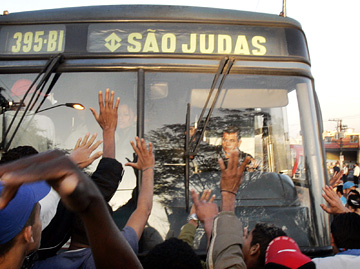 REUTERS/Paulo Whitaker
If the windows separating the terminal from the tarmac suddenly shattered, and if the weakness I felt after the previous night’s debauchery suddenly dissipated, I could’ve hit the plane with a spitball. It was that close.
The time: 9:15 p.m. Scheduled take-off time out of Sao Paulo: 9:45 p.m. In 30 minutes the plane was scheduled to ascend into the troposphere and reduce Sao Paulo and its sea of skyscrapers shrouded in smog to bland playthings for the birds-eye mind.
Then the airline rep picked up her receiver. She said something in Portuguese in a steady but gravelly tone over the intercom, and half the people stuffed in the terminal sullenly gathered up their things and began filing out—a not-so-vague sign.
The rep switched to English and let the rest of us have it: Brazil’s air-traffic controllers had gone on strike. Every flight to and from the country was indefinitely canceled.
Most of the remaining would-be passengers were Americans, and they erupted like frightened geese. My mood swiftly blackened. I was no longer on my way home, but, rather, alone and stranded in one of the most populated cities in the world with enough cash to last a day, maybe two.
As I joined the gaggle of confused and angry Americans standing in line to talk with the airline’s rep, I cursed myself for spending the previous night on the Brazilian island of Florianopolis buying rounds of beers for the friends who’d assembled to see me off. Hope it was worth it, idiot.
Self-flagellation wouldn’t help me, of course, so I started searching the crowd for an ally. I noticed a bespectacled man about 15 to 20 years my senior with salt-and-pepper hair and goatee. Although the hard, frigid reality of the situation tugged at his eyes, he didn’t lend his voice to the American-made thunder. This was the first good sign I’d seen in a while.
In a muted British accent, David said that, yeah, he could use a little company. So we decided to stick together until we figured out what was going on.
I’d yet to explain my money problem, but I figured the passage of time wouldn’t make it any easier. How much better was I going to get to know him anyway? So I dove in and told him that, after spending two months in Florianopolis on a grad school scholarship, I had fewer than $100 left to my name. Could he lend me some cash? I’d been in Brazil long enough to pick up a usable chunk of Portuguese, so I could help him navigate, and I would definitely pay him back.
David said, in what I’d learn to be his reserved manner, not to worry.
We soon learned from the rep that the airline had arranged hotel rooms for us and we’d need to take one of the chartered buses assembled outside to get there. This sounded simple enough, but when we entered the steamy Brazilian night and confronted the calamity of the strike, we realized that just getting on a bus would be an ordeal in itself.
There had to be at least 1,000 people scurrying about. An armada of buses rumbled under the chiaroscuro lighting, filling the air—already thick with heat and the din of a mess of bewildered, pissed-off would-be passengers—with acrid fumes that stung the eyes and nose.
We filed into a line for the bus that stretched the length of two football fields, attempting to absorb the disaster we now found ourselves in. How long would it take to get on the bus? What would the hotel be like? How long would the strike last?
Although we’d been too preoccupied with externals to advance our conversation into the personal, I increasingly began to suspect that David would stick by me, if for no other reason than that he’d waited with me in that super-sized line.
Final proof came about an hour later, when, just before we boarded the bus, an airline worker asked if we’d be willing to room together. David and I didn’t hesitate in agreeing to the proposal: It was a natural outgrowth of the situation made acceptable by our mutual fear and hatred of it.
These circumstances added depth to our surface-level interactions: David and I were becoming friends.
The bus bounced and jostled us through the night. Over the speakers, we heard what sounded like a news report. I could tell the broadcaster was talking about the strike, but I told David I couldn’t make out the details. Wait ... did he just say the strike was over?
A guy riding with us confirmed the report with a shrug, as if to say, “Welcome to Brazil.”
Once ensconced at the hotel, David offered to buy a few rounds at the bar. It was empty save for the suited bartender. That was just fine by us—a rowdy party scene would not do.
David and I had said very little during the bus ride over, doubtlessly because he, like me, needed some head-clearing quiet time after the madness we’d endured. But the beers opened us up to parse the latest development and we agonized further over our predicament.
Who goes on strike for a few hours? How do you resolve a strike in that amount of time? When will we be getting home?
The talk served as a way to ease the strain. Of course, the beer helped, too, but so did knowing that, however much ahead remained unknown, at least we wouldn’t be alone.
Wobbly with booze, we headed up to our hotel room. David ordered more beer and we continued griping until well past midnight, when he decided to turn in.
I lay in bed sipping my beer and staring at the TV’s flickering light. It occurred to me that emergencies compress time, especially when traveling alone. They cut out all the fat that rings our relationships under normal circumstances, and lead us straight to the bare bones: Can we help each other, or not?
The next morning we learned that the airline had set us up at another hotel, from which, over the next three days, we shuttled back and forth to the airport in an attempt to secure a flight home. We lived in limbo, unsure when we’d get back to the States, waiting.
During this interminable process, David bought us cigarettes and drinks. Nicotine and alcohol spiked with anxiety powered the engine of our relationship. Another aggravating factor existed, too: his wife and my girlfriend, both of whom were not happy that we were stranded.
This topic served as the tree from which of our angst-and-beer-fueled discussions branched out. He told me about how he’d moved to Germany after medical school. About how he’d met his German wife. About his German-speaking kids. About his house in the Arizona suburbs.
I told him about my life as a grad student. About living in Vegas. About my girlfriend, who was really freaking pissed that I wasn’t home yet after two months abroad. David’s wife wasn’t freaking out, but she was bitching for other reasons, as though he had any control over the matter. That’s why, Kevin, you should love them, live with them, but never marry them.
David and I weren’t friends—we were brothers-in-arms.
Eventually, I got a hold of my father, who dropped some money into my account; and, eventually, David and I snagged a flight home.
As we were checking out of the hotel, David overheard the clerk give the amount I owed in long-distance charges. Wordlessly, he offered me his credit card. Thanks to my father, I was able to pay my bill and David knew it, but he extended his card anyway, as if it were his duty.
I didn’t say how touched I was at his continued generosity, but I think it was understood. When you know someone well, the silences are often packed with just as much meaning as the words.
David and I didn’t speak for a long time after we parted ways at the airport in Dallas on our way back, finally, to our respective homes. Like me, he was doubtlessly readjusting to his world and confronting “real” life’s quotidian pressures, which were waiting for me, at least, like a stalker.
And then, unexpectedly, on the one-year anniversary of our ordeal, I received an email from him that managed, through a curious mixture of surfer-like jive, ironic posturing and a spray of exclamation points, to capture the absurdities and frustrations of those few days trapped together:
“Dude
Where you at?
I’m stuck in Sao Paulo !!!!!!!!!!!!!!!!!!!!!!!!!!!!!!!!!!!!!!!
Help !!!!!!!!!!!!!!!!!!!!!!!!!!!!
Later
David”
That’s right: With time and distance separating us from the strike and Sao Paulo, David and I could finally laugh about what had once driven us both crazy and close—as friends so often do.