
Surviving Paradise
Travel Stories: Visiting Fiji in the midst of a coup, Jim Benning stumbles over the line that divides stimulating anxiety from real fear. He has the T-shirt to prove it.
05.10.01 | 1:09 AM ET
The middle-aged Australian travel agent looked at me as though I had just requested a one-way ticket to Hell.
“You want to go to Fiji?” she sniffed. “Haven’t you read the paper?”
She had reason to wonder. The South Pacific archipelago known for turquoise waters and tantalizing white-sand beaches had leapt from the travel section onto the front page. Armed rebels had just taken the prime minister hostage, and a mob had run through the capital city, Suva, burning and looting businesses.
It wasn’t the best time to visit the islands. I’d always dreamt of going to Fiji, but the way I’d imagined it, my only fear would have been getting a little too crispy while dozing in a beachfront hammock, or dinging myself on sharp coral while surfing off one of Fiji’s famed reefs. Violent mobs and AK-47-toting guerrillas never entered into the equation.
Two weeks into a trip to Australia with my girlfriend, Leslie, I’d received an e-mail from an editor at an online journalism Web site asking that I go to Fiji, all expenses paid, to write an article about an Internet newspaper there covering the rebellion. (“Getting that story would be quite a coup,” he wrote.) I called the U.S. consulate and asked about the hazards. Dozens of journalists were there, I was told, and so far, none had been harmed. “You’ll probably be all right,” a clerk offered. “But things can always change.”
I was sold.
“It sounds like an adventure,” Leslie said. “Go, but you better come back in a couple of days. I didn’t come all the way to Australia with you to travel solo.”
Now all I had to do was convince the travel agent.
“Why don’t you go to New Guinea,” she insisted. “It’s very nice this time of year.”
I politely declined and left her office with a round-trip ticket. On it, in bold type, was a disclaimer: “Traveler has been advised of turmoil in Fiji.” I read the line over and over. Each time, it rattled my nerves. Yet I also felt a surge of adrenaline. I liked it.
Some degree of risk is inherent in all travel. That’s the hook. We gamble that the rewards of each journey will outweigh the dangers. It’s a seductive wager, and I’d felt the addictive high it engenders many times: walking through terrorist-targeted bazaars in Istanbul, touring bombed-out neighborhoods of Belfast. I’d felt a pang of anxiety in each instance, yet had always returned enriched, with a deeper appreciation for the world’s complexities, as well as for the comforts of home.
This time, the risks were greater, yet so were the potential rewards. Fear at reasonable levels heightens my senses. The world becomes sharper. People, places, experiences burn brighter. Yet I’d always known there is a theoretical boundary out there, a point at which fear would work against me. In Fiji, I’d push that boundary, perhaps even cross it, and I’d learn something about myself.
My plan was simple: I’d spend only as much time in Fiji as necessary. I’d fly to Nadi, the low-key tourist hub, the first day; take a short flight to and from Suva, the troubled capital where I’d do my reporting, the next; then return to the safety of Australia the third.
The flight over was surprisingly mundane. Air Pacific, no doubt hoping to encourage what little tourism into Fiji remained, made no mention of the nation’s troubles. As we neared Nadi’s airport, in fact, a welcome video joked, “These days, sumptuous meals greet visitors to Fiji, but in the country’s cannibal past, the sumptuous meals were visitors.” Few of us were laughing.
I cleared customs and carried my bags out the airport’s front doors. A warm, moist breeze washed over me. Palm fronds clattered in the gusts.
I had little idea what to expect. While I’d read that the violence had been contained in a small part of Suva, a city two hours away, I couldn’t imagine the rest of the country being unaffected. After all, martial law had been imposed, and tensions between Fiji’s ethnic Indians, who comprise 40 percent of the country’s population, and indigenous ethnic Fijians, who felt they were being squeezed out of wealth and power, were at the heart of the rebellion. The country’s Fiji Indian prime minister was still being held hostage. The ethnic Fijian rebels were still angry. The U.S. government was still warning its citizens away. Nothing had been resolved.
I walked down the airport’s driveway. Several uniformed soldiers chatted nonchalantly, rifles dangling from their shoulders. I crossed a narrow highway and walked to a small resort several hundred yards away, its parking lot empty but for a few cars, its modest rooms melting into the landscape. Beyond the gates, vast green fields stretched in every direction. Lush rolling mountains rose in the distance, their tops obscured in velvety white clouds. A mile away, the blue Pacific shimmered.
I checked into a room and asked about the local situation.
“Everything’s peaceful,” said a Fijian clerk, smiling politely. She wore a long tropical-print dress and a bright red flower in her hair, but she looked forlorn.
“Not much business, huh?” I said.
She frowned.
“The tourists are scared. They’re canceling trips. They see the news and think all of Fiji is bad. It’s only Suva. Now our people are losing jobs. We just want it to end.”
I walked out to the swimming pool to look around. A sullen bartender, backed by bottles of tropical rum, played absent-mindedly with a cocktail umbrella, waiting for orders. Several dozen lounge chairs dotted the patio, their seats devoid of lazing bodies. I spotted a lone couple soaking their feet in the water and asked about their trip. “It’s been great,” the man said in thick Australian. “The travel agency tried to convince us to go to Tahiti instead.” He shook his head. His lobster-like complexion suggested he was more than happy to spend the week cooking in this exact spot. “This place is empty,” he chirped. “It’s perfect.”
Perfectly awful, I thought. Get me another banana daiquiri, barmaid, and don’t bother me with your silly political turmoil. The resort wasn’t sleepy; it was catatonic. I called a cab to take a 15-minute ride into Nadi’s town center.
“You don’t want to go there,” the cab driver, an Indian man, insisted as I got into the car. “You want to go to a beachfront resort. It’s much nicer.”
“What’s wrong with the town?” I asked.
“Nothing.”
“Then I’d like to see the town.”
After a few minutes on country roads, we suddenly found ourselves in the middle of Nadi, stuck in bumper-to-bumper traffic. We sat in the same spot for five minutes. Then the driver came clean, telling me what he and the hotel workers hadn’t wanted to reveal. Nadi, too, was plagued by ethnic troubles.
“Every business here is owned by a Fiji Indian,” he said. “They’re scared that their shops and restaurants will be torched and looted, just like the ones in Suva.” Since the coup, Fiji Indian business owners in Nadi had locked their doors early and left the city en masse, creating gridlock. The military had erected barricades, blocking the streets.
“It’s been like this every night lately,” the driver sighed.
“Are you worried?” I asked.
“We’re all worried,” he said. “The rebels have a lot of sympathizers around here. Who knows what will happen? I go home each night, surrounded by others like me, and just pray the crazy men don’t target us.”
That night, I awoke with a start each time I heard the faint hollering of men in the distance.
The next morning, I boarded a twin-engine plane for the 20-minute flight to the capital. Once in Suva, I’d planned to find an ethnic Fijian cab driver to take me to the Internet newspaper’s downtown offices. Since the ethnic Fijians were the aggressors, I reasoned, I’d be safe in one of their cars. They wouldn’t attack one of their own.
I couldn’t find one at the airport. Only two cabs sat out front, both driven by Fiji Indians. I finally picked an aging sedan driven by a sharply dressed, gray-haired man, hoping wisdom or experience or the Hindu gods would see us through.
We drove toward the center, passing single-story modest homes and businesses, and by several military checkpoints, where armed soldiers studied the contents of passing cars. Burned-out business buildings, testaments to the violent mob that had stormed through weeks earlier, came into view. Finally, we stopped in front of a blackened storefront. An acrid, smoky odor wafted from the ashes. The Internet office, the taxi driver said, sat across the street.
My eyes darted up and down the road, searching for signs of normalcy. Young men and women hurried by in business attire. A couple of aging Fijian men walked past in pressed button-down shirts and long, dark sulu skirts. I made a beeline for the building.
Upstairs, the website, Fijilive, was produced in several small adjoining offices. Half a dozen ethnic Indian men in slacks and button-down shirts studied computer monitors, pounded on keyboards and chatted on the phone. A poster of model Elle MacPherson dominated one wall. The Backstreet Boys played on a small radio, apparently having conquered Fiji without a single shot fired.
For the next five hours, I talked with several editors and reporters about the coup. One younger man had a look of shock I’d once seen in the eyes of a mother whose son had just been murdered. The editors recounted the horror they’d felt the night the mob raced through town. They’d extinguished the lights in the office and shut off the elevator, fearing an attack. Through it all, with TV transmissions down but the Internet still up, they offered the only accounts of the coup to the outside world.
Their stories shook me. I took a cab back to the airport and caught the last flight to Nadi, thankful to escape Suva. The next morning, I arose early, relieved that I’d be returning to Australia. I checked out of the hotel and walked to the airport.
I found the Air Pacific desk dark and unattended. The information board above offered no details of a flight out that morning. In fact, all of the airline desks were dark, and the airport was nearly empty.
I walked over to a travel office to inquire. The lone agent frowned.
“Flight’s cancelled,” she said.
“What?”
She pointed me to an Air Pacific office upstairs.
I raced up a dark stairway. The office was closed, its doors locked. I’d have to wait an hour for the morning staff to arrive.
I paced the hallway, recalling what the clerk at the U.S. consulate had told me before my trip: “Of course, things can always change.”
Then another troubling thought hit me: Perhaps things already had changed. Violence could have broken out overnight. Maybe that’s why the flight had been cancelled. I could be stuck here for weeks, months even. For the first time, I began wishing I’d never come.
Finally, a clerk opened the door. He was surprised to find me with a ticket for today’s flight. It had been cancelled days ago.
“You mean I was sold a ticket for a flight that had already been cancelled?” I said, my voice rising to a shout. He nodded.
“Unbelievable,” I yelled.
Not to worry, he replied. He explained that a flight would be leaving for Sydney the following morning. He offered to put me up in a hotel for the night and to get me on the flight.
“I don’t want to stay another night,” I protested.
“No flights,” he insisted.
He called the hotel, asking them to send a car.
My pulse raced. Leslie was on a bus to Brisbane, en route to meet me. I’d have no way to reach her.
“Any chance tomorrow’s flight could be cancelled?” I asked.
“Could happen.”
I was dropped at another resort a mile down the road. A few Asian tourists sipped tropical drinks by the pool. I went to the resort’s office and sent Leslie an e-mail, explaining the situation, trying to put the best face on things. Then I walked out to the pool and flopped down in a plastic lounge chair. It was late morning. The sky was a clear, aquamarine blue. The rising sun beat down on my chest. A gentle breeze rustled the palms. I was in paradise, and I was miserable.
As night fell, I struggled to sleep.
I awoke at dawn and arrived at the airport early. The lights were up. Passengers sat with bulging luggage, chatting. I checked in for my flight and was promptly handed a boarding card. I smiled for the first time in days.
Finally, I thought, back to stable soil. I headed for a small souvenir shop loaded with “Fiji paradise” beach towels, postcards and baseball caps. Trying to decide between a tropical fish refrigerator magnet and a “Fiji” ball point pen to mark my trip, I overheard a man with an Australian accent ask the clerk matter-of-factly, “Have any coup T-shirts?”
The Fijian clerk slowly brought his index finger to his lips. “Shhh.”
He disappeared into a back room, then returned a moment later with a small stack of cotton Ts. I hurried over to see.
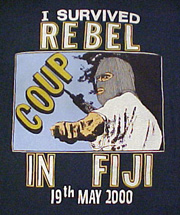
“I’m not supposed to have these,” the clerk whispered. He unfolded a shirt, carefully ensuring that the design faced away from the door. The front featured a masked gunman pointing an AK-47 skyward. It stated, “I SURVIVED REBEL COUP IN FIJI, MAY 19, 2000.”
I was struck by the unabashed entrepreneurial spirit that would dream up such shirts. Instead of dismissing them altogether, though, I thought about that word, “survived.” I may not have suffered an attack by a torch-wielding mob or a masked gunman, but I had survived a rough time. I’d seen fear in the eyes of many of the Fijians I’d met. And I’d felt real fear in my own. Coming to Fiji, I knew I might cross the boundary that divides invigorating fear from something darker. This time, being unable to leave the country under such chaotic conditions, I crossed that line. I felt something I never had in my travels to Cuba or Istanbul or even Belfast. I felt utterly vulnerable.
I pointed to the T-shirts.
“I’ll take two,” I said.