
The Mad Matatus of Kenya
Travel Stories: In an excerpt from "The Lunatic Express," Carl Hoffman spends a sweaty, noisy, desperate 24 hours in Nairobi
03.16.10 | 10:42 AM ET
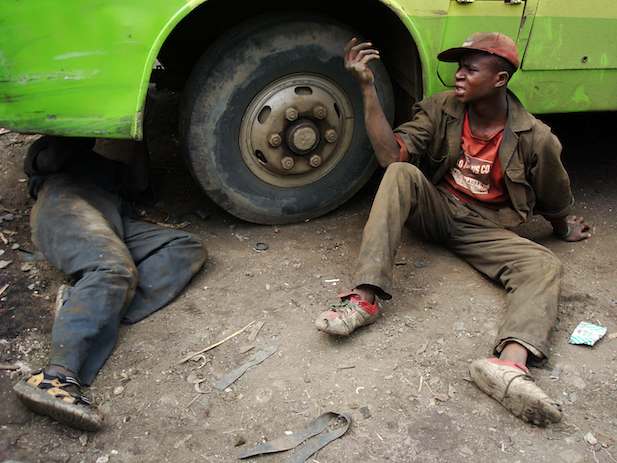 Matatu mechanics in Nairobi (Photo by Carl Hoffman)
In the history of dangerous conveyances, Kenya’s matatus stand out. Daniel Arap Moi, the country’s former president, once called them “agents of death and destruction.” In 2004 they caused 3,000 deaths and 11,989 accidents. I wanted to ride them and by luck I found David Wambugo, lounging in his taxi in downtown Nairobi, his feet up on the open doorway. There were thousands of taxis and they were all hustling me, but something about Wambugo caught my eye. He had shoulder-length dreadlocks and the whites of his eyes were as red as if they’d been caught by a too-close camera flash, but there was kindness in them. I hired him to take me to the house where Karen Blixen, the author of “Out of Africa,” had lived, and on the way back into town I asked him if he knew any matatu drivers that I could spend the day with. Yes, he said, and in minutes he was on his cell phone and it was all arranged: He’d pick me up at my hotel at 5 the following morning.
It was still dark the next morning when I left my hotel, and there he was. “Come on,” he said, “they have picked up the matatu and they are on their way.” The streets were still empty, the air cool but smelling of smoke; we were meeting the matatu at its staging point at the Nairobi train station. But even blocks away, we suddenly hit standstill traffic. “There is a problem at the stage,” he said. “Too many matatus.” He swerved onto a side street, cut through traffic, taking a winding, indirect back way. “I have been awake all night, but I am very sharp!” he said, skidding around a tight corner. “We drivers eat mira”—the mildly narcotic drug known elsewhere as qat chewed throughout the Horn of Africa and the Middle East—“and this makes us alert on the road. It is not like beer. Beer you cannot take, but mira you can take and drive. You have to eat first because this juice will not let you eat until the next day. Me, I have not slept or eaten in 36 hours.” Wambugo didn’t own the taxi; he only had access to it two or three days a week, so he chewed qat and drove without sleeping as long as he had it.
Suddenly there we were—at a semicircle packed with matatus, like a thousand ants trying to squeeze into the same hole, all honking and belching exhaust into the darkness. They were all on the very same route, the 111, operating between Ngong Town and the central Nairobi train terminal. “You see, the competition has already started,” Wambugo said, opening a folded piece of paper and extracting two green twigs of qat to chew, while smoking a cigarette.
 Wambugo spotted a green Mitsubishi bus slightly bigger than a minivan. “OK, there’s my friend, let’s go,” he said, introducing me to driver Joseph Kimani and tout Wakaba Phillip. It was just getting light; hundreds of matatus, from 14-passenger minivans to 51-passenger buses, were angling, squeezing, honking, pushing, to navigate a semicircle that they entered empty and left full. Kimani, 32, with a wispy mustache and a wiry body, worked the wheel and gears, while Phillip, thirty, ran back and forth waving his arms, shouting and banging on other matatus, trying to leverage Kimani through the madness while enticing passengers. (That’s not all Phillip did, but the other stuff I didn’t see, never saw—it was all too quick, too fluid, too under-the-radar—and didn’t even learn about until midnight, 17 hours later.) Competition was fierce. Every matatu, after all, was angling for the same passengers.
The semicircle was 150 yards, tops; passing through it took nearly 45 minutes—think the tank scene in the film “Patton.” Matatus with names like King of the Streetz and Homeboyz were jumping the curb onto the sidewalk, parrying, jockeying, blocking one another’s doors; when we broke free Phillip swung up into the doorway and we blasted up Ngong Road, an undivided two-lane strip of cracked blacktop, with the Bee Gees—there was no escape from them, I was learning, anywhere in the world—at deafening volume.
As he worked the gears and lurched along, Kimani told me he’d been driving matatus for seven years, after a brief career driving trucks. Phillip was moving up; he’d been selling vegetables on the street until two years ago. “Business was bad,” he shouted over the music. “I was very poor.” Both had climbed out of bed around 4 this morning, and picked up the matatu in Ngong Town, in the shadow of the Ngong hills, not far from where I had gone the day before to see Karen Blixen’s coffee farm. Or what’s left of it. “I had a farm in Africa…” is one of those famous literary opening lines, but her elegiac words recall a different, colonial Africa. When we hit Ngong Town an hour and a half later, it was a miasma of overcrowded mud and trash and corrugated shacks, with the occasional rail-thin, six-and-a-half-foot-tall Masai warrior looking like a Hollywood extra still in costume waiting at a bus stop. One man’s pierced earlobe was so long it was wrapped up and double-tied through its hole. The staging area was a football-field-sized patch of mud and banana peels and corn husks and cigarette wrappers and crushed plastic water bottles surrounded by four-foot-square market stalls.
We pulled in, Kimani and Phillip shouted, “Come, Mr. Carl, it’s tea time!” and leaped off the bus. We crossed the mud, crossed the muddy road, waded through garbage, wolfed down fried dough and a somosa and sweet, milky tea in a concrete room, and hit the staging area again. That’s when the complexity of it all started to hit me, the minute economic scale spread over as wide a net as possible. A small army of touts fanned out to fill the bus. “Forty, forty, forty,” they called. “Fortytown, fortytown, fortytown,”—40 shillings to Town. The touts were freelance; Phillip would pay them each 40 or 50 shillings for their work. And ours wasn’t the only matatu; there were dozens here, all doing the same, hiring the same freelance touts, a series of ever smaller layers, both cutting into the profit and spreading it out over as many people as possible.
Back and forth from Town to Ngong we went all day as the traffic built; in places it took 15 minutes to move two blocks—wall-to-wall, bumper-to-bumper matatus honking and flashing their lights and blasting music, some with monitors pumping out music videos. Each matatu spat a continuous, visible plume of gray exhaust, and the fumes were intense, overwhelming. Kimani kept the music at earsplitting volume, from Marvin Gaye to African melodies to Britney Spears, just as the volume had been cranked on the films on all the buses in South America. In America people flipped out if you talked too loudly on your cell phone; in the rest of the world there was so much noise, the very idea of silence was unheard of.
The road had no lane markings and barely a shoulder; for mile after mile it ran past makeshift market stalls and men hauling heavy, two-wheeled carts. Kimani rarely actually stopped the bus—Phillip was like an acrobat climbing over passengers to collect fares, hanging out the doorway to spot them and hurry them on and off the vehicle, banging on the side and whistling loudly to signal Kimani.
On it went, at a grueling pace, the economy of it all hard to grasp. A 14-passenger matatu cost 70 shillings to ride; in a 15-hour day it could make six to seven round trips, taking in 6,000 to 7,000 shillings, about $100. Riding a 51-passenger matatu cost 40 shillings for a vehicle that moved more slowly; it only managed five to six round trips in a day. For passengers the bigger one was slower and thus cheaper; but for the driver and tout, the bigger matatu was better, the volume adding up to more income. Still, a driver and tout like Kimani and Phillip made about KSh 600 a day—10 dollars—paid in cash at the end of every evening. Maybe. “It’s a good job,” Kimani said, his eyes darting from the mirrors, his feet and hands always in motion, “but to succeed, not everyone can do it. You must get up very early and work very long hours.”
The speed, the weaving and honking and cajoling; at first I saw it as some form of romantic African expression. But that was wrong. It was simple economics: Poor people—desperate and hungry—trying to squeeze one more passenger, one more round trip into a day that never seemed to end, a day where literally every shilling counted. On the matatu in Mombasa I’d seen it as a cool, mysterious, and exotic dance—look at those wild Kenyans and their nutty matatus! But now I saw it as it was: A mad scratching for pennies.
At noon we snapped a main front leaf spring, and Kimani sped off to the garage. But it was no garage; it was a place that boggled my mind, that stretched my imagination. It was Dickensian: block after block of mud passageways littered with garbage and upended vehicles and men sleeping on piles of tires and the sparks of welders and the smell of smoke and oil and diesel and Bondo. It was one lane wide, with two-way traffic. It was hot and glaring, a place of burning fires and braziers and hammering and music, and the mud was so dark, so black, so viscous, it was like oil. It was the worst and the most compelling place I had ever seen.
We crawled through the mud and crowds and sparks, and in front of a corrugated shack stood three boys clutching a new leaf spring, and they dove into the project like it was their last chance for redemption. They had no jack; they slithered through the mud in jeans, their leader in a gray jumpsuit and Puma soccer cleats so worn that his toes stuck out and the cleats were the barest nubs. Kimani and I plunked down on the seat of an old bus in the sun in front of a shack that sold lukewarm sodas. “I am saving to buy a matatu,” he said. “Maybe in two or three years. But after the election there was a lot of trouble and people were fighting and we could not work for two weeks. We got no pay and it was a big loss.” He lit a cigarette, exhaled a long plume of smoke.
“Mr. Carl, can you get me a job in America?”
“A job is no problem,” I said, “but a visa is.”
“Can you get me a visa?”
“No.”
He was silent, sweating, took his baseball cap off and rubbed his head. The heat was searing. Hammers smashed and banged and generators roared and flies landed on our arms, our faces. Children walked barefoot through the greasy mud with tubs of packages of cashews and cigarettes on their heads. A man draped in steering-wheel covers and screwdrivers and Playboy Bunny air fresheners, like a walking display case, hustled everyone in his path. Across the mud, a man welded on the back of a flatbed truck. He had no goggles, no face mask—against the eye-burning white light of the arc welder he held a shard of dark glass in front of his face. A fine layer of sanded Bondo drifted over and settled on my sweaty arms. Smoke filled the air from hundreds of fires. Broken, rusted, and smashed cars lay stacked on each other like books in a used-book store. A pair of 8-year-olds in ragged T-shirts slowly swept by, collecting bits of wire, stray nuts and bolts, which they dropped in a plastic bag. Another economic layer: the bottom, perhaps.
“Come,” said Kimani, “they must be finishing.” We walked back to the bus as the three mechanics slithered out from underneath it. They were black with grime and sweat. It had taken two hours, and Kimani was eager to get back out. The labor charge: 300 shillings. Five dollars split among three men.
The afternoon ground on in slow motion. More heat. More traffic. More noise and exhaust and more going nowhere. Kimani’s patience was extraordinary. Getting in and out of downtown Nairobi was five lanes of chaos, honking, and blue-black exhaust. Kimani chain-smoked and worked the wheel and gearshift with his sinewy arms as Phillip jumped and whistled and banged and gesticulated and cajoled. In Nairobi, at the train station, we literally hopped the curb and plowed along the sidewalk, scattering pedestrians. Near Ngong Town again the skies opened up and rain slammed down, snarling traffic, making the bus rank.
Suddenly we pulled over, Kimani grabbed me and we jumped out, and another man leapt into the bus and took the wheel. I have no idea how the shift had been arranged, but Kimani led me into a corrugated-roofed butchery with a dirt floor and bloody carcasses hanging from the ceiling. We washed our hands at a sink, and a man in a bloodstained white coat dumped a pile of fatty mutton onto a wooden board on our table. He chopped the meat with a cleaver, poured out a mound of salt, and slid a single bowl of ugali—corn flour—next to it all. We ate with our fingers, the mutton rich and flavorful, but inseparable from veins of thick gristle. I splurged, buying two Cokes for both of us, and they cost as much as the rest of the meal.
Fourteen hours after I’d met them, 16 hours after they’d started their day, Kimani and Phillip were at the Nairobi train station for the last time—they’d end their day when they dropped the last passengers off in Ngong Town. I’d been planning to get off the matatu, but Phillip said, “You should come back to Ngong Town with us and stay there tonight!”
“Where will I sleep?”
“Oh, we’ll put you somewhere,” he said. I was exhausted, sticky with sweat and grime, and hungry, but it seemed an offer too good to pass up.
“OK,” I said, “and I’ll buy you some beer if there’s a place to go.”
Before we pulled away, David Wambugo jumped on the matatu; he lived in Ngong Town, too, and his 48-hour taxi shift was done. “I am tired, so tired,” he said, his eyes drooping.
It was after 9 p.m. when Wambugo and I jumped out into pitch darkness and, after the downpour, a world of thick, soupy, sticky mud. Kimani said he’d drop off the vehicle, go home, get his car, and return to pick us up. Wambugo slapped and slid through the mud and the darkness, to a wall of concrete topped with corrugated tin, a metal doorway every ten feet. He banged on a steel door, locks clinked, the sound of steel on steel sliding, and the door swung open into his house: a single room 10 feet by 10 feet, where he lived with his wife, her sister, and their two children. There was a TV, a sofa, a one-burner stove on the floor, and behind a curtain, a narrow bed where the children slept. No bathroom. No kitchen. No running water. No windows. Posters of Bob Marley decorated the walls. Wambugo introduced me, and his wife silently brought me a steaming hot cup of sweet coffee and a bowl of sukuma, collard greens, which I wolfed down while watching a Nigerian soap opera about a rich man beset by bad fortune after refusing to donate money to his local Catholic church. Wambugo ate nothing. “I cannot eat,” he said, as rain pounded on the metal roof. “It is the mira. Tonight I will sleep and then tomorrow I will have a big breakfast!”
His cell phone rang; Kimani was here. We slipped through the mud again and drove to a dark, half-finished six-story concrete building surrounded by more mud and darkness. The door led into a cave, literally—a ramp that wound back and forth instead of stairs, whose walls and ceiling had been covered with rocks to make it feel like a cave. Upstairs was a bar, empty but open. I was so tired; it had been 17 hours since I’d met them at the train station. But finally, at midnight, 21hours after they’d started their day, Kimani and Phillip spilled the secrets of the matatu industry over warm pilsner in the deserted Ngong Town bar. They were, in fact, nickeled and dimed at every turn. Kimani and every other matatu had to slip 200 shillings to the police at every staging area, for the “privilege” of working the stage. “There are so many police taking a piece from you!” Kimani said. “There are police at the train station. Police in Ngong Town. Police on the roads,” said Kimani. “It is the best job! A policeman at the railway station makes at least 10,000 shillings a day, minimum, every day!”
“That’s crazy!” I said. “Why don’t you refuse to pay?”
“If you don’t pay the police, they will come on board the matatu and arrest you,” Kimani said, “and fine you 15,000 for something. It’s cheaper to pay. And sometimes the policeman will change in the middle of the day, so we must pay the new one all over again.”
“And the Mungiki is there and he finds you,” Phillip said. “If you don’t pay the Mungiki hundred shillings you will have your head cut off. Yes, you will lose your head.”
“How about reporting the Mungiki to the police?” I said.
Kimani and Phillip exploded in laughter. “The police are with Mungiki! No, you must pay always!”
Inspectors and matatu owners and robbers all demanded their share. It was Phillip’s job, as the tout, to take care of everyone; even as he had been cajoling passengers on board and hiring other touts he had been keeping track of the police and the Mungiki and every other sticky finger and greased palm.
Kimani’s matatu had been robbed at gunpoint three times. “Three or four men with guns get on the bus,” he said, looking serious, “and they say ‘move over.’ So you move over and they drive the bus to a remote place in the woods and steal everything. The first time, I was very worried. The gun was pointed at my head and it was even cocked. But now, hey, I just move over and let them work.” To make the robberies even worse, since the robbers stole the day’s proceeds, Kimani and Phillip did not get their day’s pay.
It was a vicious racket, a Hobbesian struggle to survive. Everyone was guilty and no one was innocent, not even Kimani and Phillip. The fares they charged changed according to the situation, price-gouging as art. “We double the fare in the rain,” Phillip said, laughing. “The sun is bad for the matatu driver!” They boosted it at rush hour. They had their freelance touts attract passengers at 40 shillings and then made the duped passengers pay 60, claiming the freelancers were unauthorized. “If they refuse to pay, we don’t let them off the matatu,” Kimani said, giggling and taking a swig of Tusker beer. “They must pay!”
Finally, at 1 a.m., they saw me into a concrete room with no running water behind a steel gate in a world of mud. I was delirious with fatigue, beaten up, my neck, back, knees, and shoulders aching; hungry for solitude and quiet and cleanliness; my nerves frayed from the constant jangling noise and crowds. Kimani and Phillip had four more days to go before the weekend. Another 70 or 80 hours of work for 50 bucks. And Wambugo had been working without sleep or food for two days and two nights, living purely on mira. And yet they all had been in a good mood, laughing and joking and eager to have another round.
I passed out, woke, and felt an overpowering need to escape. I threw my clothes on and stumbled out into a light rain. It was still dark and I didn’t really know where I was. Somewhere near Ngong Town. But, no worries. I stood on the side of the road and a pair of headlights swerved around a corner, flashed, and I held out my hand. A matatu screeched to a stop. I piled in, and there was Shakira wiggling her hips on the video. It was 6 a.m. The smallest bill I had was a hundred-shilling note. The tout took it and offered no change; this time I knew better than to argue. Thirty minutes later we were stuck in traffic a half mile from the train station. And I felt like I was about to snap, was snapping. The matatu stank so badly I couldn’t breathe. Hips and shoulders pressed against either side of me. The DVD—now it was Diddy—was deafening. I had been in the thick of it for 24 straight hours, nothing but crowds and their heavy, musky odor, a constant barrage of noise and people and mud and jostling. “Let me out!” I barked to the tout, and I leapt from the minivan as if I had been held underwater for too long. And never had I been so grateful for a dim, cheap hotel room. I whipped my clothes off and lay sprawled naked across the bed. The room was silent. Still. Clean. Secure. I was alone.
This has been excerpted from The Lunatic Express by Carl Hoffman.