
The Dogs of Pohnpei
Travel Stories: They roam wild on the Micronesian island. Their meat is also considered a delicacy. When one of his students offered him a plate, Rob Verger faced a decision.
01.03.08 | 11:09 AM ET
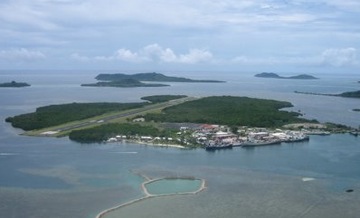 Photo by Rob Verger.
 The town of Kolonia, on the island of Pohnpei, is the only place I’ve lived that has been destroyed twice. A typhoon flattened it in 1905, and in 1944, American bombers leveled the town in a battle against the Japanese. But when I lived there for just over five months in 2006, volunteering as an English teacher at a public high school, the memory of violence was as far as it could be. The place was intact and functioning, albeit at a sleepy, island pace. The only potential danger (or nuisance, really) were the island’s dogs.
Pohnpei looks the way you might picture a South Seas island, although it is actually in the Northern Hemisphere: It’s a wide, sprawling splash of deep green—the remnants of an ancient volcano—in the middle of thousands of miles of ocean. The capital of the Federated States of Micronesia, Pohnpei is in the western Pacific, seven degrees above the Equator and about halfway between Honolulu and Manila.
It is said to be the second-rainiest place on earth. Kolonia, the only large town on the island, is perched on the northern coast and receives about 12 feet of rain a year. The deep, uninhabited mountainous interior gets twice that amount. With the heat of the tropics and all the rain, jungle grows thickly across the island. Palm trees and breadfruit trees grow in abundance, as do banana trees, whose wide, shiny leaves are sometimes cut and used as biodegradable umbrellas during one of the many sudden rainstorms.
Life on the island was slow and peaceful, sometimes euphorically serene. But thousands of dogs roam the island, and dog encounters were a part of daily life while I was there. Some of the dogs were wild, and wandered about, homeless. Others belonged to specific families, lived in their yards, and possibly had names. But they were not pets in the same sense that dogs are pets in the United States.
Many of them were mangy, filthy, flea-ridden, skinny. Some survived on what they could find on their own to eat. At night, they prowled together in packs, fighting and yelping. I could hear their howls and snarls outside my bedroom window all through the night, and the next day, I might see a dog in my neighborhood with a bloody, shredded ear, or another with a bite on its leg.
I lived in a house with two other American teachers, Margaret and Shannon. It was halfway down a narrow, dead-end road in a small, crowded, noisy neighborhood in Kolonia. Public throughways—small dirt paths—snaked between the homes, a few feet from people’s living spaces. Clotheslines stretched between trees outside each home, and in the moments of sun between rains, laundry flashed its colors in the green of the jungle.
But when we ventured from our home, the neighborhood dogs frequently presented a nasty obstacle. They usually slept away the hottest hours of the day, sometimes in the middle of the quiet roads, their brown or grey coats merging with the dirt of the street. But they were more active at dawn and dusk, and at night, they were ferociously territorial. Many lived in nearby yards, and if I stepped even one inch onto their property, the dogs would gallop viciously towards me, ready to attack.
It was not a bluff. Dog bites were common. Twice, during the semester I was there, students mauled by dogs came in with seeping bandages on their legs. And a colleague of mine at school was bitten in the behind as she was leaving her classroom for the day.
So I began to see dogs not as lovable creatures with personality but instead as animals with teeth. Frequently, while I was walking down the street near our house after dark, three or four dogs would block my path, barking madly. One strategy to avoid being bitten was to walk steadily and slowly in the very center of the road, far from any dog’s territory, trying to move with confidence and avoiding eye contact. Usually, this technique worked. We became a group of animals that had worked out an understanding: I wouldn’t bother their territory, and they would allow me to pass. The middle of the road was for humans.
Another interesting fact about dogs on Pohnpei is that they are sometimes killed, cooked, and eaten. Dog meat is a delicacy on the island. Many people whom I spoke to about this told me that they loved it, finding it tasty. Pohnpei is a place of abundant food, and as far as I could tell, people ate dog not out of a sense of need but instead, pleasure. The Pohnpeian word for dog is kidi and the word for delicious is iou (pronounced yo), and it was common to hear the two words used together.
As my stay lengthened, I became more and more interested, abstractly, in eating a dog. I joked about it with my friends. Sometimes, while I was walking at night, a dog would lunge from the shadows, barking hysterically. My heartbeat would surge, the small hairs on my neck would rise, and I’d try to work my way around it. With each of these encounters the idea of eating a dog began to seem more reasonable, and my jokes became fueled by a fear of the creatures and a vague desire for vengeance. I had no intention of actually killing and cooking a dog on my own. But I decided that if I was offered dog meat, I would consider eating it.
Several students from Kolonia’s high school lived in our neighborhood, and I was close with one of them, Jo-Jo, who lived with his family in a house just through our backyard and under a breadfruit tree. The tree had huge, hand-shaped leaves, and every few weeks the breadfruits grew larger and larger until—unless they were harvested—they fell with a messy, sticky splat. Tall, thin coconut trees separated our houses as well, and sometimes the nuts fell, tumbling like rocks, and landed on the street or on a metal roof with a concussion loud enough to wake me at night. (It is said that more people die in the Pacific every year from falling coconuts than from shark attacks.)
Jo-Jo was a junior at the school, about 16 years old. His family owned many pigs, as most families on the island who could afford them did. The more pigs you had, and the fatter they were, the more assets your family owned. Because pigs need to consume a lot of food before they are large enough to slaughter or sell, I offered to bring our food scraps over to his house. Jo-Jo was enthusiastic.
So almost every evening, at dusk, before the nighttime rains began and before the dogs became more active, I’d walk over to Jo-Jo’s with the bag of leftovers. It was a way of recycling what we could not eat. I looked forward each day to this short trip. It was a good excuse to leave our house, which sometimes felt like a tiny America set on a tropical island. The local culture, if we wanted it to be, could be left outside. But it was lonely to do so, and as the months progressed I spent more time at my neighbors’ houses, playing Ping-Pong, or drinking a coconut, or letting children teach me phrases in Pohnpeian, then smiling while they giggled at my pronunciation. The foundation of the culture there is the extended family (which almost always lived together in a single home), clan, and sharing; the more I was able to join it, the happier I was and the richer my life was.
One rainy evening I walked over to Jo-Jo’s house with the bag of food. A large group had gathered outside near a smoking fire pit, and in the heavy, wet air I could smell a strange meat cooking. It was already dark out.
Jo-Jo walked towards me, and I gave him the food. He said, “Rob, we are cooking a dog! Come back in one hour, and you can have some.” I went back to our house, and returned in a moment with Shannon. We were both curious.
On Pohnpei, dogs and pigs are cooked in a traditional oven called an uhmw. First a large fire is lit and then allowed to burn down to coals, over which round, smooth rocks are heated. The meat is then placed among the rocks and coals, and covered with a pile of thick, wet banana leaves, to roast and steam slowly.
I looked over at the smoking uhmw and saw them pulling the half-cooked carcass of a dog from the coals and rocks. Its skin was still on but its hair was completely burnt off. Its legs were curled, as if in mid-pounce, and its snout was blackened. They set it down beside the uhmw.
One of Jo-Jo’s cousins began removing the dog’s guts from an incision in its stomach. He pulled out the white and ropy intestines and placed them, coiled, on another banana leaf, where they sat in the light rain. Then, he used sticks to pick up hot rocks and placed a few inside the dog’s abdomen, so it would cook from the inside out.
It made me feel strangely ashamed to see this dead animal, and I regretted my jokes.
“How did it die?” I asked.
“It was hit by a car,” Jo-Jo said.
We walked home through the darkness and under the dripping leaves of the banana trees, and I sat on the couch and felt my stomach clench. A strange feeling washed over me. It would be polite to join Jo-Jo in the dog eating, but I also knew that if I didn’t return that night Jo-Jo probably wouldn’t be offended. The feeling was not one of obligation but it was instead a sudden heavy self-awareness: am I really going to do this thing that I’ve told myself I’m going to do? Is it a mistake to do it? Is it a mistake not to do it? I sat in the dark, listening to the rain.
In an hour I returned, with a worried stomach. The dog was not yet done. Jo-Jo told me to come back in another hour. I went back to the couch.
The next time I returned, the uhmw was empty, the leaves and hot rocks scattered in the rain to cool. The pit was still steaming. Two or three dogs sniffed carefully around the coals, curious, looking for pieces of food.
Jo-Jo emerged from his house and told me that the dog was still not fully cooked. “I have cut it up am boiling it so it will cook faster,” he said. “I will bring you some when it is done.”
I went back to my house, and in an hour, late at night, Jo-Jo knocked on the door. It was raining harder now. Dogs howled and barked in the background. He handed me a plate, covered in tinfoil.
“Enjoy!” he said, and went back home.
Both my roommates had gone to sleep. I put the plate down on the table and looked at it. I took off the tinfoil. There were two small pieces, each about five inches long and four inches wide: ribs. The meat was gray and black, steaming.
I stood there, staring.
I took a tiny bite.
It was gamey, chewy, revolting. It tasted the way the thick gristle you might cut off a steak would taste if it was charred in a fire. It did not taste like chicken. It tasted like dog—and this scrawny street dog had been struck by a car, roasted and gutted in a fire, and then cut up and boiled.
I put the meat in the refrigerator, brushed my teeth, and went to bed.
The next morning, Margaret and Shannon were displeased that there was dog meat in our refrigerator. Margaret took a picture of it, and then, after letting the meat sit in the fridge another few days, I threw it out. I washed the plate and returned it to Jo-Jo. He asked me how it was.
I told him it was iou, and I thanked him.