
The Magical Miracle Tour
Travel Stories: When a German evangelist arrived to save Africa from Satan and his evil witch doctors, Frank Bures went along for the ride
08.01.02 | 10:59 PM ET
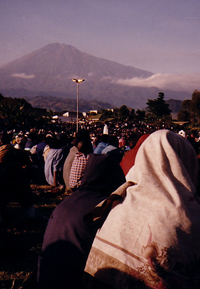 Photo by Frank Bures.
 A boy in front of me held a shiny blue booklet.
“Can I see that?” I asked him.
He shook his head and shouted, “No!” He pointed behind me.
All around us, tens of thousands buzzed with anticipation. We were waiting for German evangelist Reinhard Bonnke to bless our dusty, East African city with his presence, since his coming had been pasted to trees and cars and bars for months.
So effective had his publicity machine been (made up of every last born-again in the province), that it felt like the second coming. They said he could work miracles. They said he could cast down witch doctors. They said he could heal the sick. They said he was stronger than Satan.
Reinhard Bonnke and his Great Gospel Crusade were here at last. Witch doctors beware!
Behind me, where the boy pointed, stood a Great Gospel Crusade “Counselor” with a stack of blue booklets titled, “Now That You Are Saved.”
“Are they free?” I asked.
“Yes,” said the counselor, whose name was Godwin, “but normally we ask you to fill out this card.”
He opened the back of the booklet and showed me a “Decision Card.” It was a tear-out form that declared my decision to accept Jesus as my savior, and would be used to register the number of those saved at the Crusade. The price, in other words, was my soul.
“Sawa.” I agreed.
Godwin took my name, address and phone number.
“Do you attend church regularly?” he asked.
“Yes,” I lied.
“Do you want a personal visit?”
“Definitely not.”
He checked yes.
“Have you accepted Jesus Christ as your savior today?” he asked. His eyes wandered as though the routine were killing him. He’d probably asked the question a thousand times.
“Not yet,” I said, “but maybe after this.”
“It would be a good idea if you did,” he said and checked “Yes” again. He put the sheet in his pocket and gave me the booklet.
Looking over my “Convert’s Copy” of the Decision Card, I saw Godwin hadn’t even told me about some more appropriate choices, like “Has major spiritual problems,” or merely, “Other.”
Far across the field, several Germans wandered onto the stage and a murmur ran through the crowd. Under the giant banner that said, “Jesus Christ Sets You Free,” the Germans looked small. The speakers crackled to life and a Tanzanian preacher named Mzee Muro came out to greet us with a rousing Swahili call and repeat cheers. Then he went backstage and returned when some bass guitars and a synthesizer launched into a happy African gospel tune. The ocean of people around me burst into swaying song and dance.
The stage, too, was packed with faithful dancing for Jesus—Germans and Tanzanians alike moving side by side, the Tanzanians in time, the Germans as if on wooden legs.
Then the music stopped.
Slowly, the stage cleared and amid the silence, Reinhard Bonnke emerged.
A cheer went up, and the show began.
It was a well-orchestrated scene that has played out again and again across the continent since 1974, when Reinhard Bonnke first took his show on the road in Botswana and allegedly healed five ailing believers. It was, according to legend, the fulfillment of a prophesy: When Bonnke was just ten years old, a woman came to him and said she had a vision of “a small boy with thousands of black humans following him.”
Reinhard Bonnke was that boy.
Since accepting his destiny, Bonnke claims that in 63 crusades across the globe he has preached to more than 27 million people, with 10,160,500 decision cards filled out. He mainly works among black humans in Africa, but lately he’s branched out to brown ones in places like India, the Philippines and Sicily. He routinely claims to heal polio, cancer, blindness, deafness, tuberculosis and even to perform “supernatural reconstructive surgery.” He can also heal your marriage and money woes. Bonnke says he’s had more than 103 million “books” translated into 123 languages and dialects, and these are being printed in 42 different countries.
Bonnke was banned from northern Nigeria after his visit sparked riots that left 300 people dead in 1991. In 1999, he was sued by the families of 16 Nigerians crushed in a stampede at his crusade in which hundreds of others were also injured. Last year, HBO shot a documentary about Bonnke and his friend Benny Hinn in which they tried and failed to verify any of his healing claims.
But Bonnke’s claims have only gotten more extravagant since then. Late last year, he says, he resurrected a dead man in Nigeria. This was a slight improvement on a dead baby he resurrected in a mother’s womb the previous April. Fortunately, when the dead Nigerian man awoke, someone had a video camera handy, and now you can buy the whole thing (as seen on Benny Hinn’s show) for $35. Miracles are also now available on Bonnke’s Web site. Major credit cards are accepted. Bank drafts can also be arranged.
“Please be seated,” Bonnke said. He looked much like his poster, with his pallid visage sneering at the devil, Bible in one hand, microphone in the other. He raised them both in an appeal for calm.
When we had quieted down, he made his first announcement.
“First,” he said, “I want to say a prayer for those of you suffering under the curse of poverty.”
That probably included everyone on the field.
“Because, even though I am no economist, I pray for God to break the cycle of poverty and provide jobs for those of you who are unemployed!”
Another cheer went up.
Bonnke’s German-accented English was translated by Mzee Muro. When Muro’s words boomed out, the crowd went wild. And as Bonnke went on and he revved up the rhetoric, Muro followed suit. Bonnke rolled into his sermon, flailing his arms and storming across stage, with Muro flailing right behind him. Bonnke shook his fist and raised his Bible. Muro shook his fist and raised his Bible. Bonnke jumped up and down to make a point. Muro jumped up and down to make the point. Bonnke dropped his voice to a whisper, then back to a shout, and Muro did the same. Through every step, every flinch, Muro was there, half a step behind, like a shadow. No detail was spared translation. It was eerie. The crowd loved it.
The men shouted.
“Amen!”
“Amen!”
“Hey!”
“Hey!”
Bonnke’s sermon was on the theme of “Laws.” The law of gravity. The law of sin. The law of salvation, and so on—an awkward blend of physics and metaphysics, of tangible and intangible, of hard reality and nebulous divinity.
The audience reveled. They clapped and cheered as his points were translated. They shouted back. They exclaimed. Bonnke knew how to work a crowd, and so did Muro.
With his sermon over, Bonnke began to tell us of a time, back in Jerusalem, when a group of true believers were suddenly so taken with the Holy Spirit that they started talking in a language even they didn’t understand. And neither did the devil.
Only God.
Bonnke went into a long explanation of how, when he gave us the cue, we could close our eyes and speak in this language as well.
“But not yet!”
He shouted this again and again before going off on another tangent that eventually came around to speaking in tongues, which was a blessing we would receive.
To illustrate how we were to receive it, Bonnke called a young boy on stage and held up a 10,000 note (about $20). He bent down and handed the boy the note.
The boy grabbed the money, said “thank you,” and ran off the stage.
Here was something everyone could relate to.
“That,” he told us, “is how easy it is. Now raise your hands, close your eyes, and feel the Holy Spirit come down on you, just like it did in Jerusalem!”
I closed my eyes, raised my hands and felt nothing but the hot sun. All around me, though, thousands of converts began babbling with eyes closed and arms stretched to the sky, exactly as Bonnke had said they would.
That’s not to say everyone was overtaken. Several children near me, whose parents stood enrapt, looked bored and confused. Various counselors roamed through the crowd and a few teen-agers stood nearby with their arms crossed, apparently too cool for the rapture. The peanut sellers, too, managed to retain their senses.
But the most notable exception was Bonnke himself, who strolled back and forth across the stage, aloof from the babbling masses.
Mzee Muro, however, lost all power over himself, except enough to keep the microphone by his mouth. His holy gibberish thundered over the crowd.
Gradually people composed themselves—last of all Mzee Muro—and started speaking in earthly tongues. Finally order was restored and the meeting began to wind down.
But not before the healings.
This was what I’d been waiting for. Lately I’d been having stomach problems and had an old knee injury that had flared up. But up front, Bonnke informed us there were prerequisites. First, you had to be washed in the blood of Jesus Christ. Second, you had to come to the healing in faith. As far as I knew I didn’t qualify for either.
The Lord’s health plan was as bad as any.
The healing was anticlimactic anyway. There were no mass bonfires of wheelchairs and crutches, like there’d been in Kenya. Hardly anyone even fell down. No one was raised from the dead. Bonnke simply told us to check ourselves wherever we’d had a cancer, and that it would be gone. He said some blanket prayers for AIDS, sterility, goiters, malaria, rheumatism, arthritis and other ailments.
Already people had started to trickle out of the field and back into the streets of the city. I decided to join them rather than get caught in the flood of converts and non-converts.
In the days after Reinhard Bonnke left, the town rocked in his wake. Especially in the days afterward the buzz was everywhere and opinion ran the full spectrum: Some were convinced they’d seen the Messiah, or the next best thing. Others wondered why their rickets hadn’t healed or where all those new jobs were. A few saw a good business plan somewhere in there.
And still others just shook their heads at the crazy white man who came to Africa to give away books and money and to teach everyone a new language no one could understand.