
The Truck Ride
Travel Stories: A muddy Bolivian road snagged the old Chevy, leaving Amberly Polidor stuck in the middle of the Amazon. Out there, amid the mosquitoes and the molten glass air, rescue took on new meaning.
09.17.02 | 10:57 PM ET
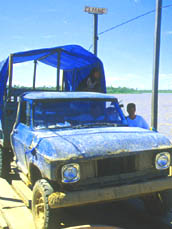 Photo by Wiley Davis.
The man sitting next to me holds a box slightly larger than his lap and about five inches deep. The flaps don’t cover the opening entirely, and inside I see something carefully wrapped in white cloth. A little girl on his opposite side reaches into the box, giggling, and pulls away the cloth to reveal two small stuffed caiman alligators. One is unnaturally posed, standing upright like a begging dog. Their eyes are cat’s eye marbles.
We are on our way to Trinidad, in the Bolivian Amazon, sitting on vinyl-covered wooden planks laid across the back of a 1974 Chevy truck that appears to have gone through as many modifications as its number of years. In addition to 14 snugly seated passengers, the truck is crammed with cargo, including a few large stereo speakers that are destined for a discotheque, I’m sure. I was told the journey would take eight hours, but the condition of the unpaved road leads me to believe that estimate should’ve been far more generous. It’s the end of the rainy season in this tropical region where the population is sparse and road maintenance is nonexistent. At least today’s parching sun means the roads can’t get any worse.
A boy seated in front of us sticks his finger in the begging alligator’s mouth and feigns injury. The man tells me he caught and stuffed the creatures himself. It occurs to me to ask how he caught them and what he plans to do with them, but I’m distracted by the rising fear that we may never reach our destination. The truck has just lodged itself in a pit of mud. Some of the men jump out with wooden hoes and start shoveling; wheels spin, mud flies, and we’re off again. The monotonous scenery—tropical trees, cows, grass, more cows—creeps by. I realize the truck’s not moving much faster than I normally walk.
Not that I’m in a mad rush to reach Trinidad. In fact, I’m currently traveling on the itinerary of my companion Wiley, who is on assignment to photograph what remains of a former Ford rubber plantation in the Brazilian state of Pará. He’s chosen to take the long and certainly less-traveled route, by land and river from La Paz, Bolivia, through the heart of Amazonia, to Fordlandia. With several months of nothing but loose travel plans ahead of me, I thought joining him would be an interesting way to pass a few weeks. In Trinidad, we’ll be boarding a riverboat for a five-day journey to the Brazilian border. But first we have to get to Trinidad.
The boy in front of me leans against his father, strokes his arm and looks up at him admiringly. Father and son are dressed alike: clean long-sleeved button-down shirts tucked into belted jeans and baseball caps. The boy’s hat says “No Fear.” Sure thing, kid, I think as the truck jolts over another huge rut and a speaker slides into my head. The boy offers me a cracker.
A man on the front bench—the one who told me we’d reach Trinidad in eight hours—sits content, sucking on a big wad of coca leaves tucked in his cheek. At the station in San Borja, where we waited on our blue tarp-covered truck, he’d offered me some leaves; it was my first time. Ignoring those junior-high school warnings against gateway drugs, I slowly added about 15 leaves to my mouth, letting them soften in my cheek. I then popped in a small chunk of ash, a catalyzing agent, and—BANG!—my saliva was numbing my tongue like novocaine and my blood was zinging. It was OK, but I thought if I were going to feel like I was at the dentist’s office, I’d prefer the laughing gas. Yet here on the truck, watching this man peacefully sway along with every jarring bump, I enviously wonder if coca is the secret to his success. Meanwhile, I’m obsessing over an airplane: the airplane that would’ve taken us directly from La Paz to Trinidad if we’d waited around a few more days.
I’m starting to lose myself in a reverie of what I’d be doing in La Paz at the moment—sipping coffee in the high Andean chill, free to stroll about and enjoy a variety of sights and sounds—when the truck lurches to a halt. The road in front of us is a vast expanse of thick mud. To our right is a bus, deeply mired. There appears to be some question as to whether to proceed along the left side, which looks especially soupy, or wait for the bus to dislodge and follow in its path with the hope of greater success. The men engage in an animated debate but ultimately decide the best course of action is simply to stand around and watch the efforts to free the bus. We’ve been on the road for six hours already, and the alligator man tells me we’ve yet to even reach our mid-way point; still, there seems to be no hurry to get moving.
Delays and discomforts are an unavoidable part of travel in developing countries. I know this. Our sufferings also add texture to the experience; they make the stories we tell our friends more interesting. But my water supply is dwindling and the truck’s plastic covering, while shielding us from the sun, is intensifying the heat and humidity inside. I’m sharing sweat with my neighbors, and even though the woman seated behind me has tossed her baby’s stinky diaper off the back of the truck, the odor remains. I remind myself, I’m not in a mad rush to reach Trinidad, but it doesn’t negate the fact that this journey is pushing me outside my generous but not infinite third-world travel comfort zone.
The father-and-son duo offer me more crackers and ask to see my South America guidebook. The father is impressed by how many pages are devoted to Bolivia. They pass the book along to an oily mustached man named Juán Carlos. “My name in inglés is John Charlie,” he informs me. John Charlie surveys the scene in front of us and cackles wildly. “The roads in the United States are just like this, eh?” His goofy grin compels me to play along with his joke despite my fading humor. “Igualitos,” I reply. Exactly the same.
Perched on the tailgate of our truck are a teenage boy with orange streaks in his hair and a girl in a tank top barely old enough to have begun wearing a bra. They sit tightly in each other’s arms, impervious to the passage of time and the rising temperature. I’ve heard the sensation of oppressive heat described in various poetically accurate terms. Gabriel Garc"a Márquez writes of air like molten glass. However, there is a point at which heat becomes so unbearable one is rendered incapable of thinking about how it is or what it is. It just is. And it’s best to sit still and let the sweat flow, lurking in a realm somewhere between transcendence and coma. My legs melt into the sticky vinyl of my narrow bench as I observe the men outside pretend they’re actually doing something to aid the stranded bus.
The pointlessness of their activity leads me to question the point of my own: a journey of indeterminable duration through the jungles of Bolivia and Brazil to find a former American settlement that today may be no more than a few vine-covered fire hydrants. I can’t help but compare myself to Wiley, the generator of this plan, and I’m beginning to think his main motivation is not in reaching the destination but in battling obstacles along the way. At every sloppy puddle, he has been the first one to jump out of the truck and push on the rear bumper while tires spit mud in his face. And now as a horde of hungry mosquitoes invades our truck, Wiley swats furiously with windmilling arms and a blood lust that quite possibly surpasses that of the bugs, all the while muttering epithets more appropriate for trench warfare than truck travel. I, on the other hand, don’t share this conqueror mentality, so why am I on this beat-up, overloaded truck, slowly dehydrating and being eaten alive by mosquitoes?
I look around at the faces of my companions, which over the course of the day have become so familiar: the boy with the crackers, still sitting patiently by his father’s side; John Charlie’s toothy smile; the teenage couple sharing quiet affection; the alligator man, who has set his box aside and closed his eyes. An indigenous woman with golden-brown skin and a proud curve to her nose splits a hunk of bread with her daughter. I remember the jar of peanut butter tucked in my backpack, pull it out and offer it to them. The woman’s face lights up. “Thank you,” she says to me in Spanish. “I love peanut butter, but you can’t buy it here.” She tears off a piece for me, and the three of us dip our bread into my near-empty jar. I realize I’m grateful for the opportunity to be sharing a day with these people. This is my reward for not being in a mad rush, for pausing to visit a place most travelers simply fly over. My endurance test starts to feel like a worthwhile trade-off.
The sound of a revving engine interrupts our feast. I peel myself off the bench and stand, leaning against the cab, to get a better view. Another truck has arrived with a chain to haul out the stuck bus in front of us. The rescue is a success and, after two long hours of waiting, the way is clear for us to proceed. Our driver, who looks like he could be a Texas cowboy, pats my arm and gives me a reassuring thumbs-up before hopping behind the wheel to resume our crawl along the muddy road to Trinidad.
We passengers resettle ourselves and smile with the shared relief that we’re finally in transit again. The acceleration of the truck generates a slight breeze, creating an almost festive mood among us. Wiley, dappled with the blood of squashed mosquitoes and still giddy from the slaughter, begins singing the theme from “Gilligan’s Island.” I’m struck by the parallel: We are 14 castaways stranded on a truck in a rolling sea of mud. But among this cast of characters, to whom movie stars and millionaires could never compare, I find myself no longer yearning for rescue.