
Tosi and Me
Travel Stories: During her summer in Pietermaritzburg, South Africa, Alexis Wolff bought a pet chicken. It purred. It baaked. And when it left her, she discovered something about happiness.
03.03.08 | 3:53 PM ET
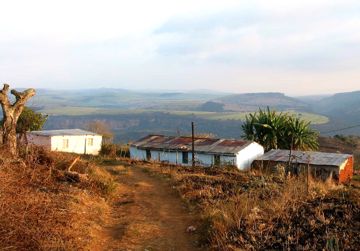 Photo by Sam Limmer.
When I was 20, studying Zulu for a summer in Pietermaritzburg, South Africa, I was strolling through a street market and decided it might be fun to buy a chicken. I handed the vendor my 18 Rand, less than $3, and in return I received a scrawny animal in a cardboard box. Chickens must not enjoy traveling in boxes, because as I walked home holding the package by its makeshift twine handle, my pet crashed against the insides so violently that the box swayed back and forth, once even falling to the ground. Irritated, I decided to name my chicken Tosiwe, the Zulu word for “fried.” It was only later when I discovered I actually liked Tosiwe a bit that I nicknamed her Tosi. I made a home for her on my front porch, and after my classes I would sit with her on my lap, petting her as she released a series of faint baaks that blurred together into something that sounded to me like a purr.
Owning a chicken delighted me, mostly because it was something I’d never done. After all, that was why I’d ventured to Africa (why I suspect everyone first does): to experience a way of living completely different from anything I knew.
When I’d learned I was staying in a mansion across the street from a horde of fast food restaurants, I was disappointed. I was further disappointed when I attended a supposedly traditional ceremony honoring the Zulu rain goddess and found participants wearing jean jackets and talking on cell phones, and then weeks later when I realized I still hadn’t seen a giraffe, lion or even a single monkey.
My South African life didn’t feel much different from my American one—not until I bought Tosi.
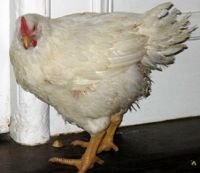 Photo of Tosi by Sam Limmer.
Tosi stayed on the porch through the several days when I didn’t realize chickens needed to be fed, through invasions by street cats and large birds, through my weekend trip out of town, and through the appearance of a woman making chicken soup on the sidewalk beyond the fence. But then, the day before I would leave for a week-long home-stay, Tosi wandered off for good.
On the bus ride away from the city, everyone—and especially my Zulu professor—poked fun at my loss.
“Don’t worry,” he assured me. “I’ll assign you the family with the most chickens.”
My professor had been amused by my interest in Tosi all along. Although I bought her hoping to feel more South African, he knew that Zulu people who bought chickens on the street took them home to slaughter for dinner; they didn’t keep them as pets.
Trying to ignore the teasing, I stared out the window. The bus kicked up dust as it climbed toward our rural destination, but through the haze I admired the imposing flattop mountain, its sides speckled with tall pine and plump marula trees as well as modest, trailer-like homes. Accustomed to the flat cornfields of the Midwest, I found the dramatic scenery mesmerizing.
Eventually the bus rolled to a stop in front of a rusty gate, and I followed my professor outside. A squat older couple approached us. They introduced themselves as Mr. and Mrs. Gasa, and as they spoke to my professor in Zulu that was beyond my level of comprehension, I looked behind them to the complex of a dozen weathered, tin-roofed buildings arranged to form a courtyard. Crude farming tools were scattered across the dirt, and goats and chickens wandered around them and then into the buildings around whose corners children were peeking, watching me. I smiled, maybe at the children, or maybe out of happiness to finally be in this place so far from cell phones and fast food restaurants.
That first night for dinner, Mr. and Mrs. Gasa fed me fried chicken. I can only assume that when my professor was speaking to them in Zulu he shared the story of Tosi, because later Mr. Gasa led me outside and pointed to the chickens wandering around the dirt courtyard. He asked if I saw anyone I knew, and when I told him I didn’t, he pointed to my stomach and smiled mischievously.
But it didn’t take long for Tosi to fade from my thoughts. I was busy practicing my Zulu and playing with Mr. and Mrs. Gasa’s grandchildren. I accompanied neighbors to a game park where I finally saw a giraffe, and I even joined a lobolo ceremony, walking in a line of women carrying crates of oranges, sacks of sugar, and other offerings on our heads. Life felt different and exciting, but what I loved perhaps most of all was its simplicity. When we wanted warm water, we heated it over a fire. When we needed eggs, we fetched them from the chicken coop. When we needed vegetables, we picked them from the garden. This was precisely the “Africa” of my imagination—the sort of place I’d been so desperate for back in Pietermaritzburg—and yet, strangely, beneath the exotic languages and dramatic scenery, it wasn’t all that different from where I originally came.
I could have spent summers detassling corn in my rural Midwestern hometown. I could have raised livestock as 4-H projects. But I’d scoffed at such bucolic endeavors then. I was too busy bemoaning my slow-paced existence and daydreaming about places where I assumed things of consequence happened. So why in my quest for something different did I end up happy somewhere so much the same?
Years later, I would think of my stay with the Gasa family when reading about a world religions professor who observed something about his students. Most came to his classes feeling estranged from organized religion. Studying lesser-known faiths gave them a greater appreciation for spirituality in all its forms; after a while, most returned with a new appreciation to the religion in which they had been raised. “To find yourself,” the professor commented, “you sometimes must go to a stranger.”
My last day with the Gasa family, Mr. Gasa appeared at my doorway. Today we’re going to bulala a chicken, he told me, holding a live creature by its neck. I got dressed and joined Mr. Gasa in an empty room. Holding the animal down with his knees, he extended a knife in my direction. I held it over the squirming and screeching animal, my hands trembling, until finally I passed it back. But I stayed and watched as Mr. Gasa sawed the chicken’s neck. Its head fell back like an opened jewelry box, dangling by a thin flap of skin. Blood spouted out in bursts. The chicken convulsed several times and then lay still.
I was at the same time horrified and mesmerized.
Throughout the course of the day the chicken was beheaded, plucked and gutted, its insides sprawled across the floor; the children fought over who would eat its head. Mrs. Gasa cooked the creature that afternoon over a gas burner, and it arrived on a platter that night as my dinner.
Maybe I could have killed and then eaten a chicken back home, but it took being with the Gasa family in this seemingly strange land for the experience to feel exhilarating.
As I ate, I didn’t think of back home, or Pietermeritzberg, or even Tosi. In fact, not a single time that day—that week—did I find myself wishing to be anywhere other than exactly where I was.