
Travel Writing: Not Exactly a Racket
Tom Swick: Contemplating and celebrating the world of travel
04.03.09 | 4:36 PM ET
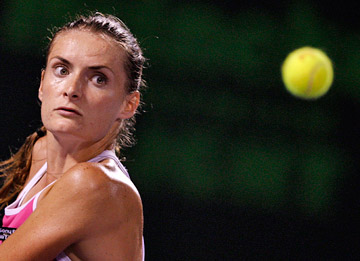 Iveta Benesova at the Sony Ericsson Open. REUTERS/Carlos Barria
In cities, back streets hold surprises you don’t find on the boulevards; similarly at a tennis tournament, the outer courts are often more illuminating than the stadium.
There are fewer fans, so you get a closer look, a greater appreciation for the nearly unanswerable velocity of the ball (which not even high definition television can capture) and the lightning reflexes of little-known players.
You are also given a widespread view of the sport’s global embrace. Taking the courts at the Sony Ericsson on the first Saturday of the tournament were players from Estonia, the Czech Republic, Poland, Russia, Uzbekistan, Kazakhstan, Ukraine, Hungary, Serbia, Croatia, Slovakia, Romania (doesn’t Bulgaria want to join the party?), Scotland, Spain, Portugal, France, Italy, Germany, Switzerland, the Netherlands (Belgium, after dominating the women’s game for a few years, is distinguished by its absence), Chile, Argentina, Israel, India, South Africa, China, Japan, Thailand, Australia, Canada and of course the United States. For at least a week every year, Key Biscayne is the most international small island in the world.
The outer courts are used not just for matches but for practice sessions, which offer up their own revelations. The main one—which comes to you as you watch an unsmiling Slav pound forehand after forehand—is that being a tennis player is not nearly as glamorous as it’s made out to be. In fact, after a few minutes observing Novak Djokovic in the midday heat, I decided that being a tennis player is in many ways like being a travel writer.
We both do for a living what the rest of the population does in its free time. Our work is other people’s idea of fun. The world takes in its stride that we live a charmed life.
We both travel widely, and rarely to hell holes. We end up in places people go for vacation: great cities—Rome, Paris, London, Melbourne—and warm climates: Florida, California, the French Riviera. Palm trees feature prominently in many of our backdrops, nicely feeding the illusion that we’ve got it made.
We both have followers: fans and readers, though the latter tend not to paint their faces in national colors. And we both have instructors: coaches and editors, both of whom think they know more than we do. It pleases us to remember that without us they’d be jobless.
Since most people watch the matches on TV (read our stories on the couch), they have no idea of the work that went into them. They can’t imagine all the hours of preparation (research), drills (legwork), first serves and second serves (writing and rewriting). Some delude themselves into thinking that they could give us competition, but all you have to do is watch a weekend hacker, or read a banal postcard, to see the huge gap between the pro and the amateur. It is a testament to our skills that we both make it look easy.
Yet most of us never reach a major final (the bestseller list). We are journeymen and journeywomen, toiling in semi-obscurity and dreaming of one day becoming a Sampras (Theroux) or Agassi (Bryson) or Serena Williams (Elizabeth Gilbert). Many of us possess the whole arsenal: the 130 mph serve (killer lead), the topspin backhand (felicitous turn of phrase), the drop shot (pun). We know we could become famous, we could break through to the top, if only we could cut down on our unforced errors (clichés).