
War Zones for Idiots
Travel Stories: The "World Series of Journalism" had begun in Afghanistan, and Tom Bissell didn't have to qualify to play. He just had to show up.
10.21.02 | 10:54 PM ET
 Photo courtesy Tom Bissell
“Tell me what it was like,” Douglas said suddenly. “What was it like?”
“Vietnam?”
Douglas nodded solemnly.
Converse sat up. “You should really ask a grunt ... A lot of time I was in hotels. Sometimes I went out to the line. Not a lot. I was too scared. Once I was so scared I cried.”
“Is that unusual?”
“I have the impression,” Converse said, “that it’s fairly unusual. I think it’s usual to cry when you’re hurt. But to cry before is uncool.”
“But you went,” Douglas said. “That’s the important thing.”
—Robert Stone, Dog Soldiers
The structure that connects Termez, Uzbekistan, to northern Afghanistan is known as the Friendship Bridge. Never mind that when the Soviet Union launched its 1979 invasion of Afghanistan, thousands of tons of Russian hardware rumbled over it. Or that when the Taliban seized Kabul in 1997, the Uzbek government, terrified of a similar Islamist insurgency, sealed it off. On a bright, cold afternoon this past December, Danish journalist Michael Andersen and I gazed upon the Friendship Bridge from a dusty road on the outskirts of Termez, hoping to cross. That is, Michael hoped to cross to report on one of the most important stories of his career. My hopes were a bit more complicated.
I had promised concerned family members that while in Uzbekistan, I would, under no circumstances, try to get into Afghanistan—an easy promise to make. I had no desire to fall prey to straggling Taliban intending to collect on the $25,000 bounty Mullah Omar Mohammed had placed on the heads of Western journalists before disappearing. Two months prior to the death of Wall Street Journal reporter Daniel Pearl seven European reporters had already been killed, and the war was already considered among the most dangerous in history for non-combatant reporters. But privately I had been telling myself something slightly different. The biggest stories, of course, were in Afghanistan, and I might perhaps try to get in, I determined, if I could attach myself to some larger convoy of journalists or aid workers and had a failsafe exit plan. All this promised to keep my options open while guaranteeing I would not do something incredibly foolish such as, just for instance, crossing into a war zone on foot with a single other reporter.
A converse silhouette of crosshatched white girders, the bridge was perhaps five hundred yards from where we stood. Before us a grassy bay of thigh-high vegetation swung back and forth in the breeze. A quarter-mile away, on the other side of the motionless Amu Darya River—as unremarkable as I imagined the view of North Dakota might appear from South Dakota—was Afghanistan.
Some cows, looking legless in the tall grass, drank from pools of swampy standing water near the river, which was itself blocked off with electrified fence and cyclonic coils of barbed wire. Michael thought that some great photos of the Friendship Bridge could be snapped from deeper in the field, and convinced me to follow him.
“Nyet, nyet!” our driver Sobir yelled. We turned, already up to our knees in the grass. He began calling out a single word in Russian while performing an ominous-looking hand motion. I asked Michael what this word meant. He said nothing, his mouth squirming thoughtfully within his blond goatee. He looked at his feet, and then around them.
“He’s saying,” Michael began, “that there are landmines here.” His head shook with a sudden decisiveness. “But I think he’s mistaken.”
For a while neither of us moved. Finally I said, “You do?”
“People live nearby. Children. Wouldn’t you think they’d put up a fence first?”
We stood there. The cows’ heads lifted, then lowered again to drink. Quiet faraway houses. The never-ending shush of the moving grass. Sobir, shaking his head, calling us back, my friends, please, toward the safety of the road’s gravel edge.
I turned to Michael, prepared to agree with him. Instead I said: “Um.”
“Yeah,” Michael said, and, taking my arm, retraced our steps to Sobir’s car.
I am certain that nearly every journalist, no matter what they typically cover, must have felt the same thing. Nothing less than the biggest event in half a century was unfolding, making every other story comparatively meaningless. The National Anthem had just been sung at the World Series of Journalism, and you did not even have to be good to get to play. You simply had to show up.
Of course, I had nothing even approximating the training or support that would prepare me to report on war. (The closest I’d come to experiencing violent unrest was in college, when I was tear-gassed during a riot. The tear gas had drifted into my open bedroom window. I was asleep.) But I did have—at least I thought I had—a microscopic in. Uzbekistan’s willingness to allow the U.S. military to launch missions into neighboring Afghanistan made the nation, arguably, America’s most useful ally in the war against terrorism. It was also the place I spent a Peace Corps stint in the mid-1990s and had visited several times. I speak primitive Uzbek and have many Uzbek friends. Just months before September, I had spent six weeks there researching an article on the ecological disaster of the Aral Sea, deepening my feeling for a part of the world I had, quite unexpectedly, come to love. So in early December, I headed back to Central Asia with vague notions that my knowledge of the region, combined with a hale streak of cowardice, would keep me out of too much trouble.
But from the moment I reached Uzbekistan’s capital, Tashkent—a relatively worldly, immensely pleasant city in my previous experience—everything went wrong. I was mugged by two men in broad daylight, lured toward one of them after he claimed to have found a large wad of American cash. (“Oh, that old trick,” the American embassy’s security officer said to me afterwards. “It wasn’t old to me,” I replied.) A few nights later, my youthful translator and I were collared by the Uzbek police and dragooned into a nearby station, where I watched helplessly as he was shaken down. “A man must experience these things,” he told me, vocal chords trembling. He quit the next day. The following night, a group of initially friendly men approached me. Within minutes I was fighting two of them off. A few nights after that, two drunken Uzbek police officers detained me for being in an “illegal area” and robbed me of forty dollars.
Had the proximate pressure of war blown the city off its hinges? To my disgusted consolation I learned of the curious goodwill gesture made by Uzbekistan’s president, Islam Karimov, a few months before my arrival. Officially in recognition of Uzbekistan’s tenth year of independence, unofficially to lance the boil of horrendous prison overcrowding caused by Karimov’s policy of arresting the observant Muslim male population, thousands of pickpockets, rapists, and thieves had been released and now infected the streets of Tashkent.
After a few long nights of waiting out unknown midnight doorbell-ringers, the American embassy’s security staff finally evacuated me from the apartment I had rented. With my budget now in total disarray, I wound up staying with Michael Andersen, a journalist I had met earlier at Tashkent’s Presidential Palace. The Central Asian correspondent for Denmark’s largest newspaper and radio show (not to mention a fluent English- and Russian-speaker and a former professional soccer player), Michael was tall and blond, with the damnably good looks of a scholar-jock. He lived with his wife and two children year-round in Tashkent, had reported from Bosnia and Chechnya, and counted as friends several former Eastern Bloc presidents. As a left-wing European intellectual, Michael was contractually obligated to loathe the American war effort, a position the resident New Yorker in me found mind-boggling. Our conversations tended to unfold rather as follows:
“Do you honestly believe that America is the greatest country in the world?” he’d ask. “That’s hardly a fair question.” I’d reply.
“Keep in mind I cherish what America stands for. I cherish it.”
“And if I may say so, that question basically reeks of sniping by European eunuchs resigned to their—.”
“It’s the arrogance I can’t stand. ‘They won’t do what we say? Bomb them!’”
“I’m from New York. And anyone in New York during the attacks—”
“It was not an ‘attack.’ This was a criminal action. It is a legal matter.”
“. . .”
“And now you are creating the next generation of terrorists with these bombs. Don’t you understand that? Every civilian who dies, every orphanage that’s turned to rubble—”
“Michael. I’m from New York—”
“This has been established.”
“—I’m from New York, and I don’t want all Arabs to die. I don’t want Muslims to die. So why should I hold these people to a lower moral standard than the one I—”
“Legal question.”
“Do you honestly believe that if this had been turned over to the World Court anything at all would have been accomplished?”
“Of course not.”
But Michael was friendly and funny, a human Swiss Army Knife of resourcefulness. He also had something that had hitherto eluded my disastrous visit: a story.
It appeared that thousands of tons of aid—blankets, food, clothing—moldered in warehouses in Termez while, just seventy miles on the other side of the Amu Daryu, thousands of Afghanistan’s IDPs (“internally displaced persons”) were starving. The Friendship Bridge was the most direct path to relieve the suffering, but Uzbekistan’s fear of refugees and militants was such that it refused to open the long-sealed bridge until the United States guaranteed the bridge’s security. Eventually, Colin Powell flew to Tashkent and, with great fanfare, announced that “the Freedom [sic] Bridge” would open “tomorrow.” But close to two weeks later, from what anyone could discern, little if any aid was actually making it through.
Michael wanted me to cross into Afghanistan with him to see the condition of the starving IDPs for ourselves. Much of northern Afghanistan was now under the control of the Northern Alliance, he reasoned, and the roads were reported to be safe. I had my doubts about this, but I told Michael that, if he got permission from the Uzbek Ministry of Foreign Affairs to cross the bridge, something I did not in the least expect to happen, I would go with him.
A few days before Christmas, however, Michael called. “It’s all arranged,” he excitedly told me. “We can get bridge passes. We’ll be back in time for Christmas Eve.”
Well then.
 Photo by Tom Bissell
Two journalists were waiting at the Friendship Bridge when Michael and I pulled up. Ravi Nessman’s shaven head revealed a formidably lumpy skull, and his scraggly goatee suggested some time away from the hot-water trappings of civilization. He normally worked out of South Africa for the Associated Press, and the prospect of venturing into Afghanistan did not seem to faze him. Markus Bensmann was a large, Cheshire-grinning German in the employ of a Japanese newspaper, as Japanese reporters were apparently forbidden from working in war zones. That a civilization only a few generations removed from kamikaze missions now shirked combat suggested the possibility of a somewhat less apocalyptic future for Afghanistan. Ravi and Markus stood next to the Friendship Bridge’s gate, enclosed in an atoll of luggage—huge, hardy bags packed with satellite phones and laptops. Provided they traveled to Mazar-i-Sharif ahead of us, I decided I would not much worry about highway robbery.
“Bissell, Thomas,” the bridge guard called out.
I gathered up my gear and was preparing to cross over to the other side of the checkpoint when Michael began arguing in Russian with the bridge’s commander.
“What’s going on, Michael?”
Michael looked at me in disgust. “I’m on their bloody list, but for some reason my name has a big ‘NYET’ written next to it. I can’t cross. You’ll have to go without me.”
I looked at Ravi and Markus. They shrugged.
“No,” I said. “I’m only going in with you.”
Without remark Ravi and Markus started off toward Afghanistan, while Michael and I sped toward the center of Termez to straighten things out. When we got back the bridge guards seemed to be standing in the same positions. “Name?”
“You know my name,” Michael said. “We were just here. Has the ministry called?”
The commander fixed his small, piggish eyes on Michael, then turned his clipboard around. There, next to Michael’s name, “NYET” was crossed out. We threw our backpacks over our shoulders, walked beneath the lifted gate, and strolled uphill along a blacktop road to the next checkpoint, a ramble of buildings so tightly arranged and similarly designed the area had the feel of a village under military occupation. Jeeps rolled by, their Uzbek pilots saluting us. Sharpshooters patrolled the shore of the Amu Darya. A fleet of green armored personnel carriers stood parked. Looking at the Friendship Bridge’s gimcrack first checkpoint provided no sense that something this operational existed just beyond it. For years this area had been one of the most sensitive pressure points in the Soviet Union, and the air still felt sick with some violent inevitability. A lieutenant with cartoonishly large epaulettes appeared, then, and walked alongside us in escort. “Going to Afghanistan, yes?” the lieutenant asked.
“Yes,” I said.
“Looking for heroin?”
“Mmm,” I said, uncomfortably.
“He’s being friendly, I think,” Michael whispered.
“Actually,” I said, “I’m joining al-Qaeda.”
He laughed and slapped me on the back. “Ha! Good luck!”
The lieutenant left us to our fate, and we walked along the bridge for a hundred yards in total silence. Then Michael burst out laughing. “My God,” he said.
“I know. I can’t believe this. I can’t believe you let me do this.”
“You’ll thank me,” he said. “In one hour we’ll be drinking tea in Mazar-i-Sharif, and you’ll thank me.”
Uzbek officials had, for much of the delay in opening the Friendship Bridge, maintained that engineers needed to vouchsafe its integrity. Walking upon it now made it difficult to see what needed to be reinforced. A trim two-lane span with shallow train tracks running down the center, the bridge was splendid, solid, clean—until we came to its indisputably Afghan side. Suddenly graffiti streaked along the girders, all of it scrawled in indecipherable Arabic-alphabet Persian. An orb of helpless illiteracy closed around my brain. It seemed like an emergency that I turn around. Michael, perhaps sensing this, once again took my arm.
To enter Afghanistan is to learn five interesting things. Hiring a taxi-yellow Toyota Corolla is (1) incredibly easy. The seventy-kilometer journey from the Friendship Bridge to Mazar-i-Sharif costs (2) a not unreasonable fifty dollars. Afghanistan’s time is (3) one half hour behind Uzbekistan’s, the month we know as December is (4) actually called Qus, and the year, as it happens, is (5) 1380.
Our driver raced along the highway at speeds I had known previously only as figures of speech. Repetitive, fascinatingly awful Afghan music keened through the badly wired speakers. On all sides the Dash-te-Laili Desert expanded with interstellar vastness. Yet somehow the driver knew the ailing highway’s every knot and gouge, slowing down to a speed that scarcely registered any disturbance. This was the northernmost portion of Afghanistan, a largely arid desert that fertilizes as one travels south. The whole of northern Afghanistan is separated from the south by the highest mountains of the Hindu Kush (which means “Hindu killer,” evidently with good reason), and the regions were mutually inaccessible as recently as the mid-1960s, when the Salang Pass Tunnel was completed. The mostly Uzbek-, Tajik-, and Hazara-populated quarter of northern Afghanistan contains about eighty percent of the nation’s industrial wealth and sixty percent of its agricultural resources. This has been a historical source of consternation to the south’s more populous Pashtun inhabitants, a people not known for their even tempers.
The desert kept growing, a nightmare of smooth gray sand that looked as though the color had been blasted out of it. The Romans had been amazed, millennia ago, by Central Asians’ ability to navigate the desert solely by the position of the stars. This was suddenly not at all amazing. Out here, one was either Copernicus or vulture bait. The memento mori of Afghanistan’s never-ending war appeared in the form of blasted green shells of T-62D tanks and abandoned 122mm howitzers. Some of the tanks seemed one payload of fuel from being operational while others had holes blown in them that looked like the bloom of some metallic flower. We soon happened upon our first checkpoint. Michael’s and my doors were yanked open. Biblically bearded faces peered in at us, free-swinging Kalashnikov barrels arcing into the Toyota. The soldiers quickly slammed shut the doors and slapped the Toyota’s roof. Our driver floored it.
“You okay?” Michael asked.
“Right as rain.”
“I ask because your eyes are smashed shut.”
The road came to a T. The road to the left led to still-shaky Kunduz (to visit Kunduz, an ancient though probably still pertinent proverb holds, is tantamount to suicide), to the right the relative calm of Mazar-i-Sharif. After turning toward Mazar, we saw spaced throughout the desert many stranded semi-truck containers, fading stencils providing the only clues to their plundered contents. Some of the empty containers were now being used as makeshift offices for checkpoint soldiers. Ahmed Rashid’s book Taliban (which Western journalists in the region were carrying the way missionaries lug Bibles) describes how these desert fixtures had been party to innovations far more horrifying. It took the Taliban three attempts to take Mazar. The first was disastrous. After a second, equally disastrous sally, Mazaris locked 1,200 Taliban prisoners of war within these empty truck trailers and cooked them to death in the sun.
We came to Mazar. More than a month after the city’s now-famous prison uprising, everything still seemed vaguely on fire. The day had grown chilly, and whole societies formed around whichever trash barrels had a healthy fire in them. On streets which only weeks ago had seen horrific street fighting, old men wobbled on ancient bicycles, children chased one another along the curb with sticks, and pairs of burqa-clad women drifted from shop to shop. The shops’ awnings and signs were crowded with Arabic, the few visible English words—“Agency of Zia Khan, Ltd.,” “Germany Eurol Super Fund,” “A. Computer”—leaping out at the eye with the immediacy of a bat in a white room. Yellow Corollas caromed through the crowds, swerving widely to avoid the local warlords’ mud-flapped and heavily chromed Toyota four-by-fours, not one of which held less than a dozen well-armed bearded passengers, Kalashnikovs and grenade launchers jutting out from the beds like weaponized porcupine quills. Spray-painted upon each truck’s fuselage was some nominal English-language indication of affiliation: “Dragon Man,” “Mercedez-Benz 2000,” “Power Hour,” and “Killer Brothers” some of the more memorable. I rolled down the window. Roasted chicken flesh and human sewage and the bitter headache smell of burning trash mixed with alien Persian voices and a never-ending chorus of car horns sounding as if an entire parking garage’s worth of vehicles had seen the simultaneous trigger of their alarms.
The driver steered us down an unpaved road through a transportingly ancient stone labyrinth to the United Nations’ main compound in the city. Inside, we saw a young man and an old man chatting in a huge, lovely courtyard. The younger man, Solim, had a round face and a thick black mustache and spoke very good English. Where was everybody? Michael asked.
Everyone was “out,” the older man explained, as he welcomed us to a nearby table and arranged for tea. Most of the U.N. staff had been forced to evacuate Mazar in the wake of September 11, and maneuvering the U.N.‘s various operations back onto their runners was going to take time. Had we heard about the grenade?
“Grenade?” Michael asked.
The older man shrugged. “A grenade was thrown into the money-changers’ market yesterday. Very terrible thing for our city. Forty people were injured.”
“No one died?” I asked.
“No,” he said, then smiled. “Afghans are tough.”
Solim asked if we had arranged for a translator during our time in Mazar city. In case not, Solim knew very many literate young men in Mazar city whose incurable pleasure it would be to assist us. “How about you?” Michael said. “What are you doing now? Are you free?”
“Of course yes,” Solim said. “We warmly welcome guests in Mazar city.”
“How are things here?” I asked, once we were moving again. “Is Mazar safe?”
“Of course yes,” Solim said. “Provided one is indoors before curfew, Mazar city is very safe.” The U.N.-recommended curfew was 5 p.m. It was now just after three.
“So, after the curfew, it’s not safe?”
“Of course yes,” Solim said. “At this time Mazar city has some security problems.”
We drove a few blocks to the Barat Hotel. On the way, Michael pointed at an old woman selling, among her Chinese and Pakistani tchotchkes, a small pile of yellow food packets. “There,” he said. “Those are the food packets the Americans air-dropped last month, aren’t they?”
“Of course yes,” Solim said. “Quite delicious. Made in Texas!”
The Barat was an admirably ordinary seven-story building across the street from Mazar’s central square, where the Tomb of Ali, the Fourth Caliph, stood among duck-filled ponds and gardens like a blue-tiled castle. Inside the hotel we found two floors’ worth of Western journalists, including Jeff Schaeffer from the Associated Press and Ravi and Markus from the Friendship Bridge. All were stricken with bed-head, coarse with stubble, sour-breathed, sneaker-shod. They stood chatting outside a hotel room they had transformed into media Mission Control. One look inside at the satellite phones and laptops rigged up to a portable generator and I grasped why this hotel had its own armed guard. They were surprised we had gotten over—and, perhaps, a little concerned, as it meant more beaks pecking at Mazar’s small pile of available feed. What were Michael and I hoping to “get” here? The camps. They nodded, as cordial as in-laws. The aid angle was a grim one.
All the same, Mazar was a great place for stories, Jeff said. “There are hardly any journalists here. It’s not this big media fuckfest yet.”
“The grenade yesterday was amazing,” another reporter chimed in. “There was still blood on the concrete when we got there.”
Ravi was less sanguine, having spent much of the day looking into the incident. The wires were burning: Had the Taliban returned? Ravi determined this was unlikely. One witness told him he saw two Northern Alliance soldiers rough-housing, and that during the friendly scuffle the grenade had been knocked free.
The talk soon turned to other wars, other places where one stood knee-deep in confusion and panned for information. Most everyone had covered combat or its brute equivalent before. Ravi, for instance, had found himself amid several African riots; Jeff had spent time in the West Bank during the Intifadah; Michael, I now learned, had once missed by a single hour being incinerated in a shelled building in Chechnya.
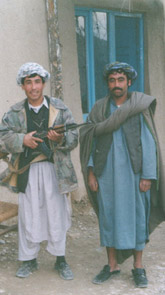 Photo by Tom Bissell
In the popular imagination, the war correspondent chain-smokes, exhales fatalistic mots, and wears a gritty layer of sweat. In contrast, the war correspondents lodged in the Barat Hotel appeared defiantly normal. Most had girlfriends and wives, though no one seemed terribly eager to talk about that. Whether this was because of the peril of the situation or the almost overwhelming maleness in the air—everyone was dressed a bit like we were about to choose sides for touch football—I was not sure. In tones more evocative of trumping sportswriters, they kept insisting the city was more or less secure. A New York Times photographer claimed Mazar was the safest war zone he had ever covered. But a normal person would not be here. Whereas I had wandered into Afghanistan almost by accident, these reporters had taken the speediest, most direct route available. Ravi was able to come only after securing a flak jacket from AP Moscow. (My biggest deliberation had been whether to pack my Marine Corps T-shirt.) Several seemed to enjoy a little too much arriving at the Barat a few careless minutes after curfew, while I was already steeling myself to leave again when the sun was high.
Like many Americans, I had spent the months of September, October, and November 2001 devouring wire reports from Kabul and Kandahar and Herat watching khakied, spotless television reporters declaim before docile Afghan crowds. Bylines and corner-screen logos somehow provided these men and women with the seeming invulnerability of a moonsuit. But every astronaut knows that each step is in defiance of the surrounding vacuum of death. An hour of tooling around Mazar had disclosed physics as unforgiving as those of space. This was a quickly thrown-together war being waged by a patchwork of unpredictable, often unreliable guerillas. Even the American Special Forces squadrons putatively in charge of these guerillas were having trouble discerning whom they could trust. Despite the epidemic of nonchalance, no one standing in this hotel—virtually no journalist in this country—had any real protection save for the goodwill of Afghanistan’s people. It occurred to me, then, that I had no reason to be here. Not one. As realizations go, this was curiously undramatic.
While Michael squared away our room, I walked out onto the hotel’s fifth-floor porch and looked across the street at the Tomb of Ali, one of the holiest sites in Afghanistan. Ali was Mohammed’s son-in-law and regarded by Shia Muslims as his true successor. It was surprising that the vehemently Sunni Taliban—to say nothing of al-Qaeda’s 55th Brigade, which had called Mazar home—had not defaced the structure. What had happened was chilling enough. In July 1998, the Taliban attacked Mazar for the third time. Mazar’s outlying soldiers fought to their last man, and the hell-bent Taliban entered the city driving Saudi-provided Datsun pick-ups. The massacre that followed must rank as one of the worst in modern history. While Mullah Omar Mohammed granted his talibs a judicious—if highly un-Islamic—two hours of killing, the slaughter did not end for two days. During the ordeal a Taliban mullah entered the Tomb of Ali and announced over the muezzin’s loudspeaker: “Now we are here to deal with you.” No one knows how many Mazaris were killed. The U.N. later estimated between 5,000 and 6,000. Taliban figures the number as closer to 8,000.
“What do you think?” Michael asked, he and Solim joining me on the porch. “We have an hour before curfew. Shall we try visiting some of the aid agencies and arranging a visit to the camps?”
I could not think of an activity at that moment I would have liked less to try. Perhaps cruising Mazar in voluble search of buggery. “Sure,” I said.
I followed them down the hotel’s spare twisting staircase as Michael inquired after Solim’s feelings about the American bombing. Solim said he was very, very pleased and overjoyed that the Taliban was gone. Michael reminded Solim that he was Danish, not American; Solim did not need to feel guarded. Solim said he was very, very pleased and overjoyed that the Taliban was gone. Michael’s head tipped forward with chagrined laughter. How about during the bombing near Mazar, then, which came to pass in late November? How did Solim feel? Had he been frightened?
“Oh, a little,” Solim said, “a little. But we were sure that we wouldn’t be hurt because Mr. Bush himself announced the U.S. does not bombard residential areas.”
Even at 4 p.m. Mazar was emptying. The unarmed rushed home, the armed did not move, and whole neighborhoods lay beneath long, toppled blocks of shadow. A far-off explosion, like damp thunder, filled the air. As I prepared to leap from the car and cower in a roadside ditch, Michael reminded me of the French and American soldiers out at Mazar’s airport detonating unexploded ordnance.
Our first stop was Unicef’s compound. Here a Canadian and two Europeans wearing heavy winter clothing pecked at glowing laptops. They barely looked up at us when we walked in, though the locally employed Mazaris smiled and happily pumped our hands. Camps? A spot of trouble with the camps. They were mostly trying to figure out where to put the relatively small amount of aid that had already come in. They did not have the jurisdiction to authorize anything by way of a camp visit, sorry. Nice to see us, though. At the compound of the World Food Program we found no one but a few drivers. At the United Nations Joint Logistics Center—which sought to coordinate the activities of the various U.N. agencies in Mazar—Michael and I chatted inconclusively with a genial Dane who was working solitary, clock-spanning hours to make the Center “operational.” Any aid situation with “military assets,” he said, rubbing his eyes and smiling behind a desk littered with paper and maps and printed-out E-mail, “are at first a little chaotic.”
Finally, minutes before night had fallen completely, we arrived at the offices of Médicins Sans Frontières. Unlike the offices of MSF in Tashkent, the compound was unmarked. Its Head of Mission was young Belgian doctor whose lidless and permanently open eyeball moved in a socket of scarred, glass-smooth flesh; how this happened I could not bring myself to ask. He did say, however, that he thought a camp visit could be arranged for us tomorrow. But we could not ride in any MSF vehicles. Journalists getting killed under MSF’s watch was not a problem this doctor wished to have. Could he tell us about the camps? Michael asked. Were people really starving? In the camps MSF could reach, the doctor explained, the mortality rates were still “very low.” As for those no one could get to. . . He shook his head.
By the time we made it back to the hotel it was too close to curfew for Solim to try to make it to his house across town. The three of us sat down to a light supper in the hotel’s canteen when a journalist we hadn’t met before—a tall and staggeringly pompous Brit—blustered in. He ignored us, making straight for a table of young, star-struck, English-speaking Mazaris. Soon he was loudly dropping the names of numerous global hot spots with gloomy familiarity. I walked over and asked him how long he’d been in Mazar. “A month,” he said challengingly.
I headed upstairs and from our room looked out upon Mazar’s lawless nocturne. The Taliban were vanquished, and yet five stories below me warlords cruised the city’s alleys and thoroughfares, already working out their new vectors of influence. Swords of headlight cut through the murky night and I watched two four-by-fours pull up on opposite sides of the street, their soldiers climb out and then just stand there, holding their Kalashnikovs and eyeballing one another in the dark. Everyone agreed that the presence of the few hundred American and French soldiers out at Mazar’s airport was the only thing holding these brutes short of total urban war.
Michael and Solim walked in, then. “I’d get away from that window if I were you,” Michael said absently, having a seat on his bed and pulling off his socks. “I don’t think any arrests would be forthcoming if someone decided to take a shot at you.” I closed the curtains. Michael turned to Solim, who sat on the floor with a slumber-party smile, and asked him if he could ever remember a time in his life when there was no war.
“Since the beginning of my birth,” Solim said, “the only thing that I heard was war.”
Michael wondered if Solim was more optimistic about Mazar’s future. “The political situation is changing every day,” Solim said. “We don’t have a good remembrance from the Northern Alliance because they are repeating their past reactions. The only thing that they enjoy is killing, abduction. So we really, really welcome the new government.”
Did Solim, I asked, want British or American soldiers to police Mazar?
“Oh!” he said instantly. “Literate men warmly welcome all of them. Because those forces would be the only ones who would bring peace and security in our country.”
I looked at Michael, hoping he would not say what he said next: “Do you know tomorrow morning the West will fly forces into Kabul?”
“We will welcome them,” Solim said with a hard nod.
“But they’re not going to come here,” Michael said, not without sympathy. “They’re only going to be in Kabul. For six months. Then they’re leaving.”
“We’ll welcome them,” Solim said again, more quietly.
At noon we followed an MSF Land Cruiser out of Mazar and into Afghanistan’s countryside. We were on our way to Camp Number Four, where, we were told, one or two children were dying a month. While this was unacceptable in human terms it was much better than it could have been. Camp Number Four was actually “one of the better ones,” we were told.
War appeared to do two things to landscape. First, war took the land by its bedspread edge and shook it free of people. Then war tore it to pieces. War had not needed much help here, as half a decade of drought had driven away all but the land’s most mulish inhabitants. The American bombing had provided these souls with a final pharaoh to flee—to the mountains, we had heard, where they squatted in camps unreachable by aid groups and ate grass. The nail-gray sky hung close above the lowly rolling hills, locking in the cold. That morning, I had opened my eyes to see thick white cumulus issuing from my mouth.
On our portside the saltine-colored Kalai Jangi fortress drifted by, as long as several city blocks. This was the site of Mazar’s 25 November prison uprising, a three-day skirmish that ended after a strafing run by American fighter planes and the flooding of the prisoners holding out in the fort’s basement with hundreds of gallons of freezing water. Four-hundred Taliban and al-Qaeda fighters were ultimately bombed into paradise—their bodies had been piled like faggots of wood alongside this very road—as well as 150 Northern Alliance soldiers and one American CIA officer. Despite the posthumous heroism bestowed by our president upon Johnny (“Mike”) Spann, no explanation had yet been provided as to what he and his partner, a man known in Mazar only as “Dave,” had been doing here. Mazar, not surprisingly, eddied with rumors: that in visiting the fort the agents had been deeply off-mission, that Spann and his partner had threatened John Walker—the American talib who had been captured here—with his life if he did not talk, that their appearance in the fort had been the uprising’s trigger, that during the fighting’s initial stages Spann’s partner either abandoned him to his fate or tried valiantly to save him and either way wound up shooting his way out of the fort, saving the lives of two Red Cross officials also trapped inside.
Suddenly the outline of Camp Number Four formed surreally along the horizon. A ring of small rock houses encircled a mustard-colored three-story building with charred windows and a partially crumbled facade. The rest was open space, as much open space as a bad dream. As we pulled through the camp’s gates a gale of watery sleet hit the windshield, the wind roaring. Michael and Solim and I climbed out, and a forty-strong crowd of IDPs amassed around us.
In my heavy boots I slid around in the mud, trying very hard not to fall, while the camp residents looked upon my efforts with obvious amusement. Most of them were wearing plastic slippers, their feet bluish and raw. The camp’s spokesman came forward and welcomed us, Solim offering running translation. He spoke through his thick curly brown beard without emphasis or hysteria, his huge brown eyes blinking away the sleet. They were very glad to see us at Camp Number Four, the spokesman announced. They were Tajik, he went on, illiterate mountain people who had been living in camps for three years, many much more than that. Some of them had been driven from the Tajik border because of Tajikistan’s civil war, which lasted from 1992 until 1997, others because of Afghanistan’s long-running drought. They were very hungry and very happy to see us.
We walked along the perimeter of stone houses. The crowd grew as we walked, a few shivering, expressionless children stepping out into the cold to have a look at us. A few were bare-armed. Many were barefoot. I asked our accompanying Italian aid worker how long he had been in Afghanistan. “Three weeks,” he said. He had come to Mazar from Africa. Unbidden came his belief that Afghans were more “frustrating” to deal with than Africans because most Afghans had once enjoyed better lives. “Of course,” he said, “if it’s frustrating for us imagine what it’s like for them.”
Michael and I had, on the sneak, begun to take photos, but we were quickly discovered by the IDPs and then, to our wonder, encouraged to take more. People arranged themselves into smiling clusters for us, their chins drawn up in kingly pride. A thought—this is not appropriate—inscribed itself in fire across my mind. But they were happy to pose. And so I whirled and snapped, laughing when I slipped and muddied my knee. The IDPs laughed too. I called myself “tentak,” Uzbek for “stupid,” and shot myself in the head with a finger pistol. The few IDPs who understood Uzbek clapped in delight.
Michael had dropped back fifty yards or so with the Italian and Solim, who was translating for Michael as he recorded some dialogue for use on his radio show. One of the Uzbek-speaking IDPs and I embarked upon a friendly pidgin conversation, and we ventured out even farther ahead. He was hungry, he said. I nodded and wrote that down. This seemed to satisfy him—that a stranger thought his hunger notable enough to record. From one of the stone houses came a tall, laughing IDP. Laughter, I thought. How indomitable! When he drew closer—when, in fact, he was upon me—I realized this man was not laughing. He was screaming, thrusting his finger at me, his voice breaking apart. I tried, in my shock, to double-back toward Michael and Solim, but the momentum of my admiring crowd had cut off my path. The only way through was to push. I turned back toward the man, now fully deranged with anger. The Uzbek-speaking IDP tried to tell me what he was saying, but my concentration hung in shreds. For the first time I smelled around me a thick humidity of shit and sweat and human sadness. These people’s beards were falling out due to malnutrition, small white nits embedding the hair that was left. They were, I was certain, about to tear me apart.
But the man was led away by two camp neighbors. I swallowed a peal of nervous, inexplicable laughter as my palsied hands returned my camera to my backpack. The remaining IDPs hugged themselves and looked at the ground. Michael and Solim and the Italian, having seen some sort of disturbance, came running up. “Everything all right?” the Italian asked. Great, I told him. Everything is fine.
We did not get very far before another angry IDP appeared. He hectored us as we walked past him, our disgraced silence frustrating enough to impel him to remove his headwrap and throw it at our feet. We turned to him. The man’s house had collapsed the night before, Solim translated, killing two of the man’s daughters. Behind him stood a house whose roof had indeed collapsed. He had buried his daughters last night, he said. He would show us the graves. Three children a day were dying here. Why was not the West doing anything for them? They were starving. They had no firewood.
I looked over at Michael. He stood there holding his pack, eyes fixed upon the cold muddy goulash at his feet, his face as colorless as ice. The Italian materialized next to me. Look here, he said quietly, they know you’re journalists, and they know their “mortality status” determines the amount of aid they receive. Three children a day are not dying here. They dig false graves and show them to him, too, sometimes. These people are receiving aid. He pointed around the camp. Most of the houses were covered with white plastic tarps to keep out the rain, and these had come in an aid shipment that arrived just a few days ago. You see? I did see. I also saw the screaming man, who fell to his knees, his nearly toothless mouth wide open in anguish. I wondered if it even mattered whether his daughters had died, if this man fit upon any matrix of honesty. Was he somehow less desperate if his daughters, rather than crushed, were merely crying and starving?
Eighty percent of the food aid donated to the World Food Program for use in Afghanistan had come from America, but neither U.N. nor American troops were doing anything to protect this province’s roads. A month later, to the surprise of no one in Afghanistan, the country’s interim president, Hamid Karzai, would call for a nation-wide deployment of peacekeeping troops. Fighting among warlord factions would erupt around Mazar soon thereafter, and Ravi and Jeff would file a piece about a mountain village north of Mazar whose starving inhabitants had been reduced to eating grass, just as Michael and I had heard.
Some refugees led this spent, crying man away, his rubbery legs sliding in the mud. Solim told us that the refugees were telling him that this was not Michael’s and my fault. We were here to help. I nodded, not exactly hearing him. Something had blown loose inside me, cognitive hoses ripped from their moral bulkhead. The real war correspondents back at the hotel call this condition emotional dehydration, and I was both ashamed and relieved I had achieved it after seeing so little. My brain quietly powered down, capable of handling only the most basic functions. Walking, for instance, which I now did, though I was no longer in Camp Number Four. The merciful incoming data of other realities was all I could process. My birthday in a few days. Probably call my folks from Termez tomorrow. They would be worried. Hi. Merry Christmas. Everything is fine.
I awoke halfway back to Mazar, along another empty road. Michael mentioned he wanted to visit some more aid agencies. I told him to drop me at the hotel, and he sent me off with a grim, fraternal clap on the back. I wandered upstairs and toppled onto my bed. The pillow was hard as a sack of wheat. This had bothered me the night before. I dozed, woke up headachy, then tried to read a little of The Iliad, which I had carried with me, thinking it would make for interesting reading. “But it is not so much the pain to come of the Trojans that troubles me,” I read, “as the thought of you, when some bronze-armored Achaian leads you off, taking away your day of liberty, in tears.” I put the book down and went through my things. Ah. Tylenol. The cap was tricky. I could not quite align the child-proof arrows. Finally I popped the cap off, the bottle squirting from between my convulsive hands and the pills shooting across the hotel-room floor in a fan of separate trajectories.
Soon it was night, and Michael had not yet returned. I found Jeff Schaeffer, who had just enjoyed dinner in the canteen and was returning to his room. Among the war correspondents at the Barat, Jeff was arguably the most normal-seeming of all. He ran the Paris bureau for Associated Press Television News and had about him the sweatered, conscientious air of a high school guidance counselor.
Jeff took one look at me and insisted I join him for a nightcap. I sat on his bed as he poured a double shot of Jack Daniels. My empty stomach clenched around the booze, searching for nutrients. I told Jeff we went to the camps today. He nodded and poured me another. Did I have enough for a story? “Maybe,” I said, “the story is about finding out that in a war there is no story.”
“A process piece,” he said, unfazed.
I looked at him in wonder. Didn’t this place, I asked, frighten him?
He sat down on a chair across from me and for a long time said nothing. “The soldiers outside,” he said at last, “they don’t want to hurt you. Sometimes guns mean stability.”
I shook my head. Could that be true?
He leaned forward and spoke very slowly. “They don’t want to hurt you. It has nothing to do with us.”
That Jeff could not see what I saw—that he might have been right—pained my dull, useless eyes. Michael and I were planning to leave the next day (though we would be turned back at the Friendship Bridge and would spend our very strange Christmas in Mazar-i-Sharif); Jeff, for his part, would live for three of his next five months in Afghanistan. My eyes began to burn. “I have to get out of here,” I said. My head shook and shook.
In my own room I found Michael listening to some taped interviews he had conducted earlier in the afternoon. “I got it,” he announced with bitter satisfaction. Got what? I wondered. “I got someone from Save the Children saying that ‘scores’ of deaths could be directly attributed to the Americans’ and Uzbeks’ dithering on the bridge.”
“Congratulations,” was all I could think to say.