
The Iditarod: Worth the Work It Takes to Follow It
Travel Blog • Jenna Schnuer • 02.26.09 | 1:13 PM ET
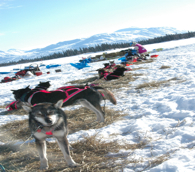 Musher DeeDee Jonrowe’s team, 2006. Photo by Jenna Schnuer.
For spectators, dog mushing is a hard sport. There’s no loop de loop on a race track. There’s no back and forth on a court. Once the dogs go by…they’re pretty much gone. Dog mushing as spectator sport takes patience, dedication, and a lot of reading (internet and newspaper updates of days-long races are key). But just one dose of a race, one chance to watch it in person, to see the connection between the mushers and the dogs and, quite simply, you’re sunk. It gets in you.
I fell for it in 2006 when I went up to Alaska to do a story about the Iditarod. Really, I didn’t think dog mushing would become an obsession. I figured it’d be an interesting thing to check out and then I would be done with it. I thought it was just another piece of Alaska that I should see. Instead, my interest in the sport keeps growing. It all stems from the connection between the mushers and their teams. We should all be so lucky to have bonds that strong with another living creature. I’m not sure I’ve ever even really seen that between two people. They have to trust each other. The mushers and the dogs know it. I know some will say I’m romanticizing the whole thing; I don’t care—I saw it.
Here’s the moment that got me over and over: as the teams readied to leave the checkpoint, the dogs would go completely hyper. Some would pogo up and down, many would start to pull, almost all would holler and whine. Then, when the checkpoint referee gave the go and the musher gave the “hike” command, the dogs would quiet and, all at once, just start pulling. The only sound coming from the sled runners as it slid on by. It was the most beautiful quiet.
So, you in? The 2009 Iditarod starts March 7. That gives you one week to study up and choose your favorite musher. And then I’ll see you out here.