
John Flinn on Telling the Travel Tale
Travel Blog • Michael Shapiro • 08.22.06 | 1:47 PM ET
Editor’s note: Travel writer Michael Shapiro just attended the annual Book Passage Travel Writers & Photographers Conference in Corte Madera, California. He was on the conference faculty and is writing about the gathering for World Hum.
One of the joys of teaching at the Book Passage Travel Writers Conference is the chance to drop in on classes during your downtime. On Saturday morning John Flinn invited me to visit his advanced travel writing class. Flinn is the executive travel editor of the San Francisco Chronicle and a graduate of the University of Bill Bryson and Tim Cahill.
 Flinn suggests saving the strongest part of the each sentence till the end. You wouldn’t put a joke’s punch line in the middle of a sentence so why put the kicker any place but the end.
The lead in Flinn’s story in Sunday’s Chronicle, “In Step with England,” is a perfect example: “What worried me most about going on a hike with Bill Bryson was that everyone would assume I was Katz.” You may recall that Katz was Bryson’s loutish hiking companion in “A Walk in the Woods,” Bryson’s hugely successful book about hiking the Appalachian Trail. Imagine if Flinn’s lead read, “I was worried that people I met would think I was Katz when I went hiking with Bill Bryson in England.” That’s flat.
Another way to keep the reader engaged is with strong imagery. About six years ago Flinn donated a kidney to his wife and wrote that in preparation for surgery their arms were “porcupined” with needles. Had he said “riddled” with needles it wouldn’t have been as strong.
 Which gets to Flinn’s next point: avoid cliches. Flinn asked his class: How many times have you read that a village was “nestled” in the hills? (Ok, I admit I’ve used nestled and it wasn’t that long ago.) Or that visitors to Hawaii are “caressed” by tradewinds. The challenge of writing is to find original and creative ways to express yourself, he said. One way to do that is with dialogue: when Flinn was on Maui watching the whales jump from a Napili restaurant, a waitress looked out the window and said, “It’s whale soup out there today.” That little bit of dialogue helps the reader envision the scene and brings another character to life.
Another tool: have the ending reflect the beginning of the story. This doesn’t mean the conclusion should be a summary—that would probably be dull. But if you can play off the lead and add a new twist, so much the better. After walking the Ridgeway Trail, Flinn and Bryson end up in a 16th-century inn with low doorways. Returning late one night from a pub after a couple of pints, Flinn smacks his head on an oak beam above the door.
“Based on the loud and, I must say, rather inspired salvo of foul language that filled the corridor, the other guests must have all come to the same conclusion: That American guy with Bill Bryson was Katz.”
Flinn plays on the lead, injects some humor, and makes the last word the kicker. Now that’s how to end a story.
Michael Shapiro wrote a cover story entitled “Land Beyond Time” about Wales for the May-June issue of National Geographic Traveler. He’s also written recent stories for Islands about Kauai and Chiefs Island in Botswana’s Okavango Delta. His work also appears in the New York Times, Washington Post and San Francisco Chronicle. Shapiro’s book, A Sense of Place: Great Travel Writers Talk About Their Craft, Lives, and Inspiration
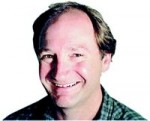
Top photo: The San Francisco Chronicle’s John Flinn
Bottom photo: Author Bill Bryson in cooler climes (Michael Shapiro)