
What Does it Take to Understand a Culture’s Cuisine?
Travel Blog • Joanna Kakissis • 06.18.08 | 12:41 PM ET
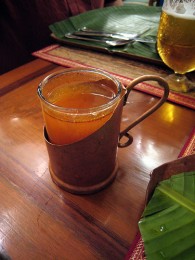 Gourmet contributor Shoba Narayan recently dined with her mother at Masala Klub, a new high-end eatery at the Taj West End hotel in Bangalore. The meal began well enough, with white wine and a good lemongrass rasam (“the holy grail of our community, the Tamil Brahmin people”). But the main course—a collection of too-chewy paneer, undercooked spiced haricots verts and other “forgettable” dishes—left the women underwhelmed. Why couldn’t the savvy chef at Masala Klub impress these compatriot foodies? Narayan says it’s because Indians are so famously possessive of their cuisine that even the most talented haute and fusion chefs rarely stand a chance in the kitchen.
The Narayan family knows the difference between a truly authentic dal makhni and the one I’ve eaten with ignorant satisfaction at a North Raleigh strip mall. Write them off as inflexible food snobs at your own risk. They know exactly what cultural detail each taste evokes, and for that alone, they should be heard.
You don’t have to be a local to understand a culture’s cuisine, though it’s easier if you’ve grown up connecting these foods to places, memories and people. Those who attach cuisine to identity have a hard time with traditional food that’s been modernized or globalized.
I see this in my own attachment to Greek food, which I grew up eating as a child of immigrants in the United States and, of course, eat all the time now that I live in Greece. I’m definitely no fan of fusion Greek: it confuses me, with its non-compatible tastes overwhelming each other, disconnecting me from one of the Mediterranean’s greatest food cultures. Haute Greek is usually too pretentious or Frenchified, though there are notable exceptions such as 48, a don’t-miss restaurant in Athens. The best Greek food is not haute but rustic: chickpeas stewed with eggplant, boiled wild greens dressed with olive oil and lemon, sea bass broiled on fennel fronds, thick yogurt sweetened by a dollop of quince preserves.
My family’s “holy grail” food is, of course, a traditional one. It’s called gamopilafo (wedding pilaf), and it’s made on my mother’s native island of Crete. The preparation sounds deceptively simple—rice cooked with the goat or lamb stock and a sheep’s milk roux called staka. I’ve eaten it at Cretan weddings and at restaurants in Crete and Athens. These attempts at gamopilafo are often tasty, but they have never wowed me. Only the version made by my mother’s brother, Stavros Birikakis, has that power. His gamopilafo is rich with flavor, powerful and lively—like Crete itself.
Woe to any non-Uncle Stavros chef who tries to make it.
Photo Charles Haynes by via Flickr (Creative Commons).