
Seven Wonders of the Shrinking Planet
Speaker's Corner: Jim Benning and Michael Yessis unveil World Hum's seven wonders: places, things and people that embody ways the planet is shrinking and cultures are colliding
07.06.07 | 12:04 PM ET
The world has seven new wonders, to be added to the seven old wonders and, naturally, to the seven wonders of Canada. All this talk of wonders got us thinking about the planet’s wonders from a World Hum perspective: places, things and people that embody intriguing ways the globe is shrinking and cultures are evolving and colliding. In short, it prompted us to put together our own list of wonders that are not timeless but entirely of our time, a list of the seven wonders of the shrinking planet.
“Airworld”
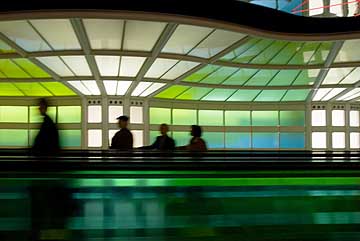 In his 2001 novel Up in the Air, Walter Kirn describes “Airworld” as a “nation within a nation, with its own language, architecture, mood and even its own currency.” It’s an apt introduction to a Jet Age phenomenon familiar to anyone who has ever set foot in an airport: the vast, fluorescent territory beyond the security checkpoint, a place of crowded airport bars and moving walkways and hard seats, as well as a psychic landscape. It’s the place where nobody lives—well, almost nobody—yet it’s a limbo that, every once in a while, we all call home.
Related on World Hum:
* Adventures in ‘Airworld’
* ‘Airworld’: As Seen Via Cellphone Video
* Greg Lindsay on In-Flight Magazines and ‘Airworld’
Photo of Chicago’s O’Hare Airport by Idle Type, via Flickr (Creative Commons)
Dubai
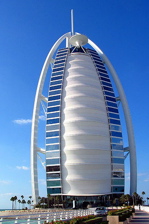 Some are suggesting that Dubai’s moment in the media spotlight has come and gone, but we’re not so sure. We’re still marveling at this emerging theme park in the Arabian Desert, which is drawing more visitors than all of India. Want to go skiing? Soon, you’ll be able to swish down the slopes at Dubai Sunny Mountain Ski Dome, with its own artificial mountain range. Want to buy an artificial island? Get in line—with the likes of Tommy Lee and Richard Branson—for one of 300 islands under construction at The World, a ridiculously ambitious development. If Las Vegas has a new-millennium successor—with mosques—it’s Dubai.
Related on World Hum:
* ‘The Cultures That Produced Dubai and Las Vegas Surely Must Have Something in Common’
* Dubai on the Cheap?
* Dubai World Buys Queen Elizabeth 2
Photo of Burj Al Arab Hotel in Dubai by bryangeek via Flickr, (CreativeCommons)
Google Earth/Google Maps
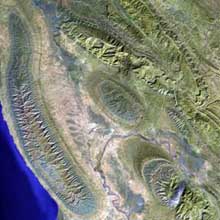 Since June 2005, Google Earth—a digital globe, stitching together commercially available satellite images to create a 3-D representation of the planet—has been downloaded more than a quarter of a billion times. Google Earth and Google Maps have become the go-to mapping applications for everyone from television news producers to mashup artists to road-trip chroniclers, and it seems users have only begun to recognize the many ways they can guide travelers and bring people and cultures together. To Wired magazine—and to us—they do no less than change the way we see the world.
Related on World Hum:
* Google ‘My Maps’ Debuts With Oral History of Route 66
* Michael Hess: The ‘On the Road’ Google Maps Mashup
* From Abbey Road to Arctic Monkeys: Mapping England’s Pop Music Heritage
Photo of Konari, Iran via NASA/Our Earth as Art
Manu Chao
 Philadelphia Inquirer music critic Dan DeLuca recently called Manu Chao “the world’s only born-in-Spain raised-in-France multilingual punk-rock-rai-reggae-dub-salsa aerobic instructor rock-star rapper.” That only begins to describe why we think Chao is the poster boy for the best in shrinking-planet music and a one-man wonder. He sings in multiple languages, including Spanish, French, Arabic, English, Portuguese and even, apparently, Wolof. He fills stadiums around the globe with wildly diverse crowds. He celebrates travel. Perhaps most importantly, he turns out consistently hypnotic and addictive pop music that can be enjoyed from Havana to Cairo.
Related on World Hum:
* Rolling Stone Picks Best 25 Road Trip Songs Ever
* Yo-Yo Ma on Travel and the ‘Silk Road Project’
* Listening to ‘Layla’ in Tehran? Not on Radio or TV.
Cover of Manu Chao’s Proxima Estacion Esperanza
The Northwest Passage
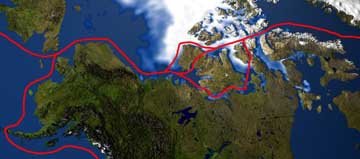 For centuries, humans have sought—and failed to find—a commercially viable passage connecting the Atlantic Ocean to the Pacific via the Canadian Arctic Archipelago. Now, as the effects of global warming—another product of the Jet Age, like “Airworld”—begin to reveal themselves and the Arctic thaws, one of the last grails of Earth-bound exploration is within our grasp. It is, to say the least, bittersweet. A Northwest Passage could cut 5,000 miles off a sea journey from Europe to Asia—and exacerbate tensions around the world. Maneuvering has already begun among countries who want to control it. As with global warming, such struggles could have a long-lasting, worldwide impact.
Related on World Hum:
* The Future of Travel: ‘Will August 2006 be Remembered as the Point of No Return?’
* Ethical Travel: What is a Traveler’s Responsibility?
* British Airline Pilots’ Association: ‘Air Travel has Become a Scapegoat for Global Warming’
Photo of the Northwest Passage by NASA/Wikipedia

The California Roll
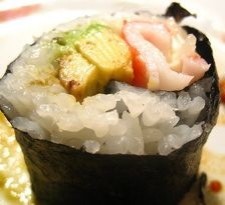 The California Roll isn’t particularly new—by most accounts, it was introduced in Los Angeles in the early 1970s—and chefs have since come up with more interesting fusion sushi combinations, but with its sacrilegious mix of avocado, cucumber and fake crab, the California Roll embodies sushi’s rise in popularity around the world and, more broadly, the many ways that cuisines from every corner of the planet are mixing in new, inventive and surprisingly tasty ways. Just don’t get caught eating one by the Sushi Police.
Related on World Hum:
* Bambi Roll, Anyone? Inside Japan’s Sushi Crisis.
* Inside Great Sushi and the World’s Biggest Fish Market
* Hide the California Rolls! Here Comes Japan’s ‘Sushi Police’
Photo of California Roll by Phu Son via Flickr, (Creative Commons)
Starbucks, Forbidden City*
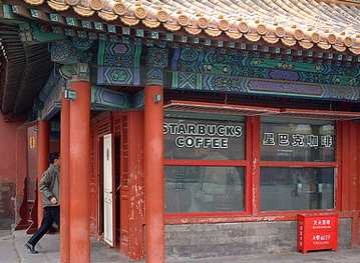 Armed with espresso machines, the foreign devils have breached the walls of the Forbidden City. OK, maybe they were invited in. No matter. While the Shanghai skyline is more typically shown as evidence of a rapidly changing China, the presence of Starbucks in the Forbidden City, a symbol of power in the oldest continuous civilization on Earth, is a more potent example of the shrinking planet’s impact on China and, for that matter, the rest of the globe. Some Chinese are calling for the removal of the coffee outlet from the historic Ming Dynasty site, which also makes it, fittingly, a symbol of any nation’s struggle to maintain its cultural identity amid rapid change.
Related on World Hum:
* ‘Confucius Craze’ Sweeps China
* Tiananmen Square, 18 Years After the Massacre*
* Secret Shanghai: Old Streets and Etched Faces Tell the Tale
Photo of Starbucks in Forbidden City by d’n'c’ via Flickr, (Creative Commons).
* Update Monday, July 16, 10:25 a.m. ET: When we noted in the introduction that these wonders were “not timeless but entirely of our time,” we didn’t know just how “not timeless” some of them might be. In response to ongoing protests—some have been clamoring since it opened seven years ago—the Starbucks Forbidden City outlet closed on Friday, July 13, according to a Reuters report.
* Update Monday, July 16, 11:51 a.m. ET: Help us choose a new wonder. We’re taking suggestions all week in the weblog.
* Update Monday, July 23, 5:23 p.m. ET:We’ve selected our new seventh wonder: The Irish pub.
What would you include in a list of seven wonders of the shrinking world?