
Michael Hess: The ‘On the Road’ Google Maps Mashup
Travel Interviews: Almost fifty years after the publication of Jack Kerouac's definitive road novel, Michael Yessis talks to the man bringing Sal Paradise into the Internet age
09.27.06 | 7:18 AM ET
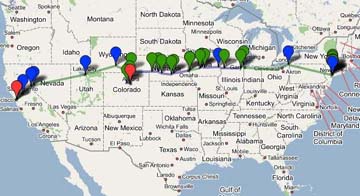
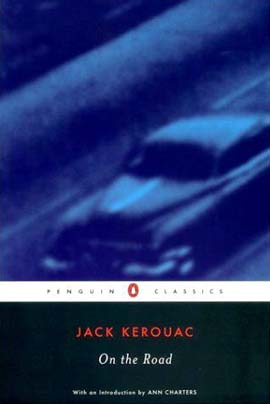 The idea for plotting Sal Paradise’s journey in On the Road
World Hum: You’ve been at this for more than four months now. I imagine you must have a deep love for “On the Road.” Have you read it many times?
I’d actually only read the book once on the Christmas drive from Albuquerque to my mother’s home in Fort Bragg, California. Megan and I read it together as we drove. So I’m not sure that I actually have a deep love for the book. What I do have is a deep love of adventure and travel. For me, there is nothing better than a road trip, especially after I settle into the drive and leave past stress of the packing and leaving behind and the future stress of getting to the place you are going is still far away. “On the Road” is constantly referenced as an iconic travelogue, and it was a gap in both of our literary experiences. So, I’m not sure “love” quite fits. But for the first date, I found it intriguing enough that I wanted to get to know it a little better!
So how do you get from there to creating Littourati?
The site actually came about because of three interests I have: literature, maps and programming. I am a voracious reader and have been since my childhood. I’ve always been fascinated by maps, too, and have often pored over them for long periods. I find that I’m more knowledgeable about a place, or a journey, if I can see it drawn out before me.
I discovered that, at least on the web, there were few, if any, maps of Sal’s journey, or of any other literary journey. I felt that mapping Sal’s journey would provide new levels of understanding, for me and others, on Kerouac, his motivations, the motivations of his characters and other things about “On the Road.” For example, he talks about being stuck in Shelton, Nebraska. It’s one thing to read that particular passage, but another thing to put it in perspective with a map—to see just exactly how far away from everything Shelton, Nebraska really is and to realize how that would have affected Kerouac and Sal.
Finally, the last piece of the puzzle came in the blog. It seemed to me that a map was great, but that part of my bigger understanding of the book would come with reflection. The book has been critiqued by others with more of a background and knowledge of literature, Kerouac and the Beats than me. However, a lot of things that Kerouac writes about conjure images and reflections in me. I get opinions and memories as I try to relate his images to my life, and in that process, I get greater understanding of the book and what it means to me. The process of reading the book, and then mapping it, takes me on the journey with Kerouac. Like any companion, I will see some things similarly and some things differently than him. I thought that a personal reflection on our trip together, enabled by the mapping, would be something that might stir a response in others. I also wanted to provide some practical information about the places Sal visited or mentioned, in hopes that those who might consider retracing all or part of Kerouac’s journey would know something more about those places. This has been an important part of the blog, because I can’t say enough about what I have learned about America past and present by exploring these places in more detail, even if my explorations have mostly been online.
Like what?
Take North Platte, Nebraska. I had never heard the story about how the town provided food and beverages to over 6 million servicemen and women who traveled through it by train during World War II. This was started as a spontaneous outpouring of appreciation to the troops, but gradually grew into a full-time undertaking fueled by volunteers and donations from the surrounding region. The canteen was closed for a year before Sal comes through the town, so it is not mentioned in the book. In fact, Sal does not give the town a very positive description. But had not the book introduced me to North Platte, I would not have known about this very interesting bit of history.
 What kind of reaction are you getting from Littourati readers?
So far the reaction has been positive. “On the Road” has touched and influenced a lot of people, and not only people who were contemporaries of Jack, but even today’s young generation. I had one guy, now in his 50s, who had made a similar trip and commented on every post with his impressions and understandings. I had another guy, younger than that, tell me he did the trip hitchhiking and by bus. Most of these people have run across the blog randomly. But they seem to like it, and seem to want more. I’m just happy those who have run across it have gotten something out of it.
You and Sal just crossed the California border and are heading into the homestretch. What your favorite parts of the journey so far?
I guess the first thing I really get a kick out of is Sal’s reaction to being stuck in the rain at the Bear Mountain Bridge. On one hand, I want to say “Come on, ya big baby!!!” But on the other hand, I know from first-hand experience how difficult long waits for rides in the rain can be from my own hitchhiking experience in Ireland.
I love his careening trip with the farm boys across Nebraska. It’s one of those experiences where you just let fate take its course. It reminds me of driving in Bangladesh, where you just smile as your driver heads straight toward a giant truck, both blowing the horn like mad, until one or the other swerves at exactly the last instant. If you think about it too much, you’d never get anywhere. I can picture Sal, sauced on whiskey and holding on for dear life, smiling the whole way, as those boys “ball that jack” across the prairie.
I think that in those few fleeting moments throughout his trip where Sal really thinks about what he is doing and his life are the things about the journey that are most rewarding. He has a reflective moment in a hotel room in Des Moines, for example, where he questions who he is and what he is doing. And the mundane things he does, like eating apple pie and ice cream all the time and sleeping on the grass under shade trees, are part of the mystique of the book.
I’m less impressed about Sal’s drug and alcohol-fueled experiences with his friends. I know Jack lived fast and died young, and that that these experiences were part of his mystique. But I think that you really get to know the inner experiences and workings of Jack in those times when a sober and clear Sal is reflecting, thinking, speculating and experiencing. I’m not a teetotaler by any means, but I think that those non-drug and alcohol experiences resonate more with me than the others.
You’re doing this from Albuquerque. How hard is it to stop yourself from hitting the road?
It is difficult in some ways. I love to travel, and I love taking the back roads and driving through the centers of towns rather than bypassing them on the interstate. I also love to check out local establishments and get a flavor of a place.
But there are other considerations that make it easy to stay home. Being married is one anchor. Luckily my wife loves to travel as well, but we are somewhat older (I’m 42 and she’s 40) and sort of past that “devil may care” attitude toward life. I like my bed, getting to my computer in the morning and reading the news, having a relatively set schedule for meals.
Lack of money is another anchor. It is just more difficult to pay for long trips, and I am not working a traditional job at the moment so we are really living on one salary. I think that those long hitchhiking trips were something that I really should have done in my 20s, when I was unattached and didn’t care so much about the sureties in life.
A third anchor keeping me home is the 1,000 pound gorilla on my back, my dissertation. My real employment right now is trying to finish that, get a PhD in political science, find a teaching job somewhere and settle down.
That being said, the call of the open road still beckons. I may not hitchhike it, but I can easily see Megan and me driving it and finding the small out-of-the-way places that are so fascinating to us. We are currently trying to see as much of New Mexico as we can. It is a really nice place for doing some off-interstate driving. Perhaps one day we’ll drive Sal’s journey for ourselves and see the out of the way places I’m only able to explore by Internet right now. But I think that the traveling that we do now is in the tradition of Kerouac—fun but reflective, off-the-beaten-path, and ultimately life changing, like any good traveling should be.
Any thoughts about which book you’ll be doing next on Littourati?
Part of me wants to do a New Mexico book, since I’m here now. I really like “Death Comes for the Archbishop.” Though not a “travel” book per se, it does mention a number of areas in New Mexico that I’m familiar with. I also thought about getting even more local with “Confederacy of Dunces.” We moved from New Orleans two years ago and that city is near and dear to us, especially after the hurricane. There are a number of places there that the characters frequent and upon which I can write at length. A friend of mine has also suggested “Lolita” which I have never read. I’m always open to other suggestions, and hope that I get suggestions from people who follow the blog, or get some people who are enthusiastic enough to join me and map their own literary journeys.
Oh, I’m sure some World Hum readers will have some other ideas for you. Thanks, and best of luck with the rest of the journey.
Thanks for showing interest in this fun little project of mine. I’m really glad that it seems to have touched a chord in some people and that they feel it is worth reading and following. I think I’ll be most gratified if people who have never read the book happen to run across Littourati, read some entries and are inspired to read the book themselves. I’m not necessarily trying to sell more copies of “On the Road,” but I think anything that inspires people to expand their knowledge and adds to their experiences is a worthwhile endeavor.
 Email to friend
 Twitter
 del.icio.us
 Digg
Digg Facebook
 Furl
Furl Ma.gnolia
 Mixx
Mixx Reddit
 StumbleUpon
 Yahoo! Buzz
Michael Yessis is the cofounder and coeditor-in-chief of World Hum.