
‘Getting Stoned With Savages’: The Adventures of Flip-Flop Man in Vanuatu and Fiji
Travel Books: In J. Maarten Troost's new book, he again flees Washington D.C. for a life on the islands of the South Pacific. Kristin Van Tassel reviews his foray into the world of volcanoes, sharks, hookers and kava.
09.12.06 | 6:31 AM ET
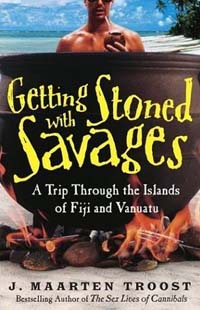 J. Maarten Troost’s new book, in which he escapes again to the Pacific isles, does not require him to navigate human excrement during his ocean swims, as he did in The Sex Lives of Cannibals, but he nevertheless once again finds himself stumbling through the dingier corners of paradise.
In his new travelogue, Getting Stoned With Savages, Troost flees the “soft-leather Italian shoe” culture of Washington D.C. in order to renew his tenure as an island “flip-flop man”—this time on the South Pacific islands of Vanuatu and Fiji, rather than the equatorial atoll of Tawara in Kiribati.
As was the case in Kiribati, Troost finds himself far more disoriented than he anticipated. Although in Vanuatu and Fiji the beaches do not function as public outhouses, the islands do offer Troost plenty to negotiate—frequent volcanic tremors, six months of cyclones, shark-infiltrated waters, imploding backyards, political coups, aggressive prostitutes, and kava-induced memory loss. Kava, an intoxicant derived from pepper shrub pulp, and the inspiration for the book’s title, comes to focus Troost’s adventure, as he spends many of his evenings scouting the local nakamals, or kava bars.
“Cannibals” established Troost as a hootingly funny travel writer. His sequel is similarly amusing—complete with his trademark, third-person “abstracts” at the beginning of each chapter. (Consider “Chapter Eight: In which the author travels to the island of Tanna, where he ascends an active volcano, witnesses the extraordinary Nekowiar, culminating with the slaughter of 200 pigs, and meets with villagers deep within the forest who live according to the tenets of kastom, which is another word for naked.”) But certain events covered in “Getting Stoned With Savages,” including the birth of Troost’s first child about three-quarters of the way into the narrative, as well as 9/11, the bane of every humor writer, do not fit as successfully into the lighthearted tone, making the narrative feel awkward in places.
Troost does a particularly good job of integrating history into his contemporary travel tale, offering interesting information about a region in the world few readers know well. The usefulness of the history, however, does not fully compensate for the absence of a strong story. “Stoned” does not have the coherence of Troost’s first book, possibly because Vanuatu and Fiji lack both the relentless idiosyncrasies and profound solitude of Kiribati—essential elements in holding together Troost’s earlier narrative.
Troost himself acknowledges the difference near the end of “Stoned,” when he admits that in both Vanuatu and Fiji he never shakes the feeling of being an ex-pat, in contrast to Kiribati, where: “The isolation was absolute; the deprivation universal. Living on an atoll was like living on a boat. It didn’t matter if you were rich or poor, native or foreign. You rolled with the same waves.” Troost makes this distinction in part to illustrate the disconnection he ultimately feels in Fiji and Vanuatu and, hence, his subsequent longing for home.
But the distinction might also offer a metaphor for Troost’s relationship with the reader. In “Stoned,” the reader watches Troost from afar, often laughing at him, but never fully connecting with him, never feeling the same waves. As a result, Troost’s latest, funny island adventure belongs more to him than it does to us.
 Email to friend
 Twitter
 del.icio.us
 Digg
Digg Facebook
 Furl
Furl Ma.gnolia
 Mixx
Mixx Reddit
 StumbleUpon
 Yahoo! Buzz