
Destination: Spain
“Americano”: A Backpacker Travel Movie Worth Seeing?
by Jim Benning | 03.24.06 | 11:42 AM ET
Too few travel-themed movies capture the spirit of travel as we see it at World Hum. “Before Sunrise” did. So, too, did “The Motorcycle Diaries.” This new film in limited release, Americano, sounds like it has potential. It focuses on a recent college graduate played by Joshua Jackson who is contemplating his future as his trip to Europe winds down during Pamplona’s San Fermin festival. Interestingly, actors in the movie were filmed as they participated in the actual Running of the Bulls. In a three-paragraph review in today’s Los Angeles Times, critic Kevin Crust praises the film: “Writer-director Kevin Noland effectively utilizes his fine young cast and the natural beauty and rich culture of northern Spain in amiably posing timeless questions of youth.”
 Email to friend
 del.icio.us
 Digg
Digg Facebook
 Furl
Furl Ma.gnolia
 Mixx
Mixx Reddit
 StumbleUpon
 Yahoo! Buzz
Guernica and “Picasso’s War”
by Jim Benning | 03.24.06 | 9:35 AM ET
Since our contributor Ben Keene featured the town of Guernica as his Place of the Week today, I thought I’d mention a terrific book about the attack on the town and the extraordinary Picasso painting of the same name. It’s Russell Martin’s Picasso’s War: The Destruction of Guernica and the Masterpiece That Changed the World, published in 2003. Martin recalls the Nazis’ attack on the Spanish village, Picasso’s work on the painting, its move to New York’s Museum of Modern Art until the death of Franco, and then its post-Franco return to Spain aboard an Iberia Airlines flight in 1981.
Guernica, Spain
by Ben Keene | 03.24.06 | 9:34 AM ET
Bullfighting School: ¿Quién es Más Macho?
by Jim Benning | 03.13.06 | 12:50 PM ET
I don’t talk about this much because, frankly, it just intimidates people, as it should. But back in 1998, when I was but a young magazine freelancer with a dog-eared copy of Hemingway’s “The Sun Also Rises” on my bookshelf, I enrolled in bullfighting school. The California Academy of Tauromaquia in San Diego, to be specific. That’s me in the photos. It was for a story for Men’s Fitness magazine.
I studied the art of bullfighting for several weeks, learning the ins and outs of cape-handling, among other essentials. For homework, I studied episodes of the TV show “When Animals Attack.” And then, wearing the traditional white shirt and cap of a bullfighting student, I stepped into a stone bullring in Mexico under a hot desert sun (actually, it was rather cool, but “hot” sounds more unforgiving; stick with me here), and went mano a mano with a snarling, charging 400-pound heifer. I graduated with honors.
Before any of you send angry e-mails: Not only did I not harm the animal, but at the time, I was a vegetarian who wouldn’t go within 10 feet of a Big Mac, so send your notes elsewhere. But I digress. I bring this up now because Gadling just pointed out a recent New York Times story in which the writer attended the same bullfighting school and faced a 300-pound heifer.
Now, I know what you’re thinking: Three hundred pounds? That’s it?
Exactly. That’s the first thought that ran through my mind.
Back in the day, if you wanted to prove yourself in the ring and deliver a meaty story to your editors, you made sure you faced at least 350 pounds of lumbering beef. Know what I’m saying? And honestly, if you were an editor worth your salt, you wouldn’t print a bullfighting story by a writer who faced anything close to 300 pounds. At the New York Times, you’re just giving more ammunition to those in Red America who claim the liberal media elite are out of touch. Don’t you editors know your heifers? Get back in touch. We need you. No bull. Okay, a little bull.
As for the California Academy of Tauromaquia, it offers an excellent bullfighting education, and I’d recommend it to anyone interested in learning the basics. And really, shouldn’t we all know at least the basics? No? Okay.
Spain: Home of the World’s Coolest Architecture
by Michael Yessis | 03.10.06 | 12:22 AM ET
Slate recently posted a slide-show essay about innovative architectural developments in Spain. The presentation includes great shots of Bilbao’s Guggenheim Museum, Granada’s Museum of Andalusia and Barcelona’s Santa Caterina Market. New York’s Museum of Modern Art also currently has a great multimedia exhibition on its Web site, featuring audio commentary and images of more stunning Spanish buildings.
Tourist Architecture: Kitsch Curios and Vainglorious Monstrosities
by Michael Yessis | 02.13.06 | 10:02 AM ET
I think the proposed Grand Canyon Skywalk is unnecessary. Jonathan Glancey thinks it’s a travesty. And his criticism extends to other questionable developments in well-traveled spots around the world. In Saturday’s paper, the Guardian’s architecture correspondent listed his picks for worst additions to natural landscapes around the world. He pulls no punches.
The World’s Most Seductive Road Trip Routes
by Michael Yessis | 01.30.06 | 4:31 AM ET
The Sydney Morning Herald’s Paul Edwards lists 10, including Italy’s Amalfi Coast, Spain’s Las Alpujarras, South Africa’s Cape Peninsula Scenic Route and New Zealand’s Pacific Coast Highway.
Incident in a Spanish Church
by Catherine Watson | 12.15.05 | 7:28 PM ET
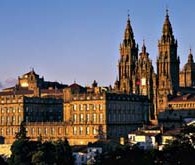 Photo from Spanish Tourism.
 She never spoke to the boy in the red windbreaker. But Catherine Watson's encounter with her fellow pilgrim along the road to Santiago de Compostela transformed her in an unexpected way.
An Unhappy Anniversary at the Running of the Bulls
by Jim Benning | 07.14.05 | 12:32 PM ET
The annual Running of the Bulls wrapped up today in Pamplona, Spain. For most participants, it’s a quick, adrenaline-filled sprint that ends safely. But not for everyone. This year’s event marked the 10th anniversary of the death of Matthew Tassio, a 22-year-old Illinois native who was the last person killed in the running. Writer Andrew Walker was watching from the sides that day. In an unusual story in the BBC, Walker recalls the chaotic scene and remembers the fallen traveler. “From time to time, my mind strays back to that cool, sunny morning in 1995, and I think of Matthew, his parents and friends,” Walker writes. “I haven’t been back to Pamplona.”
No Bull: San Fermin Festival in Jeopardy
by Jim Benning | 04.14.05 | 9:26 PM ET
Terrorists Attack Spanish Trains
by Jim Benning | 03.11.04 | 8:50 PM ET
At least 186 people were killed and 1,000 people injured in bomb attacks on commuter trains in Madrid today. The Spanish government blames Basque separatists. CNN has details. So does the BBC.
Visit 180 Countries in One Afternoon and Get Free Drinks
by Michael Yessis | 11.24.03 | 9:48 PM ET
It’s possible at the World Travel Mart, the annual gathering of representatives from nations, airlines, car rental companies, cruise lines, hotels, railways, regional tourist boards and just about every other travel-related business you can think of. They put the best spin on their “product” for thousands of tour operators, travel agents and, of course, travel writers in search of stories, freebies and potent cocktails—not necessarily in that order. Cleo Paskal of Canada’s National Post traveled to this year’s Mart in Birmingham, England, and found it to be “a surreal event.”
Rebranding Nations: Can a Logo Change the Way We Think About a Country?
by Michael Yessis | 12.02.02 | 3:26 PM ET
Poland’s Ministry of Foreign Affairs recently hired a branch of the global advertising agency DDB to design a logo to be used to promote tourism and trade in the country. The resulting image—a red-and-white kite whose tail is held by a dancing stick figure that doubles as the K in the word Polska—has spurred discussion in and outside of Poland regarding national “branding.”
“[A]s with any other brand, people have associations, good or bad, with the nations they know,” writes Sarah Boxer in Sunday’s New York Times Magazine. “But can you change people’s minds by repackaging, rebranding a nation?”
The governments of Poland and many other countries seem to think so. Why? It’s Spain’s fault.
“Two decades ago, Joan Miro designed a splashy, sunny national emblem to promote tourism,” Boxer writes. “Thanks in part to the Espana logo, Spain is no longer associated just with Franco, the Spanish Civil War and Don Quixote. It is a country of wine (Rioja), movies (Pedro Almodovar) and art (Miro).”
Poland’s logo may not spur the same sort of transformation, but it has had its intended effect on at least one person: me. I’ve never been to Poland, and I’ve always had a vaguely gray, industrial image of the country. Now? I’m amazed, and even a little reluctant to admit, that the logo has instantly brightened my thoughts.
How does the new logo affect you? Check it out here and share your thoughts.
World Tourism Revenue Down 2.6 Percent
by Michael Yessis | 06.25.02 | 12:03 AM ET
The Madrid-based World Tourism Organization reports that the September 11 terrorist attacks in America helped cause travel revenue to slump throughout the world in 2001. Still, travelers spent more than $463 billion (U.S.) during the year. France was the world’s top tourist destination, drawing 76.5 million visitors, followed by Spain (49.5 million) and the United States (45.5 million).
The Torture of Group Travel
by Jim Benning | 05.09.02 | 10:24 PM ET