
A Very Long Way to the Hong Kong Cafe
Travel Stories: In Ilulissat, Greenland, Daisann McLane found one righteously good Singapore curry chau mihn. More surprising, though, was the man who emerged from the kitchen when she shouted, "Hai go douh yauh mouh jung gwok yan a?"
03.21.07 | 6:52 AM ET
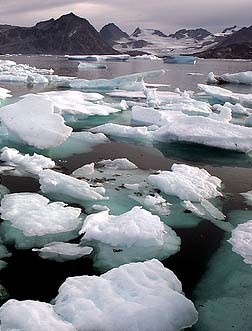 Photo by
 Several years ago I went to Greenland on a travel writing assignment. Getting there was a trip in itself. First I flew from New York to Ottawa, then from Ottawa to Iqaluit, Canada on commercial airliners. In Iqaluit, I hopped an eight-seater charter jet for the journey over the Greenland Sea.
It was an exciting flight. Halfway there, at 25,000 feet or so, one of the baggage compartments popped open, releasing the Canadian pilot’s gear into the cold, cloudless skies. I couldn’t see what was happening from my side, but I heard him groan, “Oh shit!” and I thought we were all about to die among the icebergs. I didn’t know he had only lost his windbreaker.
About the icebergs. They are everywhere in Greenland’s waters, luminescent, bluish-white chunks floating in the cold, emerald-green ocean. The ice is ancient, thousands of years old, and it is said to be the purist water on earth. Greenland does a big export trade with Japan in ice. Rich Japanese businessmen impress their clients by serving up scotch on genuine iceberg rocks.
By the time I arrived in Ilulissat, Greenland, I thought I had gone as far as I could go to the ends of the earth. The little town had the feel of a frontier settlement from the last century. I wandered the twisting, muddy paths, up and down rocky hills, avoiding packs of toothsome and snarling sled dogs. Hungry, I despaired of finding anything I could eat—the local cuisine is composed of dishes like barely-cooked salmon and whale blubber.
And then, at the top of a steep path, I spotted a low shack that had a sign that froze me in my tracks:
Hong Kong Cafe
A friend of mine once told me a story about his dad, a New Yorker who was one of the great photojournalists of the last century. In his lifetime he roamed all over the world, covered World War II, was imprisoned by the Japanese in Shanghai, landed with General MacArthur in the Philippines. Anyway, my friend’s extraordinarily well-traveled dad always used to tell him: “Son, remember one thing. No matter where you go in the world, you are never far from a Chinese restaurant.”
In the back streets of a remote town on the Greenland coast, I discovered how right he was.
Inside, the Hong Kong Cafe was tiny and windowless—those Greenland winters can be cold—but there was nothing else exotic about the place except the menu, which was bilingual in Danish and Inuit. The guys behind the counter also looked Inuit. For a moment I wondered if the “Hong Kong” in the name of the place was a fiction, something conjured up by an imaginative Inuit or Danish owner to lend authenticity to greasy chow mein.
But I brushed away those doubts and strode to the counter. For a minute, I puzzled about how to order. Danish was out, and I didn’t know a syllable of Inuit. What the heck, I thought, and I ordered in Cantonese.
The two clerks stood there, baffled. I repeated my order. Finally, I pointed back to the kitchen and said, loudly, “Hai go douh yauh mouh jung gwok yan a?” Is there a Chinese guy in that kitchen?!
At once a door swung open, and out popped a man wearing a long white cook’s apron and a round, sailor-like cap.
Mr. Chan.
He was in his 30s, tall with a pale baby face that easily turned red. It was red. He told me that he was Malaysian, from Kuala Lumpur. Mr. Chan spoke Cantonese, a little English but he told me that his main language was Mandarin. Since he was Malaysian, I asked him if he could fix me a Singapore curry fried noodle.
“Ho yih!” he replied, and hurried back into the kitchen.
One of the Inuit waiters brought out the steaming plate of rice noodles. Maybe I’d been eating salmon and whale blubber for too many days, but I have to say it was one righteously good Singapore curry chau mihn. Really, this place deserved to be named after Hong Kong.
I had just about polished off the plate when Mr. Chan quietly reappeared. He stood hovering by my table for a moment, watching me eat the last bites, which I did with exaggerated gusto as I told him how hou meih douh his noodles were.
He beamed, and I invited him to sit down.
There are a lot of ways that you could begin a conversation with a guy from Kuala Lumpur who is running the kitchen of a Chinese restaurant in Greenland. Openers popped to mind, like “What kind of crazy person moves from one of the hottest countries in the world to one of the coldest?” Or: “What’s a nice guy like you doing in a job like this?”
But instead I chose a gentler tack. “Neih laih-jo hou yuen, ah?” You’re come a very long way, haven’t you?
Mr. Chan poured out his story. It was simple, really, he said. Back in Kuala Lumpur an entreprenurial friend of a relative had approached him. The businessman already had opened one Hong Kong Cafe in Greenland’s capital city and wanted to open some others in the outposts along the western coast. (Greenland’s Hong Kong Cafes are a chain!) The lo baan needed reliable Chinese cooks, and was offering good pay, plus roundtrip fare once a year to go back to Malaysia for three weeks. One year contracts, renewable.
“I had no wife or family, and I wanted to make money and see outside,” explained Mr. Chan. So he signed on.
That was five years ago.
“Yes, it is very cold and dark here in the winter,” he said. “And every year I think I will go back to Kuala Lumpur for good. When I get to Malaysia I find it okay for a while. But then there is too much family, everything feels too crowded. Jobs as cook don’t pay so much money back there. The time comes to decide. I sign contract again, return to Greenland.”
I looked at him for a while, trying to imagine how it would feel to be in a remote land of tumbling icebergs, 10,000 miles distant from anyone who looked like me or spoke my language. I wondered if there were parts of Mr. Chan’s story he was leaving out—a criminal past? A broken heart? Most likely he was just making a very pragmatic, and very familiar Chinese calculation: loneliness and isolation versus money saved to take back home to Malaysia someday. It is the same calculation made by the men from Guangdong who came to North America to build railroads in the 1800s, the Cantonese who came to labor in Jamaica, Cuba and Central America in the 1900s.
It occurred to me that when you are isolated and far from home, language becomes something far dearer than an exchange of words. Maybe that is why Cantonese has spread to so many corners of the world, and why it still endures.
Mr. Chan interrupted my thoughts. “You are the first person ever to come in here and speak Cantonese. Actually I feel very surprised to hear the sound. Amazed, really.”
Then he asked to borrow my notepad and pen, and scribbled his name in Chinese characters on a blank page, along with his e-mail address.
“I must go back to the kitchen now. Please you are welcome to come back again. Maybe you have time to take a walk with me. Or you could write to me sometime.”
Mr. Chan of Greenland paused for a moment, and added a request: “Write in Chinese.”
 Email to friend
 Twitter
 del.icio.us
 Digg
Digg Facebook
 Furl
Furl Ma.gnolia
 Mixx
Mixx Reddit
 StumbleUpon
 Yahoo! Buzz
Daisann McLane is a writer who splits her time between Brooklyn and Hong Kong. She began her career as a contributing editor at Rolling Stone, moved to the Village Voice, and later spent six years writing the Frugal Traveler column for the New York Times. Her book of essays and photos, Cheap Hotels
Julia Ross 03.29.07 | 10:10 AM ET
Another great essay by Daisann. As someone struggling to study Mandarin full-time, I’m always cheered by her writing on how Cantonese has opened unseen doors. Very much looking forward to the book ...
Isaac 05.05.07 | 10:27 AM ET
Hello Daisann McLane, this is Isaac from Hong Kong, I am planning a trip to Greenland as I want to see the world in the far north. I would like to know more about that Chinese restaurant, feel free to contact me with the above email address.
Thanks.
Dee 07.03.07 | 5:34 PM ET
Wow, this is a great story! I love it. When one comes across a good story, it just leaves you feeling breathless.
P.S. I’ve lived in Hong Kong, too.
DANIELLEE 04.07.08 | 10:55 AM ET
DEAR,
Daisann Mclane,
I am chinese living in Singapore.
How can i contact Mr.Chan in Greenland?
I have planned to travel to Greenland. I have read your article about your trip in Greenland.It is fun.Never heard of curry in the north pole.All the way I thought north pole only with westernized food provided.Feel free to contact me with Mr.Chan email add.
provided and reply soon.Thanks.
daniel 04.23.08 | 4:56 AM ET
To,
Mr.daisann mclane.Once i need your help how to contact Mr.Chan in greenland.I’m sorry to trouble you but anyway I have thought to have a trip to there if time allow me to do so.Anyway this should be more convenience if I have a contact so I will know where I should go if I reach there. Is there any email or contact no. please do not hesitate reply this e-mail. thanks.