
Anthem Soul
Travel Stories: James Brown tunes seep through walls in a Syrian hotel. Rolf Potts listens in and finds new meaning in "Sex Machine."
07.06.01 | 1:00 AM ET
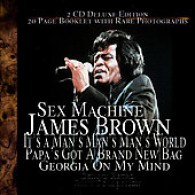
I am walking past the room of the young Russian couple when I hear the sound. Steady, rhythmic, it leaks out softly into the hall of our claptrap Aleppo hotel. Checking first to make sure no one is watching, I stop and press my ear to the door. My heart is soon pounding with joy, but I fear what would happen if one of the Russians suddenly opened the door and saw me hunched there.
Improvising a plan, I jog out to the hotel veranda and fetch a white plastic lawn chair. Placing it just next to the Russians’ door, which is across the hall from my own, I take a seat, looking casual—my ear cocked to catch the dim throb of sound. For a moment, I hear nothing—just the noises of the Syrian evening drifting in from outside. Then, faintly, the sound resumes. Shuddering with pleasure, I rest my head against the wall, thinking this must be how addicts feel when they loosen the rubber tubing and let the heroin drift into their bloodstream.
I am not eavesdropping on illicit couplings or mystical incantations, but a poorly recorded tape of James Brown songs: “Popcorn,” “Sex Machine,” “Give it Up or Turn it Loose.” There are some other songs, too, but I don’t know the names because I’m not that familiar with Brown’s music.
Two years ago, possibly even one year ago, such old American music wouldn’t have had this kind of effect on me. Since I started a two-year journey through Asia early last year, however, I have been conducting a musical experiment, and this has changed the way I listen to the world.
The experiment has been fairly straightforward: For the past 16 months, I’ve been traveling without a Walkman or music tapes. The only music I hear from day to day is what’s being played in the streets, in restaurants, or at the occasional live performance. The original idea behind this was that I didn’t want to trap my new experiences into the narrow frame of my established musical tastes. Rather, I wanted to keep my mind open and discover the music of the cultures I was visiting.
This has yielded curious results. I have indeed experienced the exotic novelties of foreign music as I travel, but I’ve found that these songs ultimately blend into the background of the day-to-day scenery. Instead, what I have truly discovered—in the rare, ecstatic moments that it’s available on the road—is American music.
To a certain extent, these vivid jolts of American songsmanship have come out of my indie-rock pedigree: Elliott Smith’s “Speed Trials” in an expat’s apartment in Ho Chi Minh City; Public Enemy’s “Lost at Birth” in a Pusan pub; the Pixies’ “Where is My Mind?” at a “Fight Club” screening in Cairo. But I’ve found that older American tunes—songs that I’ve never previously embraced—have had a much more powerful effect on me. Listening to Louis Armstrong’s “Mack the Knife” in Ulan Bator, Dave Brubeck’s “Take Five” in Beirut, or James Brown’s “Sex Machine” here in Aleppo, I feel like I’ve tapped into an energy, an inner passion I’ve never experienced in this way before.
And that passion, I believe, is patriotism.
Yesterday, I was sitting on the veranda of this same hotel when the evening call to prayer went out over the city of Aleppo. So numerous are the mosques in this northern Syrian city that the shouts of the muezzins blended together into one apocalyptic hum. As the chants of “Allahu-akbar” (“God is great!”) reached a crescendo, I imagined how this could be a beautiful sound to Muslim ears. At the same time, however, it seemed that the Islamic call to prayer was serving a social function more than a spiritual one. After all, any reasonably devout Muslim can remember when to pray, and he shouldn’t need much imagination to realize that God is great. Therefore, I’d wager that the call of the muezzin isn’t an exercise in Islamic devotion so much it is an exercise in Islamic unity: Five times a day, it reminds everybody, devout or not, of what the ideal is.
In the same way, traditional patriotism in America has mostly been appropriated for social purposes: It simplifies complicated ideals such as inclusion, adaptation, and sacrifice into a neatly packaged impulse. This impulse, of course, is a handy kind of marketing tool for things like wars, elections, and professional sports.
Take away those marketed goals, however, and the traditional symbols of American patriotism can ring a bit hollow. The official American anthem is a good example. First written more than 185 years ago, Francis Scott Key’s “The Star-Spangled Banner” was originally an ode to defiance written when America was a young, insecure nation that had recently had its capital torched by British troops. And while the first verse is innocuous enough to let modern Americans sing along and envision the Stars and Stripes fluttering at a fireworks demonstration, the song turns decidedly vengeful by its seldom-sung third stanza: “Their blood has washed out their foul footstep’s pollution, / No refuge could save the hireling and slave / From the terror of flight or the gloom of the grave.”
That’s the kind of lyric that, when accompanied by rap music, gets condemned in congressional hearings. For some reason, however, this doesn’t really matter: We feel patriotic when we sing “The Star-Spangled Banner” not because it’s relevant or inspiring, but because we’re supposed to feel so.
However, just as Aleppo’s Muslims can find sublime epiphanies outside the mosque, I keep discovering my patriotic anthems within warmer, more infectious rhythms. And that’s why James Brown has turned me into an eavesdropper here in Aleppo. At moments like this, I don’t just feel more American: I feel like I’m part of a greater conspiracy of magic and genius.
And that, in a way, keeps me centered as I travel from place to place in Asia. On the road, days are distinct for their diversions, and not for their position on the calendar. It’s not the Fourth of July as I write this, but it may as well be: With James Brown just audible from behind the door of my Russian neighbors, I pledge allegiance to the flag—not out of duty, history or politics—but because I got soul, and I’m superbad.
 Email to friend
 Twitter
 del.icio.us
 Digg
Digg Facebook
 Furl
Furl Ma.gnolia
 Mixx
Mixx Reddit
 StumbleUpon
 Yahoo! Buzz