
Blooming in Jerusalem
Travel Stories: When Lynn Cohen left the shores of Lake Michigan and the perfect boy to spend a month in Jerusalem, she couldn't wait to return home. But that was before she arrived.
07.01.02 | 11:01 PM ET
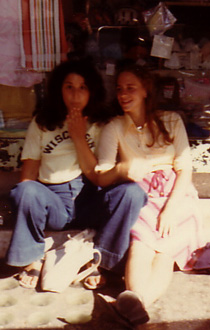 Photo courtesy Lynn Cohen.
When I was 17, during the summer of 1978, my parents and younger brother and I spent the month of July living in the doctors’ residence apartments adjacent to Hadassah Hospital in Ein Kerem in Jerusalem. My father was a volunteer in a program that hosted physicians from overseas in exchange for accommodations and an experience of living in Israel.
My blooming adolescent heart was not happy about this obligatory trip; I’d just met a boy, and he was perfect, and he liked me, and naturally, all I cared to think about, in those days, was him. My plan for enduring the coming weeks was to count off every single sun blazed day until I could El Al it back into his waiting arms.
We were set up in a fully equipped apartment, but it felt nearly empty in comparison to our wall-to-wall carpeted, leaded-glass windowed, heavily furnished, quilt-bed-spreaded home on the shores of Lake Michigan. High on this hill, light streamed in through the curtainless, metal-framed windows overlooking the rock-terraced valleys below. Hot cross-ventilation air was the only form of relief from the desert afternoons.
During the day, my father walked up the hill in his white lab coat and disappeared into the hospital. My mother read paperbacks and wrote letters and shopped for staples, arriving home with fishnet sacks bulging with vegetables and boxes of soup mix, cereal in crackling waxed paper packages with cartoon-size Hebrew writing, sweating plastic quart bags of milk that you inserted into a wide oval pitcher, then snipped the corners off to pour. Cans of preserved fish, newspaper-wrapped blocks of cheese and meat, stacked loaves of pita bread, and a white dairy spread called “labneh” that tasted like a cross between sour cream and yogurt. We ate mostly cold meals.
During those first few days, my brother and I caught the bus into town, where we would wander along crowded avenues lined with stores and kiosks and tourist shops. We bought bags of sunflower seeds and watched how the Israelis cracked them open and spit out the shells in two deft mouth movements (of course we were not able to do this). We stopped at refreshment stands and sipped from straws stuck in bottles of cold grapefruit sodas, spinning around on the parlor style stools. We mostly hung close to the center of town where a well-known pizza parlor overflowed with American kids our age. Once in awhile one of us would recognize someone from our Hebrew school class on youth group tour. I don’t know about my brother; I would be glad for the familiarity, but pretend to feel superior. After all, I was living here now.
We wandered, eating half pockets of falafel wrapped in butcher paper and dripping with tahini and hot sauce, walking down the tourist-crammed, bus-rumbling, car-honking, exhaust-spurting avenues. Without the encumbrance and embarrassment of our parents’ presence, I luxuriated in the fantasy that people would see me and think I was Israeli—though I knew only the basic Hebrew I’d studied as a junior in high school. We took shortcuts down dark alleyways where Orthodox men in high black hats and ear curls peed into shallow gutters. Handsome gigolo-looking men ogled me as I pretended not to notice. They wore colorful disco shirts that had a sheen, opened to their navels showing off gold chains and chests furry with dark hair. They had small tight asses and wore polyester bell bottoms and tassled slip-on shoes.
Most nights we sat around the apartment and read. There was a T.V. with one English channel that ran news only. I would go outside and sneak a cigarette on the rough stone steps of our apartment complex under a black sky splattered with stars and send psychic messages to my boyfriend. I never got any back, but that didn’t discourage me.
We had relatives in Jerusalem who hosted us every Friday night for Shabbat dinner. They were Americans who had emigrated to Israel, “made Aliyah,” as it is known—Aliyah means “the going up.” Annabel was a ferociously energetic woman with extreme, open eyes who made wall hangings out of fabric ends, lace, burlap and yarn. Their apartment walls were covered with brightly colored hangings in all sizes of biblical moments, the burning bush, crossing the Red Sea, and panoramas of the Jerusalem skyline, the many domes sewn out of fabric intended for elegant evening dresses. Leo was a frail man in his 70s who had learned Hebrew fluently and had in his retirement dedicated himself to children’s literacy efforts. He suggested that my brother and I might be interested in volunteering at a hospital he was connected to. It was a hospital for handicapped (that was the word they used then) children.
At the risk of pleasing my parents too readily, I agreed. The following Sunday, he drove my brother Barry and me to Alyn Hospital and introduced us to the director. We were told that the kids at the hospital could always use visitors. They lived there, and rarely had them. They were all in wheelchairs. Their parents had no choice, for one or another reason, but to leave them there. All we had to do was visit. Cheer them up. Help out the staff as it was needed.
The first day, we were given a tour of the facility, then led to the community room where 10 or 12 patients sat around watching T.V. and playing board games. Nobody looked up. The director flicked the light off and on several times, as someone might do to get the attention of a group of deaf people, and she said in a gravelly voice, “Yeladim!” Children. Faces turned toward her, electric wheelchairs whirred in her direction. At their attention, she rattled off a speech in Hebrew. She gestured toward us, and paused. I understood that she had forgotten our names. “Lynn,” I said. “Leen,” she repeated, like a cheer. Barry said his name. “Berrie,” her “r” rolling in the back of her throat.
And then she left.
The room of children stared. The black and white television was showing a rerun of “I Dream of Jeannie” with Hebrew subtitles. I could hear the “boing” sound of Jeannie head-bobbing a trick into being. In the dim space, the speckled brown floors reflected the flickering light. At the far end there was a stage where, I imagined, they put on plays, wheelchairs crashing into each other, Hamlet performed in Hebrew. Cafeteria tables met at angles as if a train had derailed. Beige plastic chairs were scattered throughout the room, some overturned. Who needed chairs? I looked around. They were all ages, all sizes. I saw a skinny boy with bronze skin and hair whose bangs fell across in his turquoise eyes even as he blew them upwards over and over again with a thrust of breath. Some of them had eyes that circled around in their faces as their heads lolled because they could not hold them up. Some had metal braces that kept their spines erect and forced their chin into a permanent parallel to the floor. A very young boy with a round face and dimples and curly hair and a gap between his two front teeth stared at me.
From the back of the room, a movement: metal spokes glinting, wheels spinning, elbows flying over handle, thrusting. At us comes a boy my age with an alluring, underground expression. He stops in front of us. Thin, serious face, defended jaw. A bearing tightly woven. Near black eyes. Deep, Dead Sea never-giving-up black hair.
His body is preposterous. Someone’s creator has played a terrible joke. His upper arms are thin as lollipop sticks, fragile as wineglass stems. His legs are dead, folded over sideways, collapsed slats of window blinds.
He flips something, like a magician, from his palm, holds a cigarette to his lips. His hand is strong as a cellist’s.
“Esh,” he says. Fire.
It sounds to me not so much the dare he intends as the necessary continuation of a conversation that had begun, between us, some incalculably long time ago. We look hard at each other. The air around me seems to move. It is the swirl of stagnant expectations. Without looking for it, I have come upon the point of my being here. Whatever this boy has to say to me, I am going to let him say it. I think ahead to my El Al flight idling on the runway; I see it gather speed, tail glinting, lifting off. My own feet feel sweetly, firmly on the ground.
I reach for my matches.
 Email to friend
 Twitter
 del.icio.us
 Digg
Digg Facebook
 Furl
Furl Ma.gnolia
 Mixx
Mixx Reddit
 StumbleUpon
 Yahoo! Buzz