Travel dispatches from a shrinking planet

Travel dispatches from a shrinking planet

RECENT DISPATCHES
9.30.08

Feasting in Lyon

Jeffrey Tayler feared he would never feel as intoxicated with the sense of discovery as he once did. But something clicked when he set foot in France’s third-largest city.

9.9.08

Visit Myanmar—That’s an Order

Travel to Myanmar has slowed to a trickle. But a decade ago, with great fanfare, the government launched a new tourism campaign. Stephen Brookes, then Rangoon bureau chief for Asia Times, remembers its bizarre launch ceremony.

TRAVEL BLOG
SPEAKER'S CORNER
image

Vagrant Ruminations of a Compulsive Traveler

Where does the urge to hunt for that “fleeting fix of elsewhere” come from? Peter Wortsman recalls a life of travel inspiration. 

Q&A
image

Rolf Potts: Revelations from a Postmodern Travel Writer

His new book “Marco Polo Didn’t Go There” includes his best stories from the past 10 years. Michael Yessis asks him how travel writing has changed in the last decade—and what he sees for the future.

AUDIO SLIDESHOW
image

Notes From an Unofficial Tourist Greeter

Summer is over, and so is Julia Ross‘ season as an ambassador to travelers in Washington, D.C.’s Woodley Park neighborhood. She’s happy to be off duty.


THE LIST
image

10 Great Travel Race Movies

Slow travel is well and good. But there’s something irresistible about a great travel race movie. World Hum Travel Movie Clubbers Eva Holland and Eli Ellison share their favorite vicarious thrill rides.

HOW TO
image

Eat Ceviche in Lima

Grab a Cusqueña and get comfortable. As Nicholas Gill explains, a trip to a Peruvian cevichería can be an all-day immersion in good conversation and raw seafood.

ASK ROLF
image

How Should I Spend My Time in Spain?

Vagabonding traveler Rolf Potts answers your questions about travel

BOOKS
image

Unsentimental Journeys: Wrestling With Paul Theroux

Bronwen Dickey considers “Ghost Train to the Eastern Star: 28,000 Miles in Search of the Great Railway Bazaar”

DISPATCH
8.13.07

Hope and Squalor at Chungking Mansion

Karl Taro Greenfeld explores Hong Kong’s notorious black-market bazaar and budget accommodations, and one possible over-populated, multi-ethnic future for us all

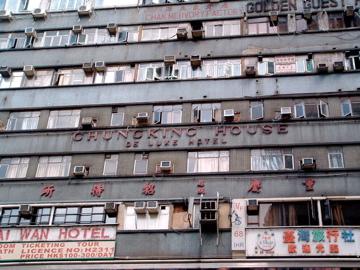
imageChungking Mansion is the only place I have ever been where it is possible to buy a sexual aid, a bootleg Jay Chou CD and a new, leather-bound Koran, all from the same bespectacled Kashmiri proprietor who can make change for your purchase in any of five currencies.

It is also possible, while wandering the alleys, hallways and listing stairwells of Chungking Mansion, to buy a discount ticket to Bombay, purchase 2,000 knock-off Tag Heuer watches or pick up a counterfeit phone card that will allow unlimited calls to Lagos, Nigeria. Need a tattoo? Piercing? Dental work? Yellow fever vaccination? Cialis? No problem, just don’t ask to see a pharmacist’s license or medical school degree. Or, if your schemes have all run aground and truly desperate measures are called for, you can sell your passport and order up a forged new identity. You can disappear here. Thousands have. Most of them by design.

I was 24 when I first visited the Mansion, stopping en route from Tokyo to undetermined points West. My friend Trey and I, encouraged by a blandishing Delhian dwarf wearing an NWA T-shirt, had boarded a shuttle-bus from Kai-Tak airport that deposited us before the dizzyingly busy entrance. He guided us to a 5th floor, B-block guest house, assuring us, “You will be stupendously pleasure with this accommodation,” before opening the door to a mini-van sized chamber strewn with loose electric wiring and a sort of fecal mildew staining the walls.

There was a sit-down toilet, on which the previous tenant’s footprints were still visible on the plastic seat, and a working hand-shower of sorts. Plus, it was hard to beat the price in famously expensive Hong Kong—about five bucks a night. Within two hours, we’d fallen in with a Canadian man who described himself as a “Leftenant-General” and told us he knew where we could get injected with a mixture of one part snake’s blood and one part Demerol.

“Wouldn’t that kill us?” We asked.

“Demerol?”

The Leftenant-General shook his head, “Best pain-killer in the world.”

“No, the snake’s blood.”

“Hasn’t done so yet.” He assured us, thumping the chest of his safari-vest.

For hundreds of thousands of visitors and immigrants to Hong Kong, Chungking Mansion provides the first waystation into what has been known since the 1997 handover to China as the Special Autonomous Region. Take everything that Disney’s Epcot Center represents—the squeaky-clean, child-safe, good-natured cheer of painless globalism—and then cover it in mutton fat, dope resin and human excrement and you’ll get Chungking Mansion. Known as “The Armpit of Asia,” Chungking Mansion is the claustrophobic home for about 20,000 residents from all over the globe. Yet the Mansion also provides a glimpse into one possible over-populated, multi-ethnic future for all of us. This 17-story bazaar of curry stalls, discount electronics vendors, pirated CD and video CD stores, brothels, meth dens and guest houses, provides a glimpse of a dystopian, post-technology future where tribes, cultures and races co-exist in bustling, jumbled squalor.

Think “Blade Runner” or “The Matrix,” set up by a Bollywood production company and recast and reshot by John Woo. It’s not just the tiny rooms and dim halls and perpetual damp and the wires and phone lines running up and down and across every vertical surface, there is also a sense of displacement and a vague anxiety that wash over you as you thread your way between Pakistani businessmen carrying bulging suitcases stuffed with pirated video CDs and a trio of over-made up, platinum blonde Russian working girls squeezed into impossibly tight red and black leather cat suits. Here are the turbaned and beaded and mustachioed masses, displaying everything that is glorious and terrifying about a truly multi-ethnic world. The cliques of barrel-chested Nigerians hanging out beside the traffic-jammed road, the gangly Bangladeshi touts on the stairs, the Chinese hookers by the money changing queues talking on cell phones, it is exhilarating and confusing all at once. Yes, you discover, we can all get along. But it will take every ounce of respect, patience and grace we have to do it.

There actually was a movie set here, 1994’s “Chung King Express,” directed by Wong Kar Wai, an anthology about Indian drug smugglers, Chinese cops and short-order cooks. “The place was always a mystery to me,” says Kar Wai, who grew up in the Tsim Sha Tsui area of Kowloon, in the shadow of the Mansion. “The people living in and living on it seemed very different from those I encountered. You can’t help but have fantasies about what was actually happening inside. Of course, as a child, I was prohibited by my parents from visiting the place.”

No one seems to remember the building’s architect, and the Hong Kong Land Development Corporation has no record of the original design. Perhaps the architect would prefer to remain anonymous, for among the structure’s foibles is that all public space, and plenty of private apartments as well, receive no natural lighting. According to Valerie Portefaix, a Hong Kong architect and co-author of Mapping Hong Kong, it would be geometrically impossible to create a darker building. Day and night blur within the Mansion; neon streetlights serve as stark illumination for the dim halls and stairwells.

Yet the five-building complex, dubbed a “Mansion” by it’s optimistic developer in 1961, was intended as spacious, affordable housing for the new, monied, urban classes of the then bustling British colony. In a promotional sketch from the early ‘60s, the city-block sized development appears as a glittering monument to Hong Kong’s capitalist potential: sturdy, white towers with generous plazas on the first three floors dwarf every other building in the neighborhood. English army officers and Chinese actresses once inhabited the tony flats along Nathan Road, just around the corner from The Peninsula, one of the most expensive hotels in the world. Ironically, the generous (for Hong Kong) square footage of the flats may have been one reason the Mansion began its slouching descent. In the late ‘60s, Indians and other Commonwealth citizens moved into the apartments, and a few decided to subdivide the 1,100 square foot units into guest houses to maximize occupancy and revenue.

At the time, Hong Kong was emerging as the back end of the hippie travel circuit that ran from Istanbul straight through Asia. Western travelers, depleted by Indian heat and Afghani hash, bivouacked at the Mansion to replenish, refit, maybe visit a dentist or tailor and buy an air ticket before moving on. Gradually, merchants opened up offering each and every one of these services, as well as a few more illicit trades that the predominantly male clientele might support.

“When I arrived here in 1967, it was a sort of back-packers place, illegal Indian restaurants, brothels, and nightclubs,” says Arthur Hacker, author of The Hong Kong Visitors Book. “Whatever you wanted: drugs, to see a naughty show, a blue movie, there were always the usual heroin and hashish.” By the 1970s, the English and Chinese families had moved on. The original landlord, fed-up with what was becoming an increasingly chaotic piece of real estate, sold off shares in the building to the new owners, who continued to subdivide, jury-rig and partition so that the current floor plan bears no resemblance to whatever the developers had envisioned.

Today, the building is strikingly out of place on a street of posh Bally and Versace boutiques; it sits on arguably some of the most valuable real estate in the world. However, with over 900 owners holding shares of the building, the ownership structure is so confused that purchasing and developing the property is virtually impossible.

The ratty, exhaust-colored facade of the building features a thousand air conditioners leaking metallic water, a hundred windows punched seemingly at random through the ferro-concrete and a dozen rickety balconies piled with offal and empty crates. Reminders of past tenants can be made out in fading painted signs: Chak Mai Ivory Factory, Freezinhot Bottle Company and Yum-Yum Filters, among others. Over the years, tenants and owners have laid hundreds of miles of questionable wiring and run a few million gallons of water through improvised PVC and Bamboo piping. The Hong Kong Department of Water and Power has made efforts over the years to regulate the mess, but a quick trip up any of the stairwells reveals tangled wiring and dense shrubs of telephone and DSL line, all mashed into corners and sometimes sparking ominously amid thick, sedimentary layers of trash. Fire is a scourge of the Mansion. The worst fire occurred in 1989, when 11 people died in a blaze on the lower floors.

The police sweep the Mansion from time to time, seeking to flush out those who have overstayed visas, as well as to crack down on drug-dealing. One girl brothels, called yat lou yat fung in Cantonese, are legal in Hong Kong. Besides this legal loophole, the Mansion’s layout makes it difficult for the police to bust hookers or drug dealers. Only two creaking elevators serve each building, which forces police to climb the stairs. As most of the unsavory elements of the building operate out of the higher floors, by the time officers have huffed and puffed their way to the 17th floor, the perpetrators and hustlers, alerted by cell phones and pagers, are long gone down interior stairwells.

Talk to locals and residents and they’ll tell you about the stabbings and heroin trade, the padlocks they pile onto their doors to protect themselves from crime.

So why do thousands of Western tourists, some of whom could afford better lodging, still shack up at the Mansion?

Like Bangkok’s Khao San Road or Jakarta’s Jalen Jaksa, Chungking has become a legendary jumping off point, the same seedy rooms used to plot a thousand getaways, and not just for a holiday but for a whole new life. These tiny rooms represent a nadir of sorts. Most of those passing through Chungking Mansion are very far from home and at the end of a run of horrendous bad luck. You don’t show up at the Mansion on a winning streak. There are approximately 80 guest houses and micro-hotels in the Mansion, and if you’re here in one of the five-by-10 cubicles, chances are you weren’t a Brahmin back home in Boston or Bengal. The Indians, Pakistanis, Russians, Bangladeshis or Nigerians, none of them were born into their indigenous privileged classes, and so they’ve struck out, hopeful of prosperity in this hustling, little “autonomous zone.” And because these tiny rooms are a last resort, they become a sort of landing zone. In the swelter and squalor—threadbare mattresses you hope aren’t bug infested, a toilet, no seat—your mind hatches subtle schemes to improve your lot, plans to get out and up from here.

We never did try that snake’s blood injection. But after some goading form the Leftenant-General, we bought a bag of dubious looking grey matter that he assured us were magic mushrooms. On a bright afternoon, we brewed some mushroom chai on a borrowed hot-plate and drank a hideous tasting tea that did little more than put us to sleep for about 20 hours. When we woke up, we hurriedly checked our wallets, passports and plane tickets and, finding everything intact, packed up and took the elevator downstairs. While we were waiting to hail a cab to the airport, we ran into the Leftenant-General one more time. He told us we were leaving one day too early. He had a line on some Ecstasy.

“It’ll be even better than those mushrooms,” he assured us.

“How long have you been at the Mansion?” I asked.

He shrugged. “Eight months.”

We caught a taxi and then our discount flight to Bangkok. We’d bought the tickets at a Chungking Mansion travel agent. And we’d gotten a great deal.

* * * * * *

Karl Taro Greenfeld has written three books about Asia, including Speed Tribes and last year’s China Syndrome. His work has been anthologized in the “Best American Sportswriting,” “Best American Nonrequired Reading” and “Best Creative Nonfiction” collections. He is currently a correspondent for Conde Nast Portfolio.

Photos courtesy of Wikipedia.


COMMENTS

Articles like these make me sorry I have never had the pleasure of seeing the world.

By  on  8.19.07  at  10:16 AM

Chungking Mansions is a more urban Khao San Road. Been there dood dat.  jesus

By  on  9.14.07  at  04:22 PM

This is easily the most inaccurate description/writeup of a place I have ever read.

This is just the typical stereotyping of a place and a culture and people that is different from the author.

OH well, I suppose the author has to eat and writing anything less sensational may not make copy.

Like they say “Never let the truth get in the way of a good story”

By  on  10.24.07  at  12:43 AM

OMG how could they live on such conditions?..

By Article Creator  on  4.3.08  at  02:21 AM

"There was a sit-down toilet, on which the previous tenant’s footprints were still visible on the plastic seat...”

Hahaha, That pretty much says it all about Chungking Mansion.  I visited but never slept there before, bet it would be a wild experience.

By Hong Kong Travel  on  4.10.08  at  07:37 PM

So what you trying to say here exactly ?

Inside job ?

By Knee Ya Ha Ha  on  4.24.08  at  09:08 PM

Graffiti sighted in Mansion stairwell, circa 1992: “Welcome to Chungking Mansion - as seen in ‘Blade Runner’”

By  on  6.17.08  at  09:37 AM

Once upon a time I happened to drink blood a snake. There was much not pleasantly. :-(

By painkiller  on  7.21.08  at  02:17 PM


ADD YOUR COMMENT

We reserve the right to remove comments with profanity, personal attacks, spam, overt advertisements or other inappropriate material.

Name:
Email:
Location:
URL:

Remember my personal information

Notify me of follow-up comments?

Submit the word you see here:


BLOG CATEGORIES

Adventure Travel
Afghanistan
Air Travel
'Airworld'
Africa
Alaska
Albania
Antarctica
Architecture and Travel
Argentina
Asia
Audio/Video
Australia
Bali
Bookstore Tourism
Belize
Ben's Place of the Week
Bhutan
Bolivia
Botswana
Brazil
Brand That Nation!
Budget Travel
Burma
California
Cambodia
Canada
Caribbean
Celebrity Travel Watch
Chile
China
Colombia
Costa Rica
Cruising
Cuba
Denmark
Czech Republic
Dominican Republic
Dubai
Eco-Travel
Ecuador
England
Egypt
El Salvador
Estonia
Ethiopia
Europe
Family Travel
Fiji
Finland
Florida
Food: The Moveable Feast
France
Geography for Fun and Profit
Germany
Georgia
Global Village
Ghana
Greece
Greenland
Guatemala
Guest Blogger: Thomas Swick
Guest Blogger: Michael Shapiro
Haiti
Hawaii
History Travel
Holland
Honduras
Hong Kong
Hot Americans on Television Botching Geography Questions
Hotels
Iceland
Icons: Ernest Hemingway
Icons: Che Guevara
Icons: Jack Kerouac
Icons: Mark Twain
In the News
India
Indonesia
Iowa
Iraq
Iran
Ireland
Islands
Israel
Italy
Jamaica
Japan
Jordan
Kenya
Kosovo
Las Vegas
Latvia
Life of a Travel Writer
Lebanon
Libya
Literary Travel
Los Angeles
London
Malaysia
Mali
Media Addict
Mexico
Moldova
Mongolia
Morocco
Moscow
Movies and Travel
Music
Nation Branding
Nepal
New Orleans
New Travel Books
New York
New Zealand
9.11.01
Nicaragua
North America
North Korea
Norway
Outdoors
Page Turner
Pakistan
Paris
Peru
Planet Theme Park
Poland
Portugal
Puerto Rico
R.I.P.
Road Trips
Romania
Russia
San Diego
San Francisco
Saudi Arabia
Scotland
Shameless Self-Promotion
Shanghai
Shrinking Planet Statistic of the Day
Singapore
Somalia
South Africa
South America
South Korea
Space Travel
Spain
Suriname
Sweden
Switzerland
Syria
Taiwan
Tanzania
Technology and Travel
Thailand
The Critics
Thomas Swick on Travel Writing
Three Great Books
Three Travel Books
Tibet
Tokyo
Top 30 Travel Books
Train Travel
Travel and Security
Travel Disease du Jour
Travel Fashion
Travel Headline of the Day
Travel Lexicon
Travel Photography
Travel-Terror Fatigue Index
Travel Tips
Travel Writer Book Tours
Tres Loco
Turkey
Ukraine
United States
Venezuela
Vietnam
Voluntourism
War and Travel
Washington D.C.
What We Loved This Week
What Would Edward Abbey Think?
Where in the World Are You?
Why We Travel
World Hum Travel Zeitgeist
Zambia