
Incident in a Spanish Church
Travel Stories: She never spoke to the boy in the red windbreaker. But Catherine Watson's encounter with her fellow pilgrim along the road to Santiago de Compostela transformed her in an unexpected way.
12.15.05 | 7:28 PM ET
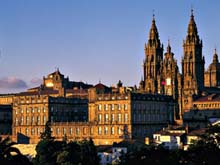 Photo from Spanish Tourism
The town with the fortress church was named Portomarin, which sounded vaguely like “portal,” but it didn’t have to be a gateway to please me; I arrived content. I had come to it the day before, late in the afternoon, walking down a very long hill through gold and green countryside.
My hiking companions went on, but I stopped just where the hillside started down and sat for a while on a lichen-painted wall of gray stone—not so much because I was footsore, but because I felt good and happy, and I wanted to sit in the Spanish sun and prolong that feeling. It was one of the best moments of the trip.
I remember that a couple of hotshot Italian bikers zipped past me while I sat on the wall, their gears set for maximum speed as they began the downward run. It was a perfect hill for bikers as well as walkers, but nothing in northern Spain—or maybe anywhere else—can really be counted on, especially if you’re going too fast. I encountered them again at the bottom of the hill, one helping the other with a newly ruptured tire. He’d hit a rock, where the road swerved suddenly for the new bridge.
In another place, on another journey, I might have thought smugly that they got what they deserved: The Camino de Santiago is a sacred way, even if it does make for good biking, and they certainly weren’t going at it reverently or humbly.
But I was trying to, and some of the lessons of that ancient pilgrim path were sinking in. I felt sorry for the time the two bikers were going to have to lose—prying the tire off, gluing on a patch, reassembling the thing, pumping air back in and hoping the patch would hold. It was better to be on foot, I thought, as I swung across the bridge and up the bank beyond, where the red-roofed houses clustered.
That night, I stayed with my friends in a modern white posada, one of Spain’s famous inns, sleeping soundly in clean sheets. We were on our way to the great shrine of St. James in the city of Santiago de Compostela, which made all of us pilgrims of some sort. But none of us were religious ones; blisters and stiff muscles aside, we saw no merit in suffering.
Portomarin stands near the end of the Camino. It’s a moved town, a reconstruction: A ruined medieval bridge and the skeleton of the original village lie beneath—just beneath—the waters of a dammed-up river. It was mid-September, and the water was low; stubs of abutments and the outlines of walls broke the surface. If we hadn’t known, the flooded buildings would have made us wonder what had happened there.
Before the dam was finished and the village drowned, the government managed to move—stone by historic stone—a small but high-walled chapel, boxy-looking and all but windowless because in the Middle Ages it had doubled as a fortress, protecting pilgrims. It now stood in the central plaza of the new village, lending authenticity.
In the morning, while my comrades downed bread and milky Nescafe in a tiny restaurant under the arcade of the plaza, I headed for the shiny green doors of the church. I wanted the place to myself—and would have had it, the hour was so early. But a boy in a red windbreaker came in when I did. I passed him on the steps, just as he dismounted and leaned his bike against the church wall. The bike had saddlebags, which meant he was another long-distance traveler, another pilgrim. But he wasn’t with the Italians; the boy was riding alone.
What struck me was his youth, but I couldn’t be sure how young. He might have been 22, though I’d just as readily have believed 31 or 17. He had a plain, pleasant face, slightly freckled, with a wide mouth and sandy hair.
His presence in the church made me feel a little self-conscious. He must have felt the same way: As if by agreement, we walked in opposite directions, or as opposite as you can get in a place the size of a living room.
The chapel’s high walls were plastered smooth and white, and the scarcity of windows was just as odd inside as it was out. The few it had were small and high up, so marauders couldn’t get in. The windows were too high to shoot arrows out of, but there is a profoundly spiritual difference between defense and protection, between a fort and a refuge. You could feel it there.
The light I remember came from a single round window high above the altar—morning light, warm and lemony. It flooded the place, so even the shadows were soft and pale. After a few minutes, I sat down near the front and closed my eyes and prayed. While I’m not devout, I am drawn to spiritual places, so sitting in foreign churches was not new. But I was doing it more often than usual on this trip. It seemed to be part of the path.
“Behave as if,” a psychologist once advised me, in a context I no longer recall, but the thought has stayed with me and evolved into this: Behave as if you mean it, because sometimes doing that will help you mean it. On the Camino, “behaving as if” means prayer, simply because so many others have done so before you—millions, most likely, over nearly a thousand years.
I wasn’t praying for anything. Requests didn’t feel right on this trip, and besides, my habitual cravings had evaporated. I was just saying thanks—for the good afternoon the day before, for the repose of the current moment, for the rhythm of the days: the alternation of rest and walking, of food and hunger, of solitude and conversation. Then I sat still. There was peace in that place, and I let it seep into me, basking in it a little, storing it up. I felt my heart relax. I hadn’t, till then, known that it still needed to.
When I stood to leave, I saw that the boy in the red jacket was also sitting down, farther to the front on his side of the aisle. He didn’t see me rise or notice that I paused to watch him. He was staring upward at the window above the altar, as if the answer to life lay in it. Maybe for him, it did.
The light seemed liquid, like a purifying bath, a bath for the soul. It was transforming him, and maybe me, as well. I felt a rush of inexplicable tenderness for the boy—the man, the child, all the ages he had been and would be. It was as if I’d known him all his life, as if I’d been his mother, sister, lover, friend, and they were all the same.
I stood there frozen by the thought, cradling him in my mind, sharing a lifetime with him in that moment. And then, like a bubble, the moment broke. The holy light was still streaming in, the clean space still felt pure, but time had snapped back to normal.
The boy stood up then, his body moving into the aisle before he pulled his gaze away from the high window. As he turned, his eyes met mine, and his face broke into a smile—a wonderful, open, whole-hearted smile, as pure as the light itself.
He had been lonely, I saw, and now he wasn’t anymore. Now he would be all right, I thought. He’d gotten what he needed in that chapel. In different ways, we both had.
I watched him walk back along the aisle and out the door, both loving him and letting him go. When I walked out, he was already gone, his red jacket disappearing on the far side of the cobblestones. I never saw him again. And never needed to.
My friends were still drinking coffee when I found them. I ordered a cup too, dropped three small white bricks of sugar into it and stirred to cool it down. How was the church, they wanted to know. It was nice, I said, telling the truth. It was very nice.
 Email to friend
 Twitter
 del.icio.us
 Digg
Digg Facebook
 Furl
Furl Ma.gnolia
 Mixx
Mixx Reddit
 StumbleUpon
 Yahoo! Buzz