
Mint and Djinns in Fes
Travel Stories: Terry Ward wondered if her Moroccan friend believed in genies. Over a pot of tea, she learned just what she wanted to know.
02.18.08 | 1:03 PM ET
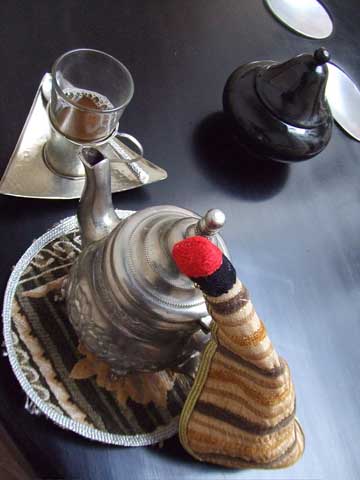 Photo by Terry Ward.
We were in the kitchen washing bundles of mint for tea, sunlight streaming through the windows and the sound of the muezzin wailing throughout Fes’ old city, when I asked Fadoua about the djinns.
I had been reading a book about Morocco called In Arabian Nights by Tahir Shah. In it are tales of a second life form present among us—good and bad, vengeful and harmless—that the Koran says God wrought from smokeless fire at the same time man was created from clay.
Djinns, as the Moroccans in Shah’s book explained, are never seen. And one never knows where they are lurking—perhaps beneath a home’s floor or within a water tank, maybe even inside a cat or a human. But the fact that they exist, one person explained to the author, is irrefutable.
“Can you see clean air?” Abdelmalik asked Shah.
“No,” answered the skeptical author.
“But, would you doubt its existence?” asked the believer.
I wondered if my friends in Fes also believed in djinns.
“They exist,” Fadoua told me matter-of-factly in French, shifting her attention from the rough green leaves in her fingers, her black eyes piercing mine like obsidian shards. “Nearly everyone in Morocco believes in them.”
I remembered a conversation from years before, when I had first arrived in Fes to study Arabic and lived with Fadoua and her family.
At the language school, I struggled to learn classical Arabic, called Fusha, but at home everyone spoke the Moroccan dialect, Darija—a different tongue entirely.
One afternoon, in the family’s tiled living room where the resident pigeons wandered in and out as freely as the guests, the conversations swirled more loudly than usual—the ubiquitous gesticulations all the wilder, too. And while I couldn’t decipher a word, the soft shushing sounds of Darija constantly interjected with glottal clucking Arabic tones painted a picture of something beyond the usual medina gossip of rejected marriage proposals and tangled inheritances.
Finally, I could no longer stand just to sip my mint tea and nibble cookies obliviously. I interrupted to ask Fadoua what she and her aunts, cousins and friends were discussing.
“A man down the street was killed in his home two days ago—with a knife,” she told me.
I asked her who murdered him, and she said it was another man. No, actually it was not really a man, Fadoua tried to explain.
But between her faltering English, my equally limited Arabic and a cultural gap that no language could bridge, I was lost.
Now, years later, I realized she’d been talking about a djinn. So I peppered Fadoua with questions.
If you have never seen one, I asked her, then how do you know they exist?
“Because it is written in the Koran,” she said.
Djinns are all around us—they live with us, said Fadoua, with an assurance that left little room for doubt.
I motioned to the three black and white cats, mottled gray from forays into the baker’s chimney, that had slinked into the kitchen, lured by the scent of fish sizzling in vegetable oil on the stove. There was something disarming in the animals’ aloofness—in the way they kept a stealthy eye on you from afar, then leapt onto a ledge or through a window at the slightest sign of an approach.
“Could they be djinns?” I ventured, not exactly starting to believe but eager to stoke the conversation.
“Perhaps,” shrugged Fadoua, cocking her head at the cats and tossing the tail of a sardine to her favorite. “One, or none, or maybe all, it is possible.”
She returned to washing the bundles of mint and spooned black gunpowder tea from China into a delicate silver teapot. Water hissed in another teapot on the stove.
I had read in my book that there were measures one could take to rid a home of djinns.
Animals could be sacrificed and the floors washed in blood and milk. Doors could be painted with special bitter honey from the forests outside Casablanca.
I asked Fadoua if such practices were common.
“Most people in the medina do something like this,” she said, adding that her family had never done so.
“It is enough to read aloud from the Koran to make the djinns leave,” Fadoua said, reciting a short verse in classical Arabic that sounded at once beautiful and intimidating.
She poured a small amount of boiling water atop the leaves inside the delicate silver pot.
“You know,” said Fadoua, “sometimes people will be careful not to empty hot water from the tea pot directly into the sink.”
She paused, as if to see if I could imagine the reasoning. Then she moved the silver pot in small, brisk circles, swirling the tea and water inside.
Fadoua was washing the tea leaves—the essential first step in preparing traditional Moroccan mint tea. It is a most common daily ritual in Morocco.
There are so many stories in this country. I shouldn’t have been surprised that another was unraveling.
“Djinns often live in dirty places, like the kitchen sink,” said Fadoua, “and if you burn an unfriendly djinn with hot water, he will probably seek revenge.”
“If it is a friendly djinn that you burn, he will understand if your mistake was honest, and will not do anything to hurt you or your family,” she continued. “But since a djinn can feel things like any living thing, it is better to avoid causing pain.”
It occurred to me that in all the time we had spent together —the countless pots of sticky sweet tea we had prepared in her kitchen— I had never really paid attention to how Fadoua rinsed the tea.
Would she throw the hot water out the window into the garden to avoid the sink, I wondered? What if there were djinns dwelling in the garden, too? Would she pour the water first into a clean pot to let it cool?
If it weren’t for our conversation, I never would have noticed what came next.
With the flick of a finger, Fadoua turned on the tap to let cold water pour into the basin. The she tipped the teapot and let the hot water flow out over the cushion of cool water, down the drain. She filled the teapot with more boiling water, pushed in a bundle of mint leaves and two blocks of sugar and placed it back on the stove.
None among us would be harmed. 
 Email to friend
 Twitter
 del.icio.us
 Digg
Digg Facebook
 Furl
Furl Ma.gnolia
 Mixx
Mixx Reddit
 StumbleUpon
 Yahoo! Buzz
Terry Ward is a Florida-based writer and a long-time contributor to World Hum.
John M. Edwards 02.18.08 | 7:32 PM ET
Hi Terry:
I haven’t had time to read this article yet, but I can tell it’s a good one. I’m taking my Amazon cart and chucking in “The Arabian Nights” sometime tomorrow. Someone, skilled in the art of catburglary and break-ins, nicked my old copy right out of my apt. Friggin bastard. He also stole one of my company directories.
Also, I’m going to finally track down a copy of Orientalism, by Edward Said, a frequent contributor to the New Jersey literary journal Raritan, the magazine of choice for highbrow literary critics who would rather not writenovels.
Anyway, is there are difference between djinns and genies? Is one masculine and one feminine? Maybe it’s like gelato (like girls a lot) and sorbet (sore butt). Anyway, ta ta.
marty kramer 02.19.08 | 4:29 PM ET
Hi Terry It brought back memories of my visit to Morocco and the mint tea which was the best I have had, have not been able to find any in the States that comes close. Any place you can recomend that might have true Moroocan mint tea?
Terry Ward 02.19.08 | 5:37 PM ET
Hi John,
Djinn is just another term for genie. I’m not sure that there’s really a way to tell if a djinn/genie is masculine or feminine, especially since we can’t see them anyway. I’ll as Fadoua about that next year when I see her again, inshallah! Definitely check out Shah’s book, I enjoyed it.
Terry
Terry Ward 02.19.08 | 5:42 PM ET
Hi Marty,
Mint tea is just great, I agree. And I’ve succeeded at making it at home in the States - you just have to make sure you get the special black gunpowder tea from China (available at Asian food stores) and some really fresh mint, preferably from someone’s garden. There’s definitely an art to making it, too. After it’s brewed, Moroccans always pour a glassful of tea and empty it back into the pot, repeating the process three times before finally pouring a glass to drink (so as to mix the sugar and mint flavor, I suppose). Also, you have to pour the tea from on high so it creates the desired white froth in the glass - this is essential!
Good luck,
Terry
Joanna Kakissis 02.20.08 | 11:04 AM ET
Nice story Terry. A Turkish friend said he used to have nightmares about djinns removing his legs and putting them on backwards so he couldn’t see where he was walking. He still sometimes checks to make sure his legs are on straight in the morning. (And he is a grown-up professor now!)
We had this conversation over apple tea, but I didn’t see what he did with the boiling water. (Maybe this is why he’s still having the nightmares??)
Terry Ward 02.20.08 | 1:48 PM ET
Hey Joanna,
And I thought my recurring nightmares of losing my teeth were bad! Legs screwed on backwards definitely sounds like the dastardliness of djinns. Thanks for sharing, interesting. And hey, please drink some ouzo for me!
Terry
Tee 02.27.08 | 2:42 AM ET
Hi Terry,
Just want to say I read this article and loved it. I have no connection with Morocco, but love the sound of the tea and genies. Fascinating.
Terry Ward 02.29.08 | 8:25 AM ET
Thank you for writing, Tee. Morocco is definitely a fascinating country. Every time I go, I learn about something new, like the genies.
Terry