
Picnicking with los Muertos
Travel Stories: During Mexico's Day of the Dead, Leslie Berestein visits a Oaxacan cemetery and finds, more than anything, life
10.30.01 | 11:56 PM ET
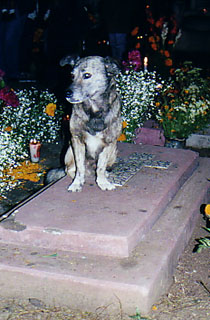 Photo by Leslie Berestein.
On any other night, this cemetery would have been an odd place for a picnic. There they sat, thousands of men, women and children on blankets and straw mats and folding chairs among the marble tombs, merrily sipping hot drinks and passing steaming plates of food.
But tonight was All Hallows’ Eve in the old burial ground of Xoxocotlan, a sprawling jumble of graves outside the city of Oaxaca. It was one of several nights of graveside vigils that start at the end of every October to celebrate el Dia de los Muertos, the Mexican day of the dead.
I stood at the cemetery’s ancient gate and looked around. Tonight, I realized, the dead here were easily outnumbered by the living.
In the distance, a particularly festive group caught my eye. Huddled near the ruins of an old church in the middle of the cemetery, half a dozen middle-aged men and women chatted animatedly, their faces glowing in the warmth of hundreds of flickering candles. I wanted to take a closer look, if only to make sure I wasn’t just imagining their mirth. I hesitated.
My last visit to a cemetery, nearly a year earlier, had been very different. I had gone to place flowers on my grandfather’s grave to mark his birthday. My family had buried him the previous summer on a hill high above a freeway, a solitary place that didn’t see many visitors. Walking around as I searched for his headstone, I noticed most of the built-in flower vases next to the graves lay empty. That included my grandfather’s. This was my first visit, and the rest of my family still hadn’t made it there, afraid of stirring up sad thoughts best left buried. I stayed for half an hour, alone, then placed my bouquet of chrysanthemums in the designated vase and never went back.
When a loved one dies in America, most of us mourn as long as necessary and then put the memory aside and get on with our lives, not wishing to let the past interfere with the present. American cemeteries can be terribly lonely places.
I had not planned my trip to southern Mexico for el Dia de Los Muertos out of anything more than the sort of curiosity that lies at the heart of most travel, a desire to see how other people do things. But standing in this crumbling cemetery 2,000 miles from home, watching these picnics atop the bones of the dead, I felt my curiosity giving way to something deeper. I hadn’t expected to find so much life.
I threaded my way toward the ruins, passing graves carpeted in lush arrangements of bright-orange marigolds, studded with burning candles, molded-sugar candy skulls, offerings of food arranged on fine porcelain plates for hungry ghosts. A few families strummed guitars and sang, serenading the bones.
I saw children playing atop the graves, a few wearing American-style Halloween masks, unafraid of the skeletons under their feet. One young couple entertained their toddler as they decorated a grave. The mother lit long matches and handed them to the child, guiding his hand as he stretched his little arm to reach the votives on the ground. Both smiled, as if decorating a Christmas tree. The father, arranging flowers, beamed at them lovingly.
I finally reached the ruins of the old church, where the picnickers I had spotted were engaged in lively banter. They were eating plates of chicken smothered in rich chocolate mole. Drawing closer, I smelled the cinnamon-laced aroma that rose from their steaming cups, the unmistakable scent of spiced chocolate champurrado.
A picnic at the park on a sunny day could not have seemed more pleasant. My hesitation melted away.
“Buenas noches,” I said. “This looks like quite a party!”
They laughed. I asked them why they were here.
“We’re keeping vigil for my younger sister,” said a woman in her forties. “She died when I was five.”
“You’ve been coming here every year since?”
“Yes,” she said, motioning around her at the others. “We all do. These are my brothers and sisters. Some come from far away to be here.”
“You must be very close.”
“We are,” said another woman, smiling as she looked up from her plate. “But you know, this is really just a good excuse for us to get together and eat!”
They broke into exuberant laughter. I found myself laughing with them, the first time I’d ever laughed in a cemetery. It occurred to me that el Dia de los Muertos is not just about remembering the dead. Just as importantly, it is a celebration of life. Life is all the more vivid, and the company of those we love all the more precious, when we are reminded of how fragile and fleeting it is.
I thought of my family. When I returned home, I told myself, my parents and I would visit my grandfather’s grave together. We would sit down on the grass beside it and reminisce about his boisterous laugh, the dinners he loved to cook, his nimble carpenter’s hands that built and fixed nearly everything in our house. Then we would laugh and hug each other and perhaps we would cry. I would tell my parents how much I love them, and how happy I am that we are all alive.
 Email to friend
 Twitter
 del.icio.us
 Digg
Digg Facebook
 Furl
Furl Ma.gnolia
 Mixx
Mixx Reddit
 StumbleUpon
 Yahoo! Buzz