
The Art of Seasickness
Travel Stories: It was bad enough being seasick. Then Jim Benning became the entertainment.
02.22.02 | 12:44 AM ET
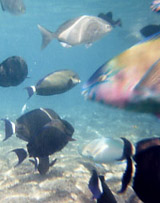 Photo by Jim Benning
It began as a calm day at sea. After a smooth boat ride from Cairns harbor, my fiancée, Leslie, and I spent three hours snorkeling Australia’s Great Barrier Reef, ogling tropical fish of every imaginable hue: neon pink, electric aqua blue, a spectacular ripe-banana yellow. But the reef soon became a distant memory. During the voyage back to port, the wind grew to a howl, the waves kicked up and the boat started bucking. That’s when I took on the exotic color.
“You’re green,” Leslie said, as chipper as ever, as we sat down below deck, pitching and rolling in the hard plastic seats.
I held my stomach and groaned.
“No, you’re not just green,” she added after further examination, oblivious to my pain, “you’re a pale gray-green. Actually, you’re more of a sage.”
“This is supposed to help?” I asked.
Leslie had always been the first to come to my travel aid. When I came down with a stomach flu once in Thailand, she braved monsoon rains to bring me a remedy. It was quickly becoming clear, however, that a simple bout of seasickness wasn’t going to elicit such sympathy.
“Let’s go up on top,” she suggested. “Fresh air will do you good.”
We climbed a rusty, salt-encrusted ladder. Leslie stumbled to a seat under an awning to protect herself from the ocean spray, joining a dozen other day-trippers in T-shirts and swim trunks. I sat further back, alone in the exposed seats, and sucked in the fresh salty wind blowing off the bow. I felt as though I might unburden myself of my vegetable-burger lunch at any moment. The others knew it, too. They squinted at me unsympathetically through the afternoon glare, all twelve of them. Some even had the nerve to smile.
They weren’t the first to take pleasure in another’s defeat at sea. During a rocky voyage to Europe in 1867, Mark Twain loved watching his fellow passengers become seasick. Sure, he enjoyed strolling along the deck and smoking in the sea breeze, too, but those pleasures “were feeble and commonplace,” he wrote, “compared to the joy of seeing people suffering the miseries of seasickness.”
Back on the Pacific, I concentrated on the horizon to steady my equilibrium and tried hard to ignore my fellow passengers’ shameless grins. Suddenly, our boat slid down the back of a giant swell. The top of the next wave heaved over the bow and crashed down over the boat, soaking me, and only me, to the bone.
The other passengers, dry as cacti thanks to the awning, took great pleasure in this turn of events. I watched in horror as devilish smiles crossed their faces. One of them began clapping in mock approval. Another joined in. Before long, the entire group was applauding. Leslie tried to look sympathetic, but she only tried.
Ill and soaked and now shivering in the wind, I quickly assessed my options. I could scream in agony and vomit right there in front of them in a daring display of angst-ridden nausea. But I loathed throwing up. So I decided to try a different tack.
I mustered a wry smile. Then I stepped forward toward my audience, waved my hand in a theatrical flourish and took a grand and regal bow. In the perverse relationship between the healthy and the seasick, I had become travel performance art. And as much as I hated it, nothing I could do could change that.
 Email to friend
 Twitter
 del.icio.us
 Digg
Digg Facebook
 Furl
Furl Ma.gnolia
 Mixx
Mixx Reddit
 StumbleUpon
 Yahoo! Buzz
Jim Benning is the editor and co-founder of World Hum.